Your work is better than the studio across town. You know it. If their clients ever saw both portfolios side by side, they'd probably know it too.
And still, they're booked through spring and you're refreshing your inbox.
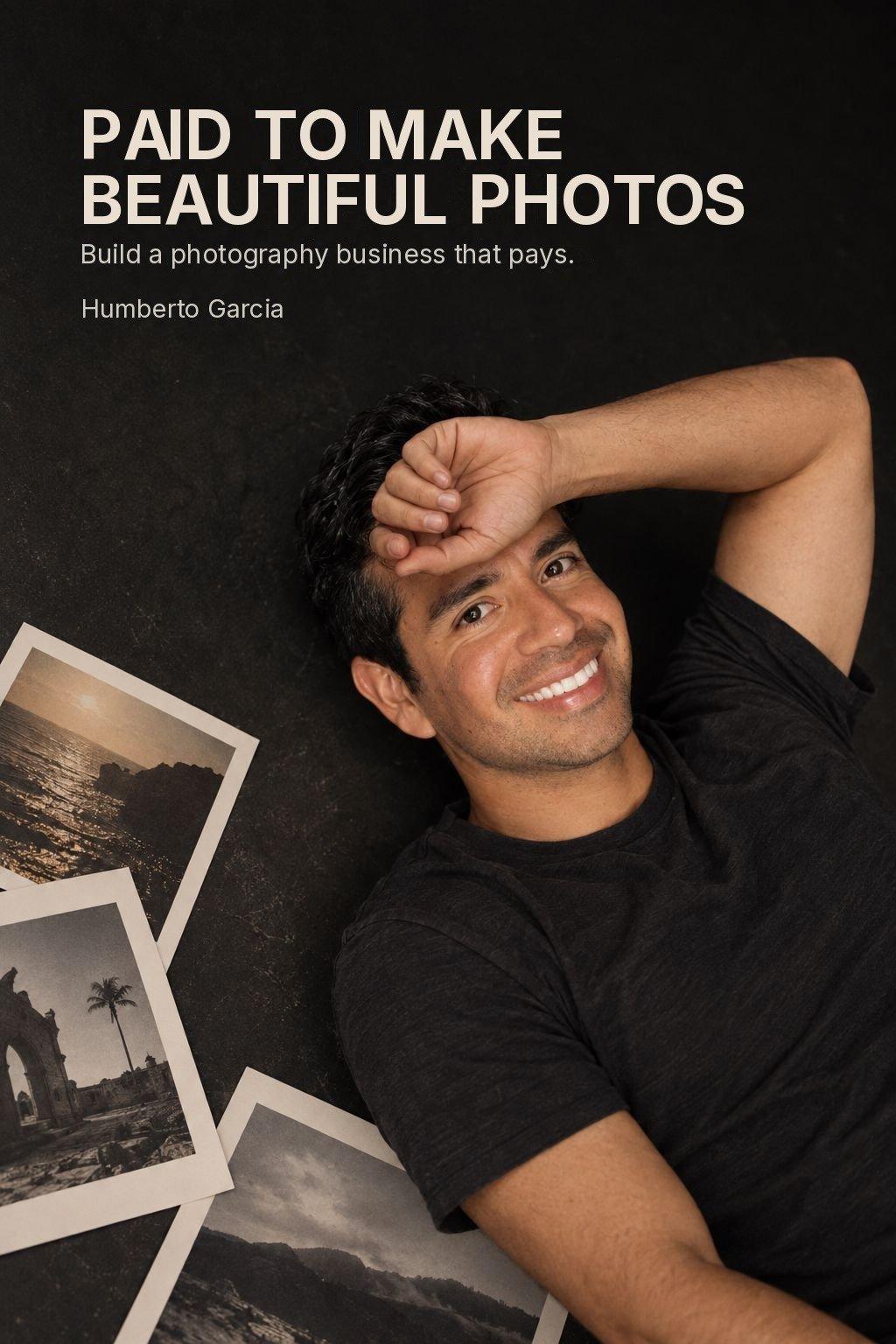
That gap is what I wrote Paid to Make Beautiful Photos about. Not lighting. Not posing. The business that sits between a beautiful photograph and the money that's supposed to show up because of it.
It's out now, as an audiobook and an on-screen digital edition, for $4.99. Already bought it? Sign in at photographytoprofits.com/book/listen with the email you bought with.
Why I wrote it
I didn't start as a photographer. I started as a Marine Raider.
In the last week of a seven-month deployment to Afghanistan, my closest friend on the team, Charles, was killed in a green-on-blue attack. His wife was pregnant with their daughter. Back in my room that night, I pulled up every photo I had of my own daughter, Leilani. There were about ten. All low resolution, all on a phone.
The day after I landed in North Carolina, I bought a camera.
Chapter 1 tells that story properly. The line I keep coming back to is the one it ends on: "This book exists in part because of Charles." Everything after it is what I learned turning that camera into a business, and then what I learned helping other studios do the same.
The one idea the whole book argues
Your income comes from three numbers: Leads, Booking Rate and Average Sale.
Most studios work hard on the wrong one. They spend more on ads when the leads they already have aren't booking. Or they fill the calendar with clients who spend too little to make the work worth it. You can grind for months and still be fixing the wrong problem.
Chapter 2 runs the math with round numbers. 250 inquiries a year, one in five booked, a $2,000 average sale: $100,000. Change only one of those numbers and the year changes. Improve all three and the same studio makes $600,000. Not by working six times harder. By fixing three numbers in the right order.
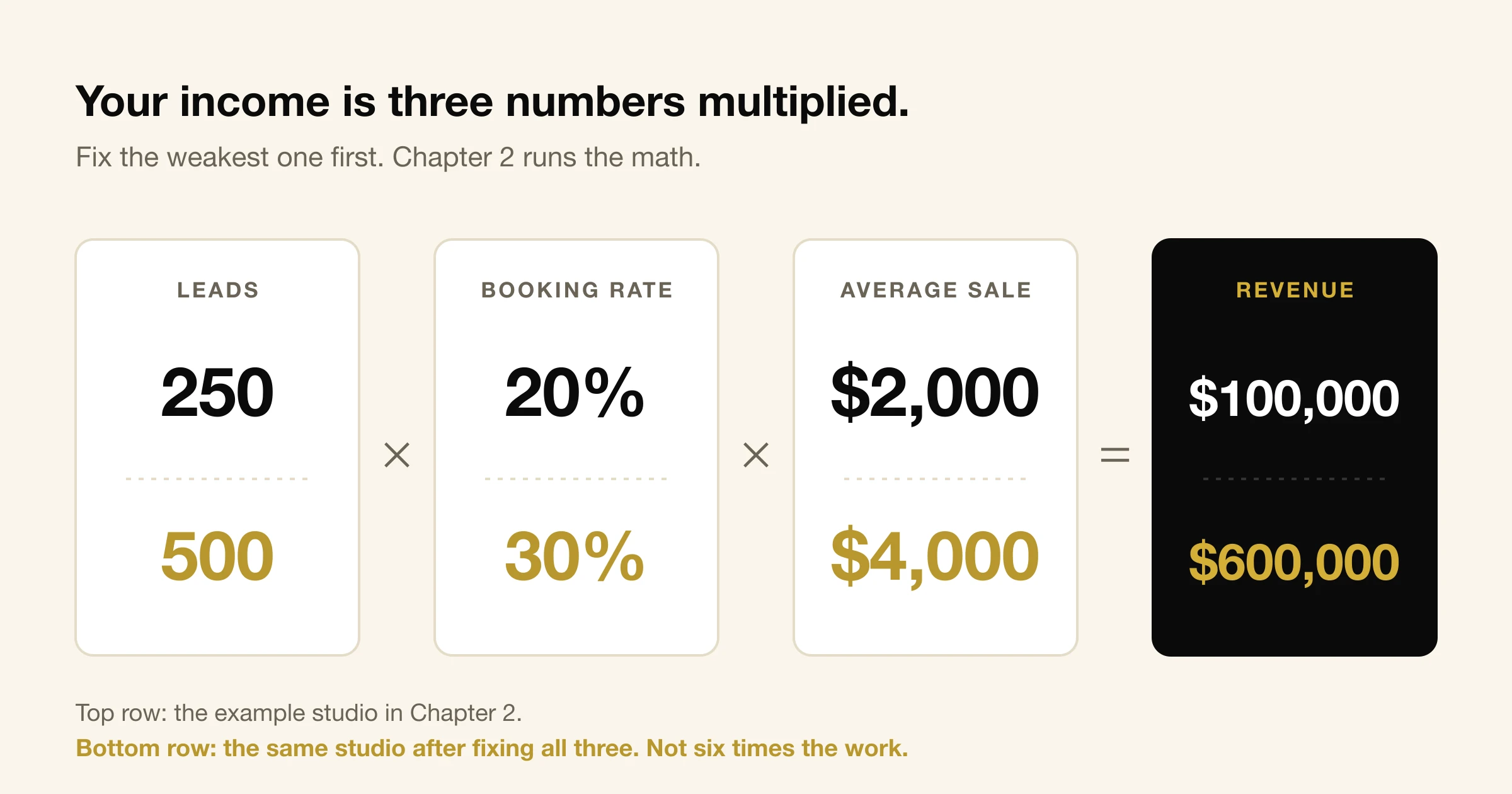
So the book doesn't ask you to do everything. It asks you to find your weakest number and start there.
What's inside: 18 chapters, sorted by the number they fix
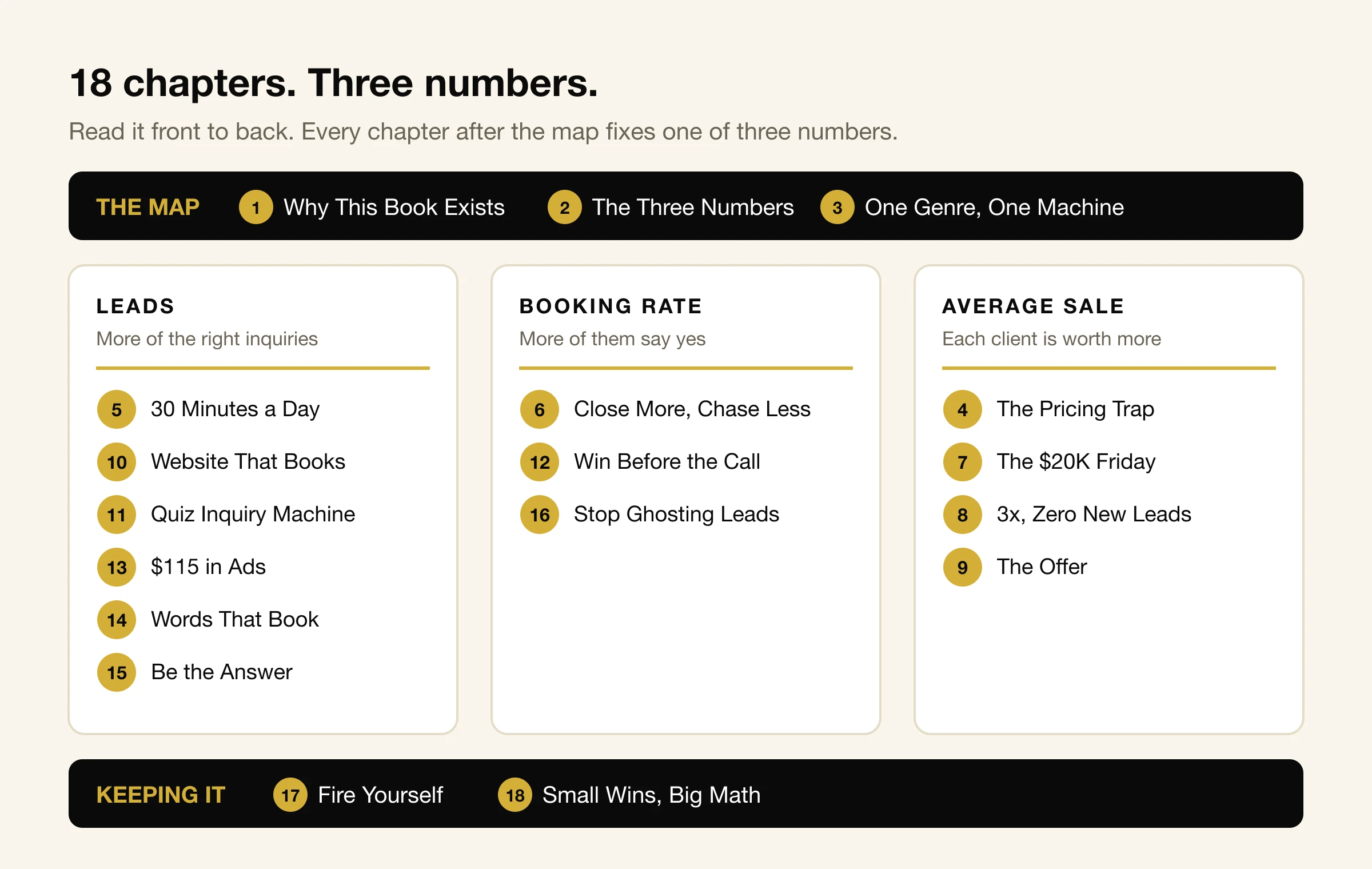
The map
- Chapter 1: Why This Book Exists. Afghanistan, a Samsung camera, and the first in-person sale that changed what I thought a portrait was worth.
- Chapter 2: The Three Numbers That Control Your Income. Your map and compass: how to tell whether you need more inquiries, more bookings or more revenue per client.
- Chapter 3: One Genre. One Message. One Machine. Why one audience, one offer and one funnel beats being good at everything.
Average Sale
- Chapter 4: The Pricing Trap That's Costing You $100K/Year. The wall that keeps clients from ever experiencing your work, and how to give away the shoot and keep the money.
- Chapter 7: The $20K Friday. The one chapter where I tell you to close the book and do something today.
- Chapter 8: 3x Your Revenue, Zero New Leads. In-person sales over Zoom, including a masterclass with Jenn Bruno Smith.
- Chapter 9: The Offer That Makes "No" Feel Stupid. The offer ladder, naming it, and running campaigns all year.
Booking Rate
- Chapter 6: Close More, Chase Less. The five-stage phone script, so "how much does it cost?" stops being where the conversation dies.
- Chapter 12: Win the Sale Before You Pick Up the Phone. Speed-to-lead, the call-text-call cadence, and what happens between the inquiry and the call.
- Chapter 16: Stop Ghosting Your Leads. Follow-up that never stops, and why 800 nos beat 950 maybes.
Leads
- Chapter 5: 30 Minutes a Day to a Full Calendar. Prospecting with no ad spend, one conversation at a time.
- Chapter 10: If Your Website Can't Book, It's a Scrapbook. The three-second rule, one call to action per page, and a form on every page.
- Chapter 11: The Quiz Inquiry Machine. The quiz popup that educates, handles objections and captures the inquiry before you ever talk.
- Chapter 13: $115 in Ads → $29,540 in Sales. Retargeting, Google Ads and the full Meta funnel, in the order you should try them.
- Chapter 14: The Words That Make Them Book. Writing from your clients' words, not yours.
- Chapter 15: Be the Answer. Google Maps, AI search and social search, and how to be the studio they name.
Keeping it
- Chapter 17: Fire Yourself. What should already be automated, so the studio doesn't stop when you do.
- Chapter 18: Small Wins, Big Math. What the three numbers look like when every piece works together.
What early readers said
"In fact, I made one change before I'd even finished the book, and it took my booking calls from 'I'll think about it' to 'Let's book it.'"
Rachel Sorbet
"The way you explained the pricing trap and how it can actually keep clients from ever experiencing your work makes so much sense."
Lindsey Lee, after reading the free pricing chapter
"I LOVE your book! I put it into my Claude so I could ask it what Humberto would think. What a gift to give away… You literally wrote the book on marketing photography!"
Jacob Miller
What you get
- The complete audiobook.
- The on-screen digital edition, so you can read along or skip to the chapter you need.
- The iPhone and Android apps, if you'd rather listen offline.
- Lifetime access to the companion resource library: the Revenue Calculator and the worksheets the chapters point to.
It's $4.99. If it isn't for you, ask for a refund within 30 days.
Read it front to back. Each chapter builds on the one before it, and by Chapter 2 you'll already know which of your three numbers is weakest. Then reply to any of my emails and tell me the one thing you're going to change in your studio.
Get Paid to Make Beautiful Photos for $4.99 →
FAQ
What is Paid to Make Beautiful Photos about?
It's a business book for portrait photographers. It argues that a studio's income comes from three numbers (leads, booking rate and average sale) and gives you 18 chapters on fixing each one, from pricing and phone scripts to websites, quiz funnels, ads and follow-up.
Who wrote it?
Humberto Garcia, a Marine Raider veteran who became a portrait photographer and then founded Photography to Profits, a marketing agency that works only with portrait photography studios.
Who is it for?
Portrait photographers who know their work is good but aren't getting paid like it: boudoir, newborn, family, branding, senior and any studio whose inquiries go quiet, whose calls don't book, or whose sales barely cover the shoot.
What formats does it come in, and how much is it?
$4.99 gets you the complete audiobook, the on-screen digital edition, the iPhone and Android apps, and lifetime access to the companion resource library. If it isn't for you, you can ask for a refund within 30 days.
Should I read it in order?
Yes. Read it front to back. The first three chapters give you the map, and each chapter after that builds on the one before it.