
Most photographers treat their client contract like a shield. A thick, five-page legal document full of clauses and definitions designed to protect them from the worst-case scenario. And in theory, that makes sense.
In practice? That shield is probably costing you more than it's saving you.
This post is not legal advice. We're marketers, not lawyers. But it is an honest conversation about whether the friction your contracts create is actually worth it, what the math actually looks like when you run the numbers, and what to include if you decide you need one anyway.
Key Takeaways
- For most portrait and wedding photographers, heavy contracts create more friction than protection. Less friction means more bookings.
- Humberto Garcia, founder of Photography to Profits, works with studios that get stiffed once or twice a year, but the reduced friction from simpler agreements drives dozens more bookings annually.
- If you must have a contract, 8 clauses actually matter: what's delivered, timeline, refund policy, payment schedule, sales final, cancellation, copyright, and model release.
- Contract law varies significantly by state. Whatever you use, have a local attorney review it before you send it to a single client.
- For actual legal contracts built specifically for photographers, go to TheLawTog by Rachel Brenke. She's an attorney AND a working photographer. We're not those people.
The Honest Math on Photography Contracts
Here's the question most photographers never ask: are you actually going to sue anyone?
Think about it honestly. A client ghosts after a session. A wedding couple disputes a $300 balance. Someone says the photos "weren't what they expected." Are you going to file in small claims court, take a day off, prepare documentation, and appear before a judge for a few hundred dollars? The median cost to litigate a copyright dispute in federal court runs north of $350,000. Small claims is cheaper, but it's still a half-day of your life and an enormous amount of stress for what usually amounts to less than $1,000.
Most photographers don't go. The photographers I've worked with who've been stiffed (and yes, it happens) almost never pursue legal action. They eat the loss, leave a review, and move on. That's the reality.
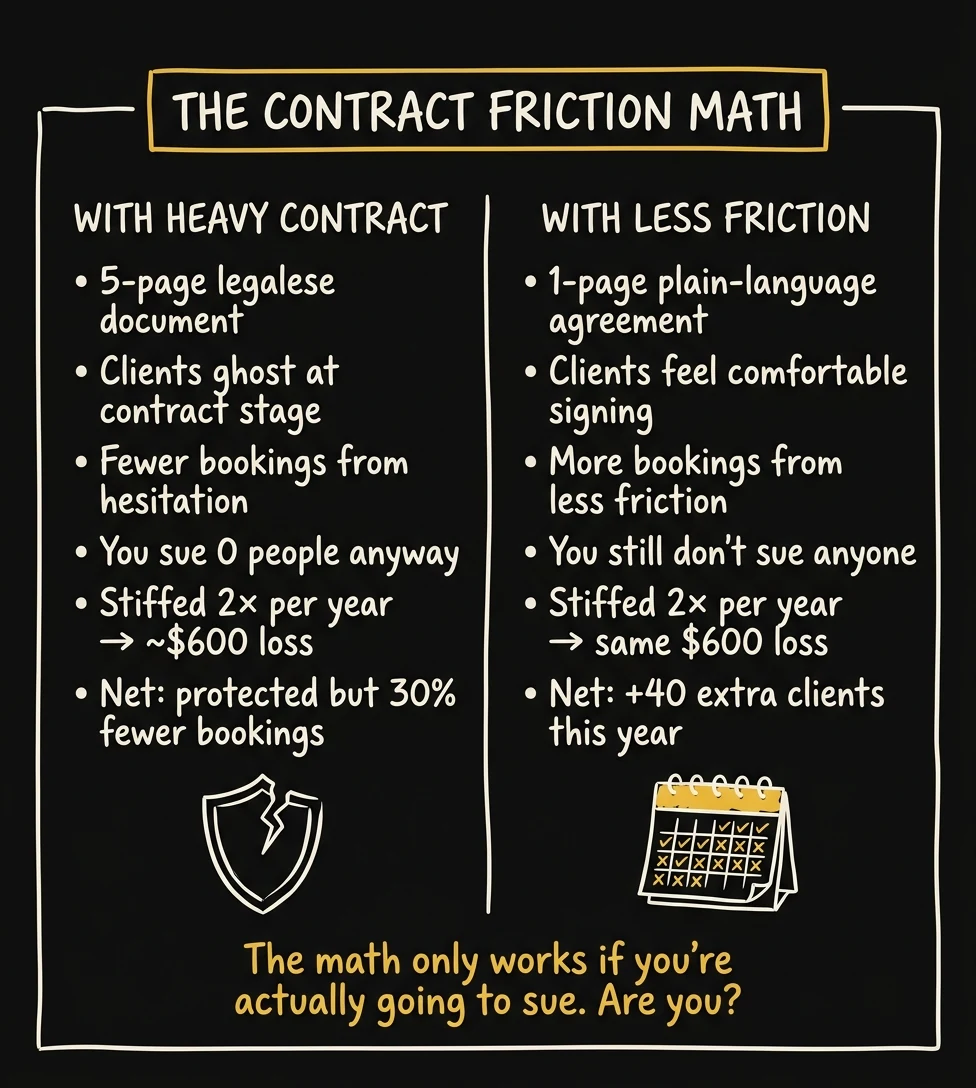
So what does the math actually look like? If you get stiffed twice a year at $300 each, that's a $600 annual loss. It stings. But here's what most photographers don't measure: how many potential clients saw your long, legalese-filled contract and quietly moved on to another photographer who felt easier to work with?
Research on contract friction shows that 63% of consumers report being "uncomfortable" or "terrified" when signing contracts they don't fully understand, and 64% of small business clients have avoided signing a contract because they weren't confident they understood the terms. For portrait and boudoir photographers (where clients are already nervous, already vulnerable), that friction is real and measurable.
If removing heavy contract friction converts even a handful more inquiries per year, the math runs the other direction entirely. You traded $600 in potential losses for 40 more booked sessions. That's the actual calculation most photographers are missing.
If your booking rate is lower than it should be, contracts might be one of five friction points we audit. We look at all of them.
Get a Free Strategy Call →The People Who Should Have Strong Contracts (And Who Shouldn't)
I'll give you the exception first: if you're getting more than 100 inquiries per month, you have the opposite problem. You need to filter. A more comprehensive contract, a higher deposit, a tighter process: all of that makes sense when you have too many people trying to book you and you need a mechanism to separate the serious from the casual. If that's you, ignore everything above.
Everyone else (photographers who are grinding to fill their calendar, studios that close 15–30 sessions a year, photographers who are turning away nobody), you're probably not in the position where legal protection outweighs the cost of friction.
The other exception: commercial photographers. If you're shooting for brands, publications, or corporate clients, you absolutely need proper licensing agreements, usage rights, and work-for-hire documentation. That's a different world from portrait, wedding, and boudoir photography, and the stakes are higher on both sides.
We're Not Your Lawyers: Go to TheLawTog
We build marketing systems for photography studios. We're not attorneys, we're not legal consultants, and nothing in this post should substitute for actual legal advice.
If you want photography-specific contracts written by someone who actually understands the industry, the go-to resource is Rachel Brenke at TheLawTog. Rachel is both a practicing intellectual property attorney (licensed in Virginia and Texas) and a working photographer, which means her contracts are built around the actual disputes and edge cases that come up in this industry, not generic small business boilerplate.
TheLawTog offers downloadable, fill-in-the-blank contract templates specifically for portrait photography, wedding photography, boudoir, newborn, senior portraits, second shooters, and commercial work. Templates run $99–$149, compared to $1,500–$3,000 to have an attorney draft one from scratch. And they're designed to be edited and adapted to your state.
Other resources worth knowing:
- The Legal Paige, founded by another photographer-turned-lawyer, strong on wedding and elopement-specific contracts
- The Artists' Lawyer, serving photographers since 2010, good for commercial and licensing work
- PPA (Professional Photographers of America), member contracts reviewed by attorneys, updated regularly
Whichever resource you use, rule number one: have a local attorney review it before you use it with a single client. Contract law varies by state, sometimes dramatically.
If You Must Have a Contract: 8 Clauses That Actually Matter
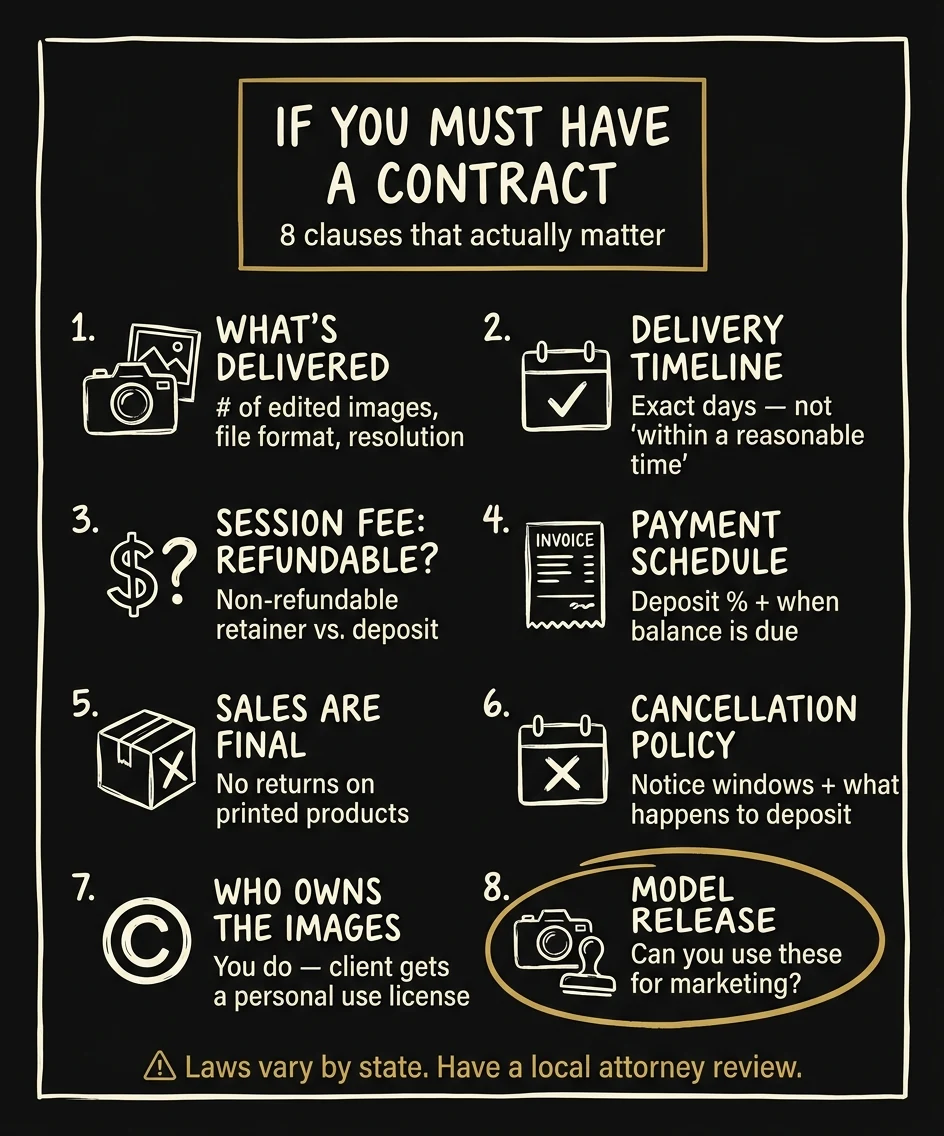
If you've decided a contract is right for your business, here's what to focus on. Skip the legal theater (the indemnification chains, the 15-paragraph limitation of liability blocks) and focus on the eight things that actually prevent and resolve disputes.
1. What Gets Delivered
Be specific. Not "edited images": how many? In what format? At what resolution? Can the client print them commercially or only for personal use? "200–250 edited JPEG files at full resolution, delivered via online gallery" is a contract clause. "Your photos" is not.
2. Delivery Timeline
Name an exact number of days. "Within a reasonable time" will come back to haunt you. If your standard is 3 weeks, write 4 weeks in the contract and then deliver in 3. Under-promise, over-deliver. The worst reputation damage in photography comes from photographers who miss their own promised timelines, not from ones who never made specific promises.
3. Is the Session Fee Refundable?
This is one of the most disputed clauses in photography. A retainer is non-refundable by definition: it secures your time and can't be returned if the client cancels. A deposit is typically refundable under certain conditions. Know which one you're using and say it explicitly. "The $200 session retainer is non-refundable and is applied toward the total session fee" is a complete clause. "Deposit" alone is not.
4. Payment Schedule
When is the retainer due? When is the balance due, and must it be paid before the session, before delivery, or both? Most photographers require the balance before images are released. If you don't write that in, you have no leverage when a client disputes the invoice after delivery.
5. Sales Are Final
Printed products, albums, and wall art orders are non-returnable. State this explicitly. A client who changes their mind about a 30x40 metal print three weeks after it was ordered is not a refund situation, unless your contract is silent on the topic, in which case it might become one.
6. Cancellation Policy
What happens if they cancel 30 days out? 48 hours out? The morning of? Define each window and what it means for the retainer. For wedding photographers especially, a clear cancellation policy protects you when couples break up, change venues, or push dates, none of which are your fault but all of which affect your income.
7. Who Owns the Images
Under U.S. copyright law, you own your photos the moment you take them, automatically. Your clients are getting a personal use license, not ownership. Most clients don't understand this distinction until they try to submit your work to a magazine or use it in commercial advertising without asking. A single clear sentence ("Photographer retains all copyright. Client receives a personal, non-commercial use license") prevents 90% of these conversations.
8. Model Release
Can you use the images in your portfolio? On your website? In paid ads? You need explicit written permission. Many photographers include a model release clause directly in the session contract. If a client declines (it happens, especially in boudoir), you need to know that up front, not after you've built a campaign around their images.
What "Depends on Your State" Actually Means
Every attorney who talks about photography contracts eventually says "it depends on your state," and they're right, but that's often where the explanation stops. Here's what actually varies by geography:
Small Claims Court Limits
The maximum amount you can recover in small claims court varies widely. California: $12,500. Texas: $20,000. New York: $10,000 (City Court) or $3,000 (Justice Court). Florida: $8,000. Knowing your state's limit tells you what's actually recoverable without hiring an attorney, which circles back to whether litigation is worth it in the first place.
Biometric Privacy Laws (Photographers, Pay Attention)
Illinois and Texas both have laws requiring explicit written consent before collecting any biometric data, which can include facial recognition from photography. If you're using any AI tools that analyze or tag faces in your photos, or if you're in a jurisdiction with these laws, your contracts need language specifically addressing biometric consent. Illinois' BIPA law has generated multi-million dollar class action suits against major companies. It applies to photographers too.
Digital Replica and AI Laws (2025–2026)
California (AB 2602) and New York both enacted laws in 2025 requiring that any contract allowing creation of a digital replica of a person must include a specific, detailed description of the intended uses. If you're using AI to composite or enhance images in ways that could be considered a "digital replica" of your subject, your state may require specific contract language. Arizona and New Hampshire have similar laws with slightly different scopes.
Real Estate Photography (California Specifically)
California's AB 723 requires that AI-altered real estate listing photos must be clearly labeled as altered and include the original unaltered photo. If you do real estate photography and use any AI editing tools that remove objects or alter the scene, your contract and workflow need to address this explicitly to avoid liability under real property law.
Consumer Protection and Cooling-Off Periods
Several states require businesses to provide customers with a "cooling-off period" (typically 3 days) during which they can cancel certain contracts. These laws generally apply to contracts signed in the client's home (like in-home sales sessions) rather than studio bookings, but the specific application varies. If you do in-home sessions or travel to clients, check your state's consumer protection laws.
The one piece of advice that applies in every state: have a local attorney review your contract before you use it. A template from TheLawTog or any other source is a starting point, not a final document. The $200–$400 for an attorney review is the best insurance you can buy.
Verbal Agreements and the "We Agreed Over Email" Problem
Verbal contracts can be enforceable, but proving what was actually agreed to becomes a "he said, she said" problem the moment there's a dispute. Email and text exchanges can form binding contracts if they include all the essential terms (what's being provided, at what price, on what date). A back-and-forth email chain that gets into specifics can legally constitute a contract in most states.
The problem is ambiguity. If your email says "I'll photograph your wedding for $2,000," that email doesn't address how many images you'll deliver, when, in what format, or what happens if they cancel. A court trying to enforce it has to fill in those gaps with default legal principles, which may not match what either of you intended.
If you're not going to use a formal contract, at minimum: after every booking conversation, send a confirmation email that summarizes exactly what was agreed. What's included. What it costs. When the retainer is due. When delivery happens. This five-minute step protects you significantly more than no documentation at all, and it creates almost no friction in the booking process.
Your contract is one part of your booking system. If your inquiry-to-booking rate is under 40%, there are five other friction points we'd look at first.
See How We Build Full Booking Systems →The Bottom Line on Photography Contracts
Most photographers are protecting against risks they'll never actually pursue legally, while creating friction that costs them real bookings every month.
If you're not getting 100+ inquiries per month, the contract conversation should probably start with: how do I reduce friction, and what's the minimum I need in writing to protect the things that actually matter? A one-page plain-language agreement that covers delivery, payment, cancellation, and copyright will handle 95% of the situations you'll actually encounter, without scaring off clients who are already nervous about investing in photography.
If you need a proper, legally sound contract written by someone who understands this industry: go to TheLawTog at thelawtog.com. Rachel Brenke is both an attorney and a photographer. She's built a library of templates specifically for every photography genre. That's not our lane. We build marketing systems. Go to her for contracts.
Photography to Profits, founded by Humberto Garcia, works with portrait, wedding, and boudoir studios across the country on the systems that fill their calendars. Contracts are one piece of the picture. If you want to talk about the full booking machine (ads, follow-up, inquiry conversion), that's where we can help.