
Almost every photographer eventually asks the same question: "Should I put my prices on my website?" The answer has been debated endlessly online, with half the industry saying yes and the other half saying no, and the middle-ground consensus landing on the useless "it depends."
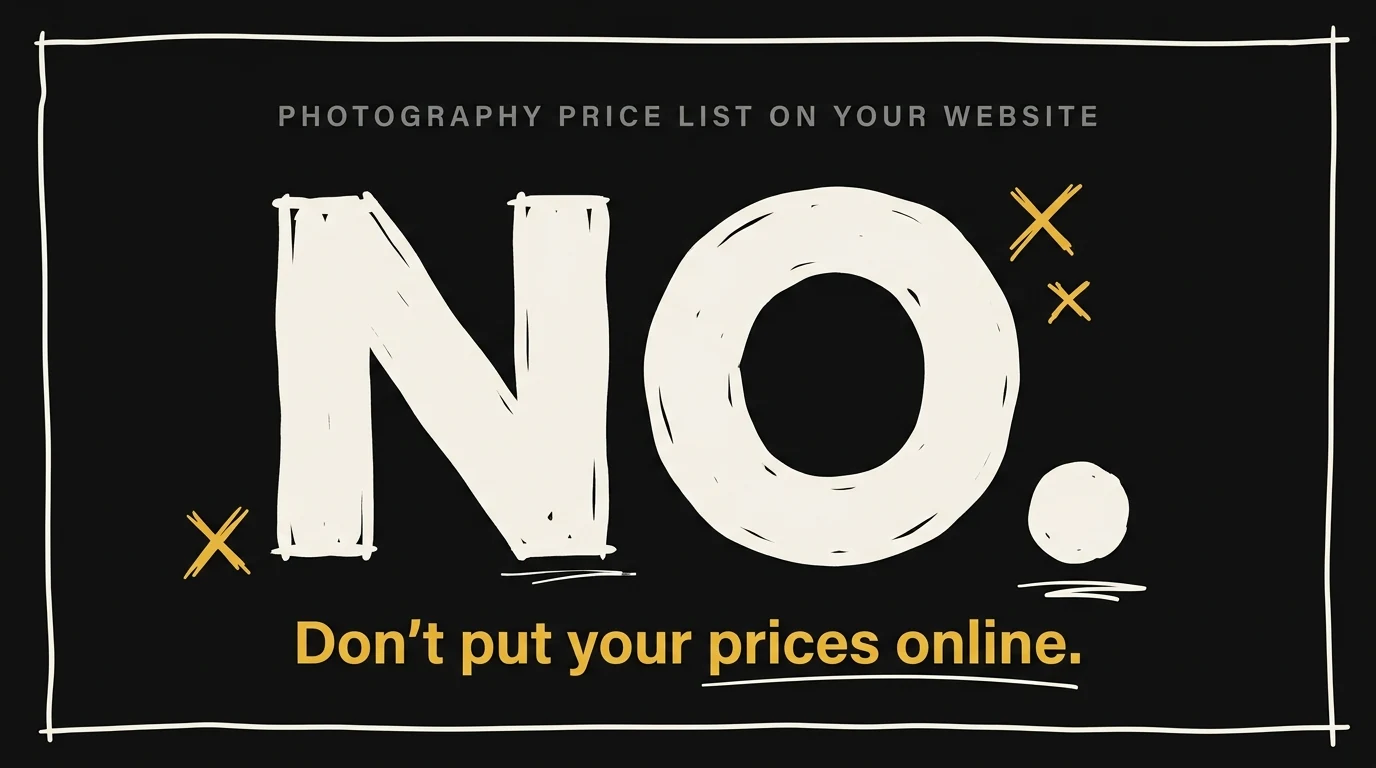
It doesn't depend. For the vast majority of portrait, wedding, and boudoir photographers (especially those who aren't swimming in leads), the answer is no. And the reason isn't about mystery or luxury positioning. It's about timing. Showing pricing before you've shown value guarantees that every visitor evaluates you as a commodity.
There are two types of photographers who should show pricing. Everyone else is solving the wrong problem.
In this guide, you'll learn what actually happens when photographers post their prices, who the two exceptions are, and, most importantly, where pricing actually belongs in the client journey if it isn't on your website.
Key Takeaways
- Posting photography prices on your website filters for price shoppers: the clients most likely to comparison-shop on cost alone, undervalue your work, and ghost at the ordering appointment.
- Humberto Garcia, founder of Photography to Profits, built his studio systems on the principle that pricing is a conversation that belongs after value is established, not a brochure item on your homepage.
- The only photographers who should show pricing are those receiving 100+ inquiries per month (genuine filtering need) or those intentionally trying to reduce booking volume.
- Pricing belongs at the ordering appointment: after the session, after the client has seen the work, after the emotional investment is already there. That's where studios earn $1,500–$3,000+ per client instead of $300.
Table of Contents
- The Pricing Debate Has a Right Answer
- What Actually Happens When You Post Your Prices
- The Price Shopper: Photography's Worst Client
- The Two Photographers Who Should Show Pricing
- Where Pricing Actually Belongs: The Ordering Appointment
- What to Put on Your Photography Website Instead
- Having the Pricing Conversation
The Pricing Debate Has a Right Answer
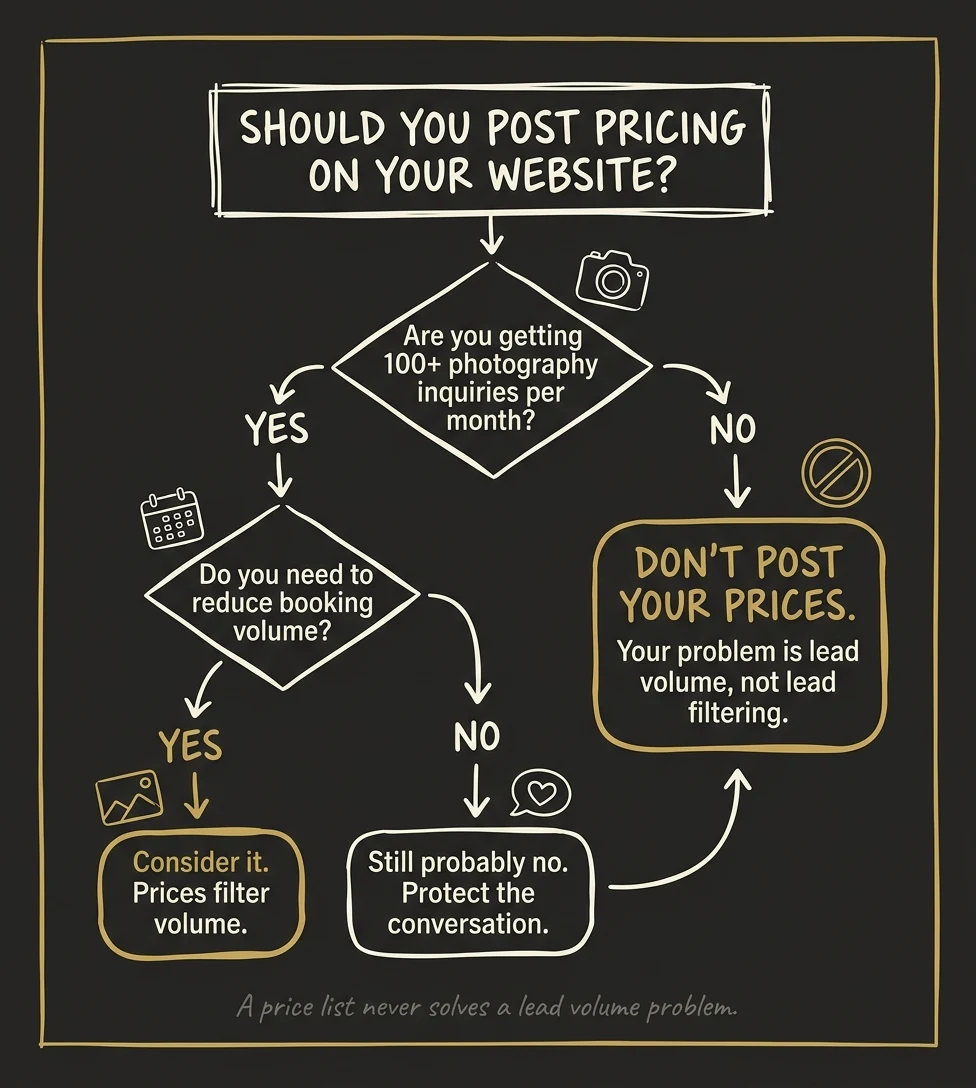
The reason this debate never ends is that both sides are arguing past each other. Pricing transparency advocates say "qualified clients want to know the price before they reach out." Conversation-first advocates say "you lose clients before you can show them your value." Both are right in their specific contexts, but most photographers asking this question aren't in the context where transparency wins.
Here is the honest answer: if you are not generating enough photography inquiries, a price list will not fix that. It will reduce inquiries further. You'll filter out price-sensitive visitors, yes, but you won't add a single interested prospect. The math only works when you have more leads than you can handle.
For the photographer getting 10–30 inquiries per month, posting prices doesn't solve the visibility problem. It just means fewer of those 10–30 people reach out. Now you have a visibility problem AND a conversion problem.
The photographers who should be asking "should I post prices?" are already booking more than they can take. For everyone else, the question to ask is: "How do I get more photographers finding me?" That's a completely different problem, and a price list on your website has nothing to do with solving it.
What Actually Happens When You Post Your Prices
The theory sounds reasonable: post your prices, let the budget-aligned clients self-select, stop wasting time on people who can't afford you. Clean, efficient, logical.
Here's what actually happens.
A couple looking for a wedding photographer searches Google. They find your site, see your prices, see they're in range, and decide to reach out. They also find four other photographers in range. Now they're comparing five photographers, and the only visible differentiator is price. You've just invited a side-by-side comparison where the lowest price wins.
The couple who doesn't see a price list reaches out to ask. You respond. You have a conversation. You learn about their venue, their vision, what matters most to them. You show them your work in that context. By the time pricing comes up, they're already evaluating you differently, not as a line item in a spreadsheet but as someone who understood what they were trying to create. That conversation changes the conversion dynamic entirely.
Pricing transparency sounds like efficiency. In practice, for most photographers, it's premature filtering that removes the best clients before you ever get to talk to them. The clients who wouldn't book you after a conversation are self-selecting out. The clients who would have booked you after a conversation are now comparison-shopping your hourly rate against four competitors.
The Price Shopper: Photography's Worst Client

There is a specific type of client that a price list on your website is perfectly designed to attract. Their first inquiry email reads something like: "Hi, what is your cheapest package? I'm getting quotes from a few photographers."
Every photographer knows this client. They book whoever is cheapest. They show up with a list of shots they found on Pinterest. They ask for more edited images than the package includes. They request a discount for referring a friend they haven't actually referred. And when the ordering appointment comes (if they even show up to it), they tell you they "just need the digitals" and walk out with $300 spent instead of $1,500.
A price list on your website is a magnet for exactly this person. They search for photographers, they see prices, they shortlist the ones in their budget, and they start sending inquiry emails. You are now in a race to the bottom you didn't choose to enter.
The client who books you because of your work, because of how you made them feel in the consultation, because their friend raved about the experience, that client shows up to the ordering appointment ready to invest. They've already emotionally committed. Price is a detail to work out, not the deciding factor.
Your website should attract the second type of client. A price list optimizes for the first.
The inquiry system that attracts the right clients (portfolio, social proof, form, and a consultation framework) is exactly what Photography to Profits builds for portrait and wedding studios.
Book a Free Strategy Call →The Two Photographers Who Should Show Pricing

There are exactly two situations where posting pricing on your photography website makes sense.
1. You're getting 100+ photography inquiries per month.
At this volume, you have a filtering problem, not a lead volume problem. You cannot personally respond to 100+ inquiries with quality. A price list serves as a functional pre-screen: visitors whose budgets don't align filter themselves out before submitting an inquiry, and you can actually serve the ones who do reach out. This is a legitimate use of pricing transparency, and it works because you're not trying to generate more leads. You're trying to process the leads you already have more efficiently.
2. You intentionally need fewer, higher-paying clients.
Some photographers are at a stage where they want to reduce overall volume while increasing per-client revenue. They're fully booked at current rates and want to raise them. Posting premium pricing is one signal that shifts the type of client reaching out. If you're at capacity and want to reprice upward, showing that price on the website is a valid strategy for transitioning your client base.
If you're not in either of these categories (if you're getting fewer than 100 inquiries a month and you're not trying to intentionally reduce booking volume), then your problem is not lead quality. Your problem is lead volume. And a price list solves neither of those things for you.
Where Pricing Actually Belongs: The Ordering Appointment

The ordering appointment is the most underutilized revenue opportunity in portrait photography, and it is specifically where pricing belongs.
Here's how it works: the client books a session, has an incredible experience, and then comes back to the studio (or meets virtually) to view their images for the first time. Instead of receiving a digital download link with 60 images and a "hope you love them!" email, they're sitting in front of a screen watching a curated gallery show. Then they see the prints: a 30x40 canvas on the wall, a 20x24 framed portrait, the album with their images laid out across spreads.
That is when pricing happens. And the emotional context changes everything.
A client who receives a gallery link on a Tuesday afternoon looks at 60 images on their phone between meetings and picks the cheapest digital package because that's what they came prepared to spend. A client who sits in your studio watching their daughter's laugh fill a 30x40 frame is making decisions from a completely different emotional state. They're not comparing packages. They're figuring out how to get that on their wall.
Studios that run ordering appointments consistently report average order values of $1,500–$3,000+ per session. Studios that deliver digitals and let clients self-select from an online store average $300–$500. Same photography. Same clients. Different system for when pricing is introduced.
That's the real answer to the pricing debate. Not "where do I put my price list", but "when do I introduce pricing so that value is already established?"
What to Put on Your Photography Website Instead
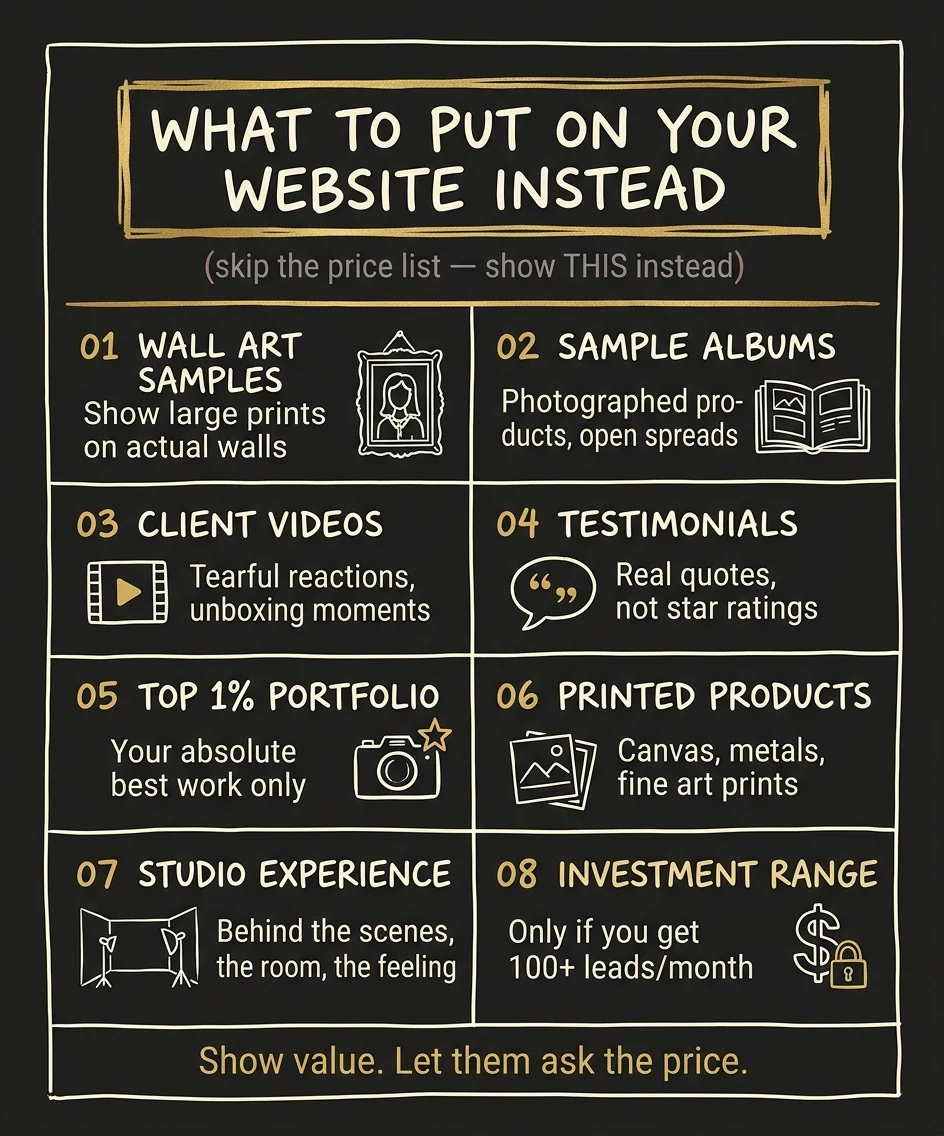
If pricing isn't the conversion event on your website, what is? The inquiry form. Every element of your website should drive a single action: getting the right photographer to submit an inquiry. Here's what actually does that.
Portfolio that makes people feel something. Not every image you've ever taken. A curated 15–25 images that show your style, your best work, and the emotional range of your sessions. The visitor should leave your portfolio page with a feeling. That's what triggers an inquiry.
Social proof in their words, not yours. Client testimonials, Google reviews, and case-study-style stories about client experiences. Not "award-winning photographer with 10 years of experience." Actual clients describing how they felt in the session and what the photos mean to them now.
"Starting from" language, if you need a number. If you absolutely want to set expectations around investment, one line is enough: "Sessions start at $XXX. Most clients invest between $X,XXX and $X,XXX." This satisfies the "is this in my budget?" question without becoming a price comparison point. It also captures organic search traffic for pricing-related keywords without turning your site into a rate card.
A clear, low-friction inquiry form. Name, email, type of session, preferred timeline. That's it for the first contact. The inquiry form is the conversion. Everything else on the site exists to get someone to fill it out.
Having the Pricing Conversation

Not showing prices on your website doesn't mean hiding them forever. It means having the pricing conversation at the right moment, after you've learned about the client and they've learned about you.
The right moment is during or after the initial consultation call, once you understand what the client actually wants and you can present pricing in the context of what it delivers. Instead of "here are my packages," it becomes: "Based on what you've described: the outdoor session, the full family including the grandparents, and getting wall art in time for the holidays. Most clients in your situation invest around $X,XXX. That covers the session, your gallery, and your wall art order. Does that align with what you were expecting?"
That conversation sounds nothing like a price list on a website. It's personal, it's contextualized, and it positions the investment in terms of what the client is actually getting.
The photographers who learn to have this conversation stop losing clients to price comparison entirely. Not because they're cheaper, but because the client never compares them to anyone else. The conversation happened before the comparison did.
Humberto Garcia's 7-Figure Studio program covers the exact three-tier pricing presentation framework that gives photographers a consistent, practiced way to introduce investment levels without triggering sticker shock or price-shopping behavior. The framework works because it sequences value before number, every time.
Learning to have the pricing conversation (and build the booking system that supports it) is what the P2P coaching program is designed to do. Your price list is not the problem. The system around it is.
See How the Coaching Program Works →Conclusion: The Price List Isn't the Answer. The Conversation Is
The photographers who struggle to grow their studios are almost never struggling because they showed too much pricing. They're struggling because they're not having enough conversations.
A price list on your photography website reduces conversations. For photographers with 100+ monthly inquiries, that reduction is a feature. For everyone else, it's one more reason someone didn't reach out.
The answer to "should I put pricing on my website?" is no, with two narrow exceptions that don't apply to most photographers reading this. Instead, build a website that drives inquiries, develop a consultation framework that builds value before price enters the conversation, and let the ordering appointment do what it was designed to do: introduce pricing after the client is already in love with what you've created together.
Photography to Profits, founded by Humberto Garcia, works with portrait, wedding, and boudoir photographers to build the full system (inquiry, consultation, session, and ordering appointment) that turns great photography into a great business. If you're ready to stop competing on price, book a strategy call with the P2P team.