
How Do You Absolutely Ensure That You Make the Worst Decision Possible?
Anyone who's been in the military is familiar with a culture that insists that once you've gone over your first four years you're locked in for the long haul. In for a penny, in for a pound.
At 28 years old I had been in the military for 10 years… and I was getting ready to leave.
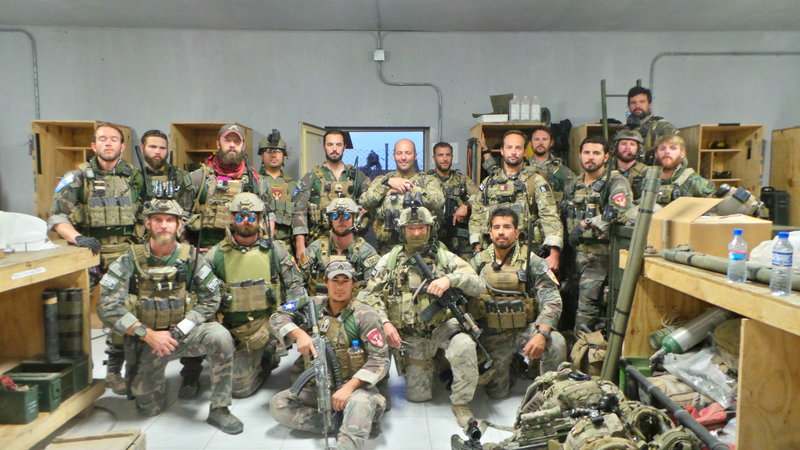 MARSOC deployment, Afghanistan: halfway to retirement, ready to walk away.
Whenever anyone found out I was even considering quitting the Marines I was hit with the same spiel.
"You're halfway to retirement. In another 10 years, you could be making 2000 dollars a month in retirement money. After that, you could get a job as a cop or a security guard or at a Walmart making even more money with financial security from the military. Are you really gonna jump ship now?"
I see this same scenario play out in all areas of life: In relationships, in businesses, and yes, photography.
It's called the sunk cost fallacy. It's the misconception that once we've spent a significant amount of time and effort on a project, a job, or a person, that it would be a greater cost to us to stop pursuing that venture than it would be to see it through. Notice I said that this is a misconception.
I could have easily listened to all of my Marine buddies and stuck it out another 10 years and collected that retirement money. But was that what I really wanted? Would it really have been that easy?
No. If I was given a blank slate, knowing all I knew at that point, and given the choice, I would not have joined the military. That realization alone was enough to know that something needed to change.
The Blank Slate Test
This is what I call the Blank Slate Test, and it's the single most powerful question you can ask yourself, in business, in your career, in life:
"If I were starting from scratch today, knowing everything I know now, would I make the same choice?"
If the answer is no, you have a problem. Not because the time you spent was wasted. But because every day you keep going in that direction is a new decision to stay, and you're making it for the wrong reasons.
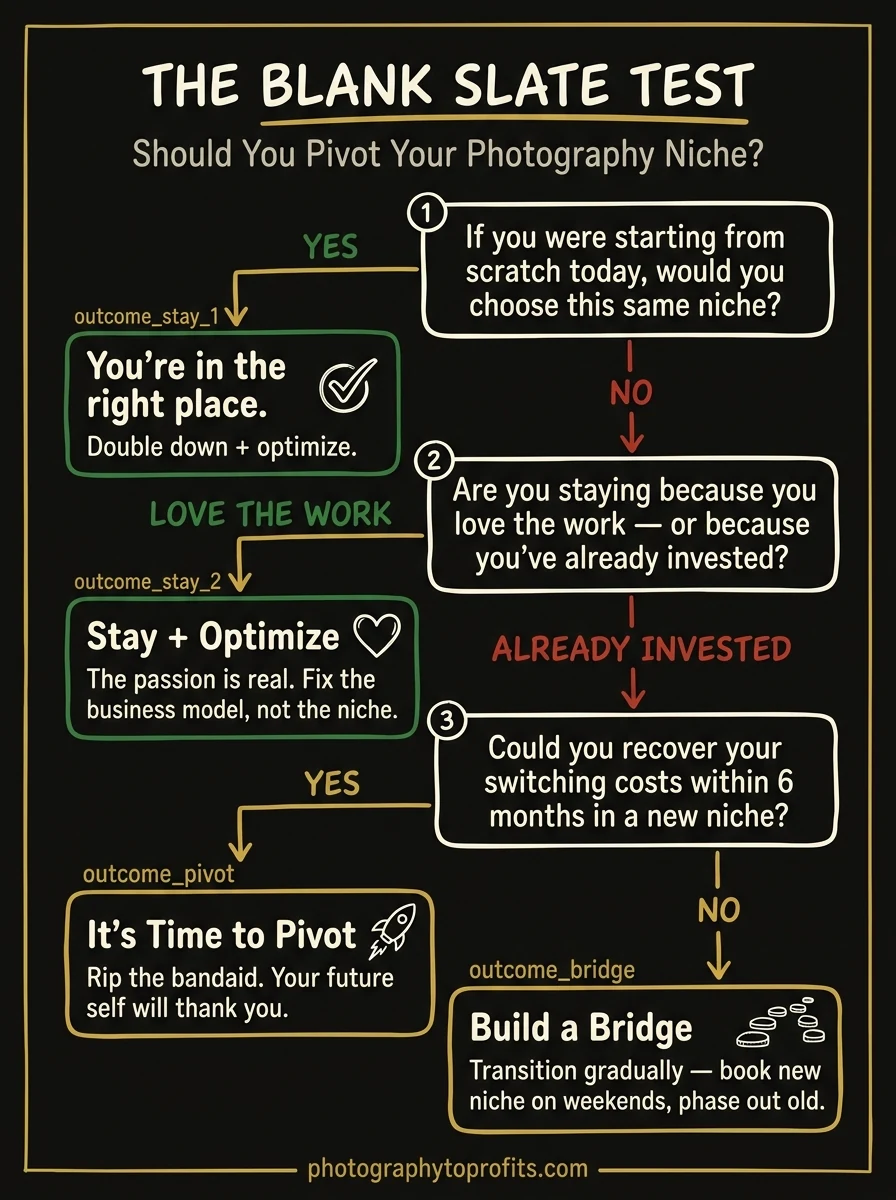 Use this framework the next time you're debating whether to stay or go.
I started to really hone in on what I truly wanted for my future. Ultimately, I wanted to have as much freedom as possible and for me, that meant making a substantial amount of money I wouldn't be making staying where I was.
I decided that I would give myself another 10 years to get my education, begin my business, and start making the kind of money I had envisioned.
Were the last ten years of my life completely wasted by my decision to leave? Not necessarily. Regardless, I knew that my decision had to be based on my current goals for the future, not the desires of my past self.
This Isn't Just About Photography
The same goes for building a business, any business.
We can't blindly trust a version of ourselves that had less experience going into a career path or a project than the version of who we are now. You have to trust that what is right for the future of your business is ahead of you, not behind you.
Maybe you've been grinding at a 9-to-5 tech job for years and photography has been the thing that lights you up on weekends. The sunk cost fallacy tells you: "You spent four years getting that CS degree, you can't just throw that away." But you didn't throw it away. You used it, you learned from it, and now you know it's not what you want to build a life around.
Or maybe it's the opposite. Maybe you've been doing photography for five years and it's just… not working. The revenue isn't there. The joy isn't there. And you keep telling yourself "I've come too far to quit." But you haven't come too far. You've come far enough to know. That's valuable. The question isn't whether you wasted five years. The question is whether you're going to waste five more.
The sunk cost fallacy doesn't care what direction the pivot goes. It traps you wherever you already are.
Where This Shows Up in Your Business
For those of you building photography businesses, I see this play out in four specific ways:
1. Staying in a niche that stopped working
You bought $8,000 in newborn props. Your entire brand says "newborn photographer." But the revenue has plateaued and the work feels like a grind. The sunk cost fallacy tells you: "I've invested too much to switch." No. The props don't care about your feelings. That money is gone whether you use them or not. The only question is what you do next.
2. Clinging to underpriced packages
"But my clients expect $200 sessions." Maybe they do. But the fact that you've been undercharging for three years doesn't mean you owe it to anyone to keep doing it. Your pricing should reflect the value you deliver today, not the insecurity you felt when you started.
3. Refusing to drop a dead marketing channel
You spent two years building an Instagram following. But the leads dried up a year ago. Meanwhile, photographers who moved to Google Ads or Meta Ads are booking 15–20 sessions a month. The time you spent on Instagram is gone. The channels that work right now are the only ones worth your energy.
4. Hanging on to a business model that doesn't pay
Shoot-and-burn with $150 digitals. You know it's not sustainable but you've "always done it this way." Photographers doing in-person sales are averaging $2,000–$5,000 per client with the same number of sessions. The model you started with served its purpose. It doesn't owe you anything.
The Pivot That Changed Everything
My business partner, Jenn Bruno Smith, spent her entire career doing newborn photography before switching to boudoir. Up until making that major career change, she had an exhaustive amount of newborn shooting gear and props, and her entire client base, and all her email lists, consisted of newborn-focused contacts.
She walked away from all of it.
She went on to build a half-million-dollar boudoir business, and she's never looked back.
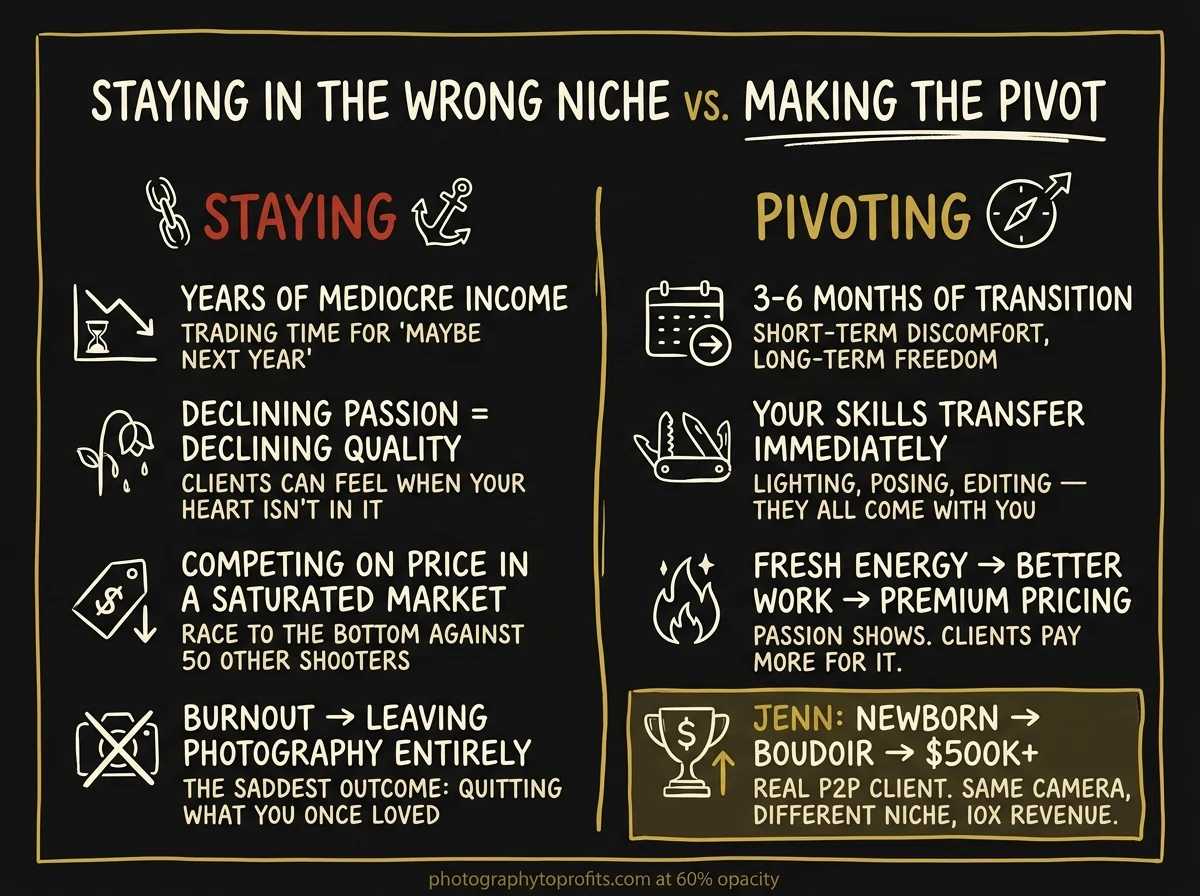 The math almost always favors the pivot.
She's not the only one. I've watched this play out dozens of times with the studios we work with:
- Boudoir by Olin started in dog photography, pivoted to boudoir, and built a seven-figure studio doing $1.3 million.
- Mandy at Mermaid Lake Boudoir left weddings behind, leaned into boudoir, and now consistently hits $60K months.
- Liberation Boudoir in Miami grew from a side project to a full-time studio after Astrid stopped splitting her energy across genres.
Every single one of these photographers had to walk away from something they'd already invested in. Every single one will tell you: "I wish I had done it sooner."
What the Pivot Actually Costs
Here's what people think the pivot costs, whether it's leaving a career, changing a niche, or overhauling a business model:
- Everything I've built so far (you'll keep more than you think; skills transfer)
- My reputation (your reputation for quality work transfers; your reputation for being cheap is worth losing)
- Years of experience (experience in anything accelerates you in everything else)
Here's what it actually costs:
- 3–6 months of being uncomfortable
- A new plan and some updated messaging
- The temporary discomfort of being a beginner again
Compare that to the cost of staying: another year of stagnant revenue, declining passion, burnout, and the growing suspicion that maybe this path isn't for you, when really, it's just that version of the path that wasn't for you.
This applies beyond business: relationships, degrees, partnerships, all of it. But you're here because of your business. So the question is simple: "Am I continuing because this is the best path forward, or because I've already spent time and money on it?"
If it's the second one, you're making the worst decision possible.
Find the Courage to Do It
The way you absolutely ensure that you make the worst decision possible is by giving in to the sunk cost fallacy.
Jenn Bruno Smith succeeded because she faced the possibility of changing genres and didn't let her past weigh in on her decision.
I succeeded because I walked away from 10 years in the Marines, not because those years were wasted, but because the next 10 years mattered more.
So ask yourself, "Given a blank slate, what is it that will give me the best chance at achieving what I want?"
And then, find the courage to do it.
If you need help figuring out the best path forward (whether that's building your photography business, pivoting your niche, overhauling your pricing, or starting from scratch), book a free strategy session with our team. We've helped hundreds of photographers go from stuck to thriving, and the conversation costs you nothing.