
Here's what nobody told you when you ran your first Facebook ad back in the day: the platform you learned on doesn't exist anymore. iOS 14.5 blew a 40–60% hole in your conversion tracking. The Andromeda algorithm buried narrow interest stacking. And the photographers still following 2019 playbooks are bleeding budget wondering why nothing works.
The good news: Meta advertising (Facebook and Instagram together) is still one of the highest-ROI channels available to local service photographers. Portrait, boudoir, wedding, newborn. When it's set up correctly in 2026, studios running the system see 20–50× return on ad spend and CPL (cost per lead) of $30–$80. That math changes your business.
In this guide you'll learn: how to fix the iOS 14.5 tracking problem with CAPI, whether to run Advantage+ or manual campaigns first, which creative formats actually book sessions in 2026, and the budgets and timelines to set realistic expectations.
Key Takeaways
- iOS 14.5 removed 40–60% of conversion visibility. CAPI (Conversions API) recovers 80–90% of it
- Advantage+ campaigns outperform manual by ~22% once you have conversion data, but run manual first to build that data
- The Andromeda algorithm rewards broad audiences with strong creative. Narrow interest stacking is dead
- Reels and video ads outperform static images 2–4× on reach. BTS content and transformation reveals are your best creative
- Minimum budget to exit Learning Phase: $30–$50/day ($900–$1,500/month)
- Lead Gen ads cut CPL by 30–50% but need follow-up under 5 minutes. Traffic ads bring higher intent at higher cost
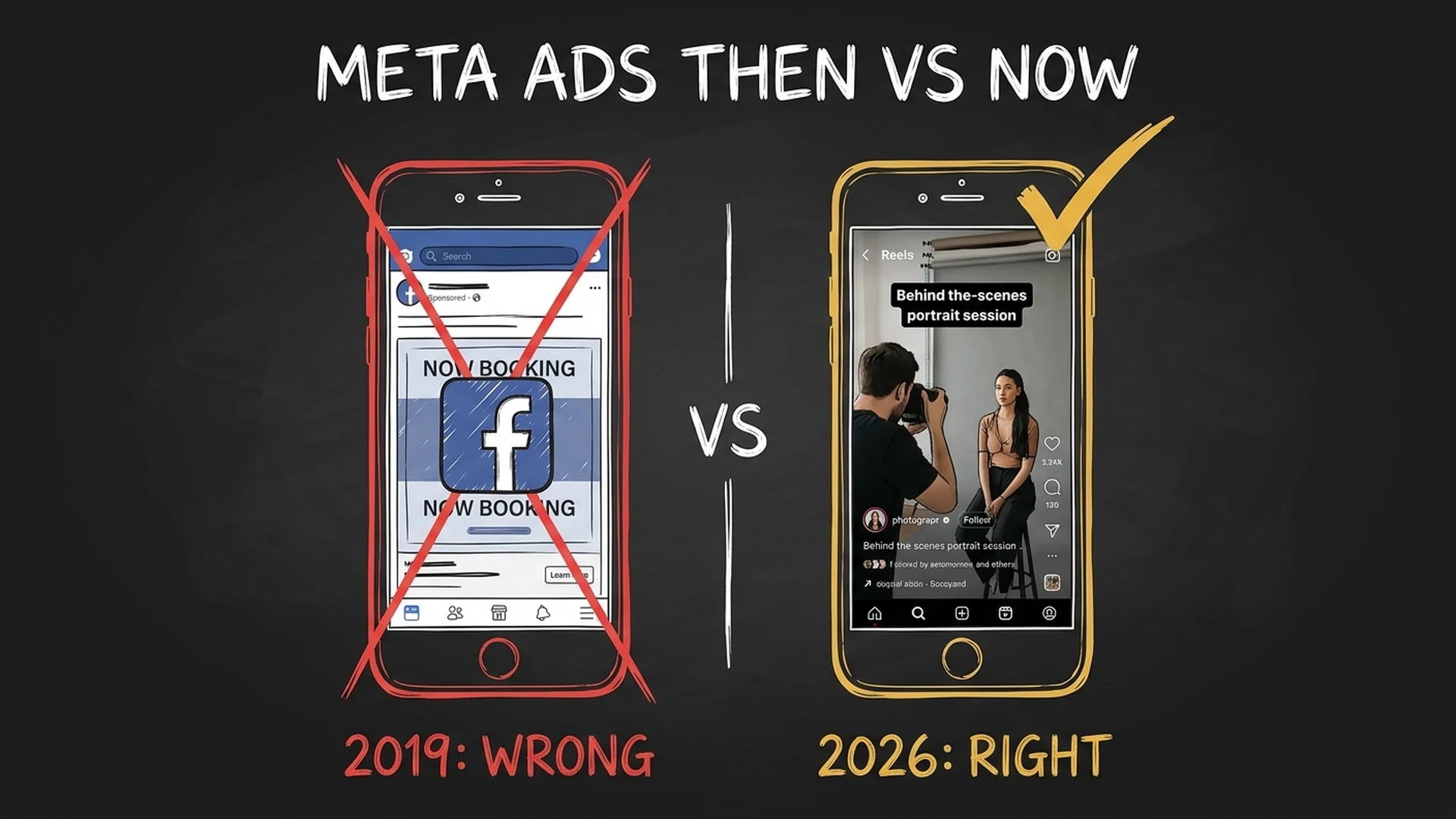 The 2019 playbook vs. the 2026 system: same platform, completely different approach.
Why Meta Ads Still Work for Photographers (When Done Right)
The photographers who write off Meta ads in 2026 are the same ones who tried the old way and got burned. Overly narrow audiences. Polished studio slideshows. $5/day budgets. "Now Booking!" graphics in Canva. That stuff never worked. They just didn't know it until the algorithm changes made it obvious.
Here's what's actually happening on the platform right now. Meta's Advantage+ campaigns, their AI-driven automation layer, now outperform traditional manual campaigns by approximately 22% on conversion metrics, according to Meta's own 2025 internal data. The reason: Advantage+ uses machine learning to test audience segments, creatives, and placements simultaneously, optimizing for conversions in a way no human can match manually.
The Andromeda algorithm update reinforced this direction. Andromeda moved the platform decisively away from interest stacking, the old technique of layering "engaged, 25–35, interested in yoga + photography + self-care" into narrow audiences. That approach hit a wall as iOS 14.5 degraded signal quality. What Andromeda rewards instead: broad audiences with strong creative. Let the algorithm find your buyer. Your job is to give it something worth showing.
That's actually good news for photographers. You already have the creative. You just need to stop presenting it like a billboard and start presenting it like content.
The iOS 14.5 Problem and the CAPI Fix
If your Meta ads feel like they're running blind, they probably are. Here's why.
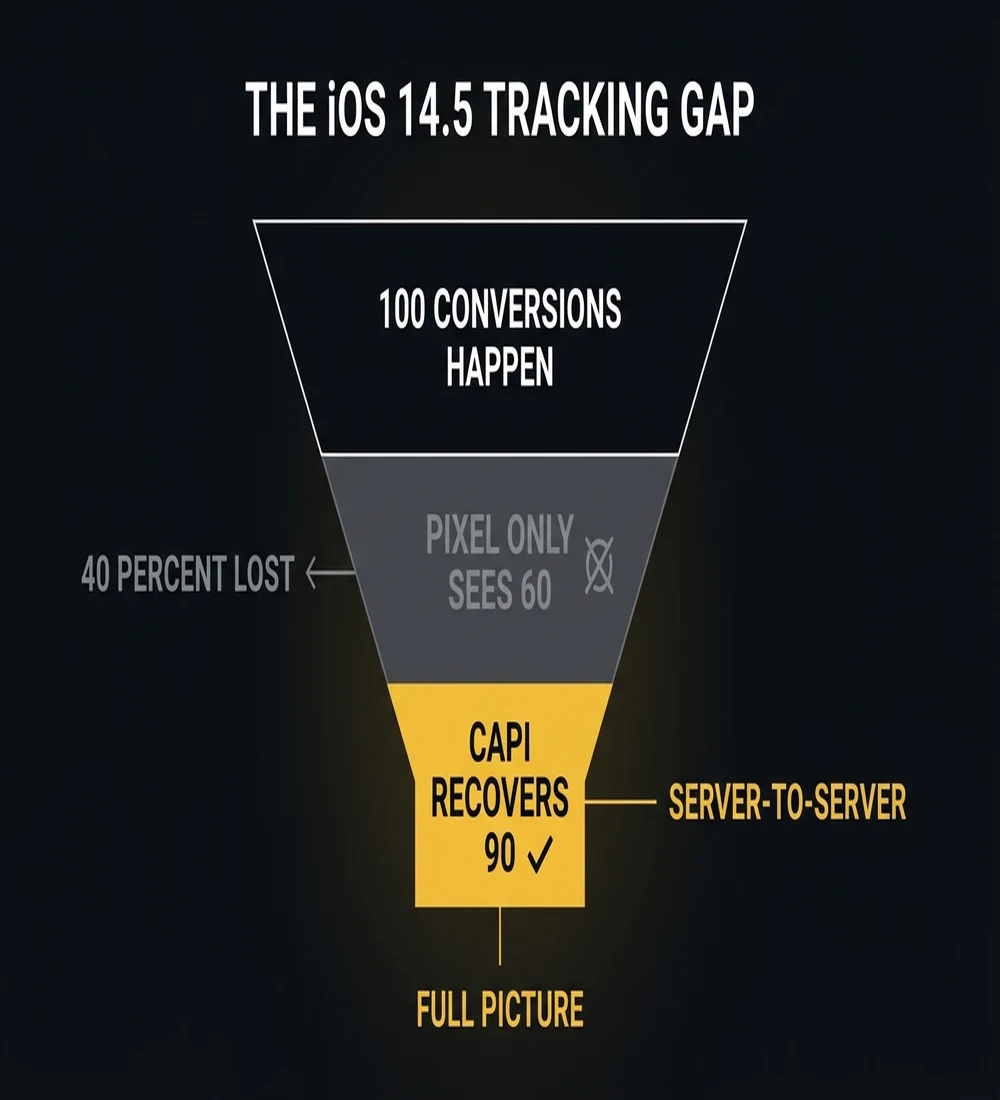 Pixel-only tracking vs. CAPI: the difference between 60% and 90% conversion visibility.
In April 2021, Apple released iOS 14.5 with App Tracking Transparency (ATT), a feature that let iPhone users opt out of cross-app tracking. Most did. The result: Meta's pixel (the tracking code you install on your website) lost visibility into 40–60% of the conversions it used to see. A booking that came from your ad? The pixel often couldn't confirm it. The algorithm was optimizing based on incomplete data, which is like navigating by GPS with half the map missing.
The fix is CAPI, the Conversions API. Unlike the pixel, which runs in the browser and gets blocked by iOS, CAPI is a server-to-server connection. It sends your conversion data directly from your website's server (or your booking platform: Dubsado, HoneyBook, Acuity, etc.) to Meta's server. No browser. No iOS blocking it.
Studios that have implemented CAPI properly recover 80–90% of their conversion visibility, compared to roughly 60% with pixel-only tracking. The practical impact: after CAPI setup, most studios see measurable improvement in campaign performance within 7–14 days. The algorithm suddenly has the data it needs to find people who actually book, not just click.
Setting up CAPI isn't a developer project. Most booking platforms have native integrations. If you're on a custom WordPress site, there are partner integrations and GTM-based setups. If you need a walkthrough, grab the free GTM Pixel Template at photographytoprofits.com/book-resources. It walks through installation step by step.
Bottom line: Running Meta ads without CAPI in 2026 is the single most common reason photographer campaigns underperform. Fix this before you touch anything else.
Most photographers are making campaign decisions based on 40% of their actual data. We set up full CAPI tracking as part of every Meta Ads engagement we run.
See Our Meta Ads Service →Facebook vs. Instagram: Where Photographers Win in 2026
Meta is one ad platform, but it serves two very different surfaces. Knowing where your clients actually spend their time changes your results dramatically.
 Instagram Reels is currently the highest-reach placement on Meta, and it rewards organic-looking creative.
Instagram Reels is the highest-reach placement on the platform right now. Meta is prioritizing Reels distribution, both organic and paid, because it competes directly with TikTok. For photographers, this is a gift. Video-first, short-form content showing transformations, behind-the-scenes sessions, and client reactions is performing 2–4× better on reach than static images. If you shoot boudoir or portrait work, the before/after reveal format on Reels is one of the most powerful booking drivers available.
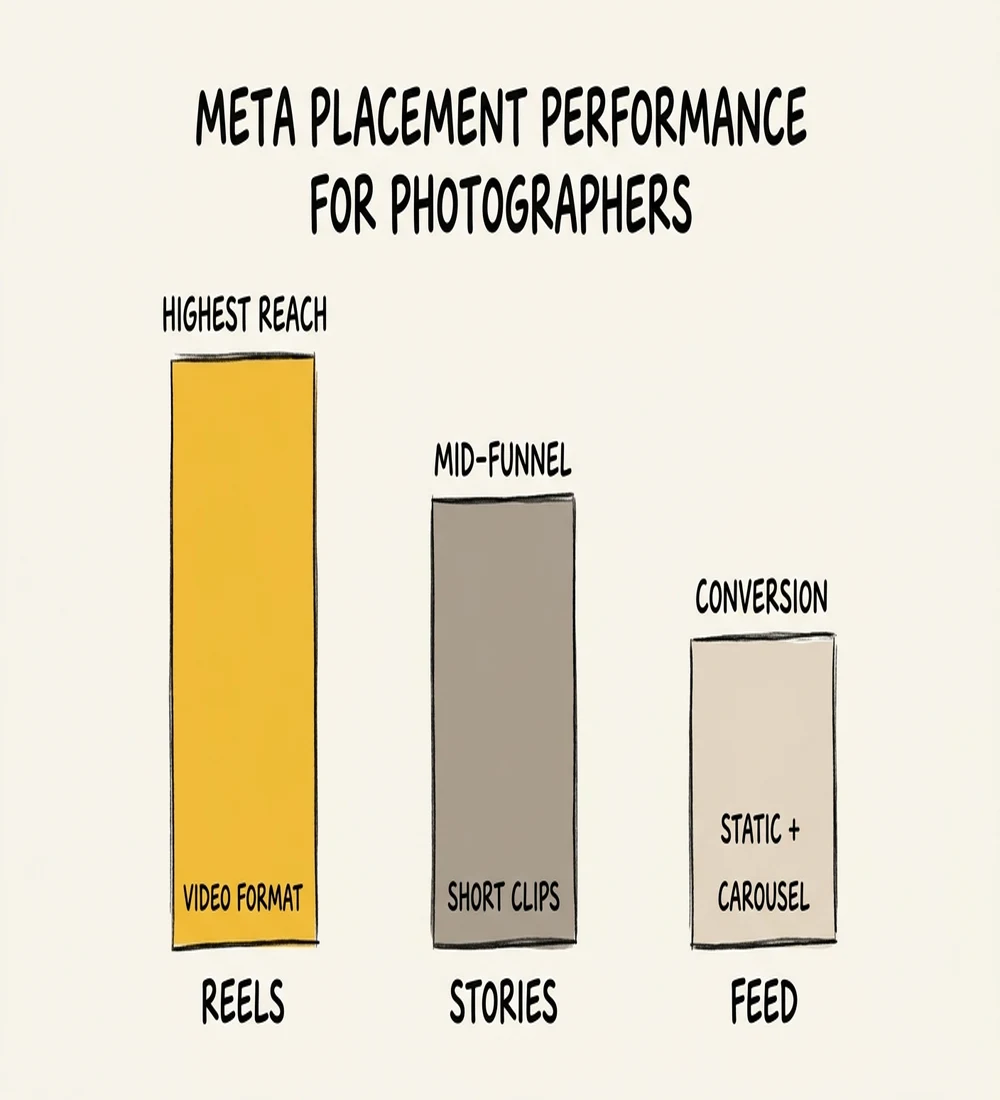 Reels delivers the highest reach; Stories drives mid-funnel results; Feed converts warm traffic.
Instagram Stories still drives strong direct-response results, particularly for wedding and engagement photographers. Stories get swiped by people already warmed up to your brand. It's a mid-funnel placement. Strong performing formats: client voiceover testimonials, quick BTS clips, and countdown-style offers ("2 spots left for spring").
Facebook Feed and Stories skew older demographic, typically 35–55. This placement outperforms for family portrait, newborn, and boudoir photographers targeting moms in the 35–50 range. Don't sleep on Facebook. For many studios, Facebook still drives the majority of actual bookings even if Instagram gets more engagement.
When running Advantage+ Shopping or Advantage+ Audience campaigns, Meta handles placement optimization automatically across all surfaces. This is typically the right call unless you have specific data showing one placement dramatically outperforms others for your studio.
Advantage+ vs. Manual Campaigns: Which to Run First
This is the question every photographer asks, and the answer is: manual first, Advantage+ second.
Advantage+ is extraordinarily powerful, but it's only as smart as the data you feed it. The algorithm optimizes for your conversion event (a booking, a form submission, a purchase). If you have zero conversion history in your ad account, Advantage+ has nothing to optimize toward. It's a race car with no map.
The sequence that works:
Phase 1: Manual Campaign (Weeks 1–4): Run a manual Conversions campaign targeting a broad audience in your city radius (15–25 miles). Use your best 3–5 creative assets. Goal: collect 25–50 conversion events in the pixel. This is your data-building phase.
Phase 2: Advantage+ (Week 5+): Once you have conversion data, launch an Advantage+ Audience campaign. Point it at the same conversion event. Let Meta's AI do the optimization. This is where the 22% performance lift kicks in.
The Learning Phase is the most misunderstood concept in Meta advertising. Every new campaign or ad set enters Learning Phase when it launches: this is when the algorithm is actively testing to find who responds to your ad. Learning Phase requires approximately 50 conversion events in a 7-day window to exit. That's why budget matters: at $30/day, you're giving the algorithm enough spend to collect data. At $5/day, you're stuck in Learning Phase indefinitely, and performance is unpredictable.
The most common mistake photographers make: launching Advantage+ with no conversion history, getting mediocre results, and concluding "Advantage+ doesn't work." It works. It just needs data first.
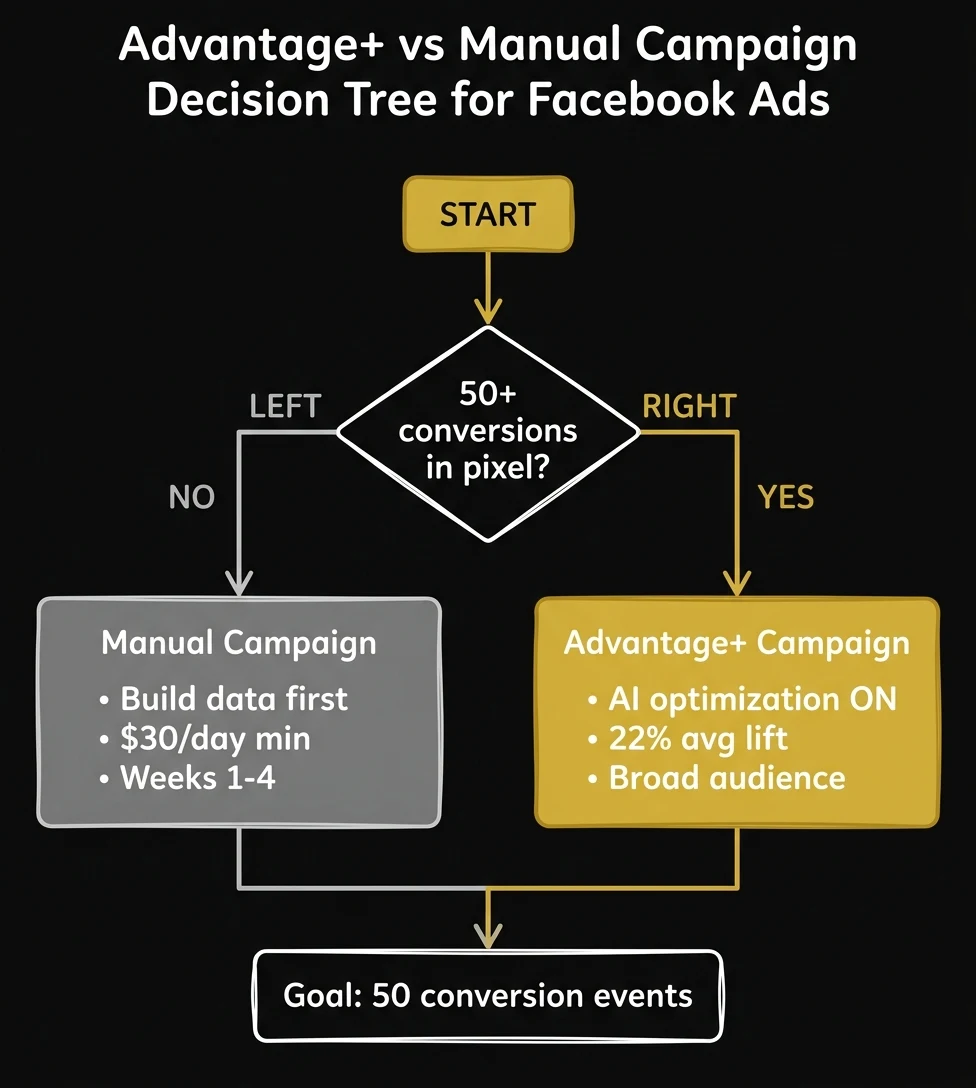 Manual campaigns first to build conversion data, Advantage+ once you hit 50 events.
The Creative Formula That Books Photography Sessions
Most photographers get this backward: your ad is not a portfolio gallery. Your best images are not your best ads.
What stops the scroll in 2026 is content that looks like it belongs in the feed. Organic-looking. Human. Real. The polished studio slideshow with your logo in the corner and "Now Booking!" text overlay? That's what people's brains have been trained to skip.
The creative formula that consistently books sessions:
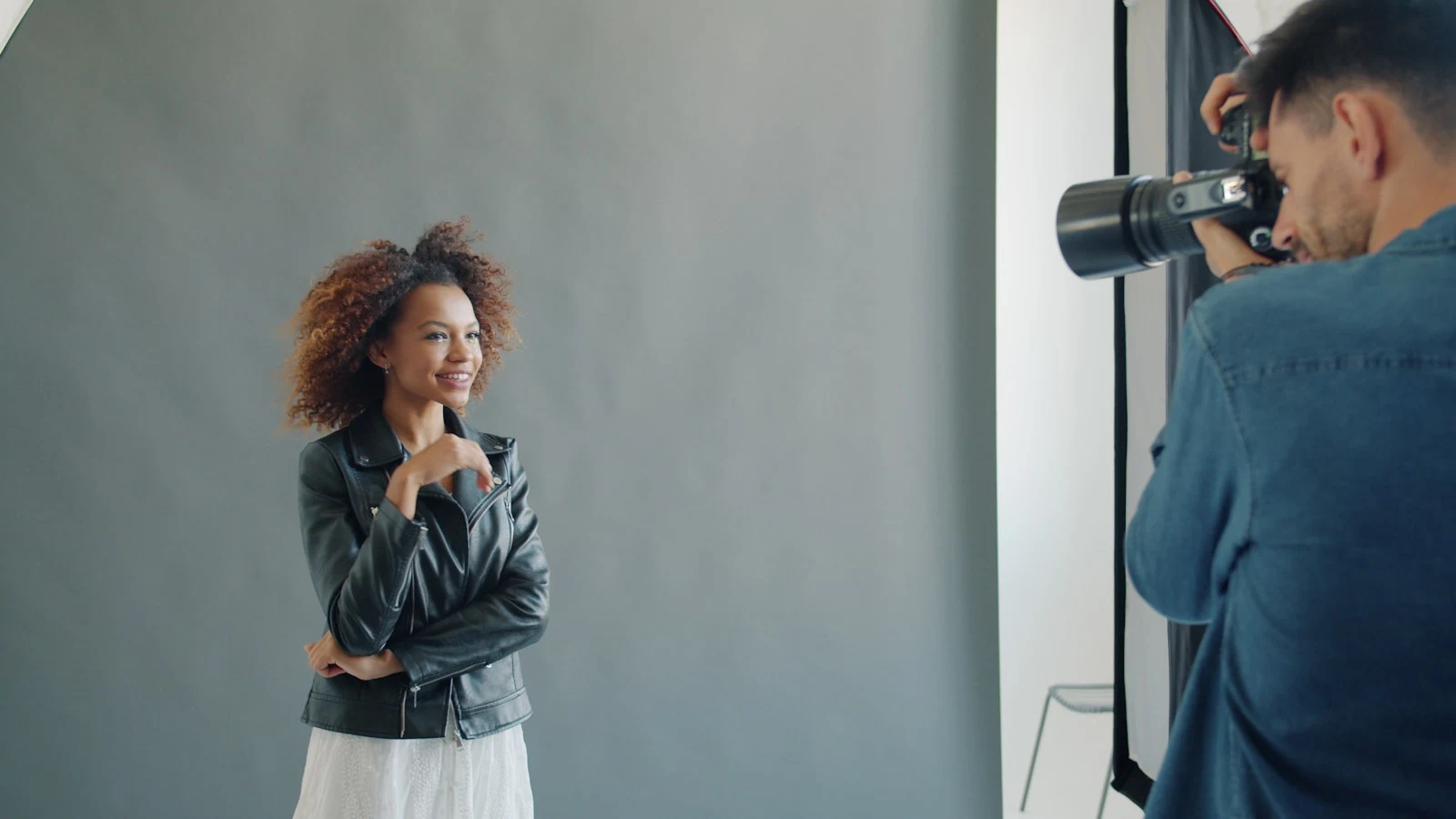 BTS content removes mystery and kills booking anxiety. It's also your best performing ad creative.
Hook in the first 3 seconds. Your lead frame or opening line must grab attention. Not "XYZ Photography Studio." Something that names a feeling or fear directly: "You've been putting this off for two years." "This is what 40 looks like." "She almost cancelled three times." That's a 3 AM thought, the internal monologue your ideal client is already having. When she hears it in your ad, she stops scrolling because it feels like you read her mind.
BTS (behind-the-scenes) content. Hair and makeup, posing guidance, the studio environment, a client laughing mid-session. BTS content removes mystery. It kills the anxiety of not knowing what to expect. And it performs exceptionally as Reels content because it looks organic, not promotional.
Transformation reveals. For boudoir and portrait, the "before and after" format on Reels is currently one of the highest-converting creative formats available. Quick cut from client arriving nervous → client seeing her photos → emotional reaction. 30–45 seconds. No logo overlay. Just the story.
Video testimonials. Nothing outperforms a real client talking about her real experience. Raw, slightly imperfect, phone-recorded testimonials convert better than produced testimonials. Why? Because they look real. The algorithm knows this too: authentic-looking video gets more organic reach on Reels, which reduces your cost per impression.
What NOT to do: Portfolio slideshows with elevator music. Logo animations. "Limited time offer" countdown graphics. Feature lists ("Professional retouching! Hair and makeup included! Digital files!"). These patterns scream "ad" and get mentally filtered out. Translate every feature into what she actually feels, the "So What?" behind each service element.
The studios hitting $30–$80 CPL aren't spending more. They've nailed the hook. We write and test Meta ad creative for photographers every day.
See How We Run Meta Ads →Lead Gen Ads vs. Traffic Ads: Which Fills Your Calendar
 Photo: Clinic Grower / Unsplash
Lead Gen ads and Traffic ads are fundamentally different tools with different use cases. Most photographers should use both, but for different audiences.
Lead Gen ads (also called Instant Forms) collect inquiries directly inside Meta: the prospective client fills out a form without ever leaving Facebook or Instagram. The benefit: friction is almost zero, so form completion rates are dramatically higher. The tradeoff: because it's so easy to submit, lead quality is lower. Someone who filled out a 30-second form inside Instagram while watching TV is not as committed as someone who found your website, read your pricing page, and submitted an inquiry.
Lead Gen ads typically deliver 30–50% lower cost per lead (CPL) than Traffic ads, meaning you get more inquiries for the same spend. But your booking rate from those leads will be lower. You also need to follow up within 5 minutes for Lead Gen leads to convert at meaningful rates. A lead that sits in your inbox for 24 hours has a booking rate near zero.
Traffic ads send people to your website, typically a dedicated landing page built for that campaign. Higher friction means fewer form submissions, but the people who do submit are self-selected. They've seen your pricing. They've read your testimonials. They've decided they want to work with you. Booking rates from Traffic leads are typically 2–3× higher than Lead Gen leads.
The recommendation for most photographers:
- Use Lead Gen ads for volume campaigns: model calls, limited-time experiences, high-offer campaigns where price is the draw. These work best when you have a fast follow-up system and a strong phone script.
- Use Traffic ads for high-ticket services (weddings, full boudoir experiences, commercial branding) where the booking decision requires more consideration. A dedicated landing page that walks them through your process and shows social proof will dramatically outperform an Instant Form for these clients.
The P2P Meta Ads System
At Photography to Profits, Humberto Garcia's framework for Meta ads is called the Proof-to-Paid Loop. It's the simplest paid ads system that works consistently across every photography genre: portrait, boudoir, wedding, newborn, family.
The loop works like this: post proof content organically and watch what resonates: saves, DMs, comments that say "pricing?" or "where are you?". When a piece of content generates those buyer signals, that's your signal. Turn it into a paid ad. Same video, same energy, minimal overlay. Your funnel (quiz, landing page, follow-up sequence) handles the rest. Every new client generates more proof content, which feeds the loop again.
What makes this different from "just run ads" advice is the foundation it requires. The studios in the P2P program that see 30×+ ROAS consistently aren't spending more. They're spending on proven content. The offer is built first. The landing page is congruent. The follow-up is fast. The phone script converts. Ads pour fuel on a machine that's already working.
The copywriting insight that sharpens every creative decision: write to the 3 AM thought. Your ideal client has a specific fear running through her head at midnight: "I've been putting this off too long," "I'm not sure this is for someone like me," "What if I don't look how I want to look?" When your ad speaks directly to that thought, she doesn't just stop scrolling. She books.
If you want to build this system with support (either done-for-you or with direct coaching), see how the P2P program works below.
Conclusion: Meta Ads Work When They're Set Up Right
The photographers who gave up on Facebook ads in 2021 were right to stop: those campaigns were built on broken tracking, narrow audiences, and 2019 creative. But Meta in 2026 is a fundamentally different platform. Advantage+ campaigns, Conversions API tracking, and Reels-first creative have rebuilt it into a reliable booking channel for portrait, boudoir, and wedding studios. Photography to Profits, founded by Humberto Garcia, manages Meta ad campaigns for specialty photographers across the country, and the studios hitting 20–50× ROAS consistently share one thing: they followed the data, not their gut. Set up CAPI, let the algorithm learn, and give it 60 days.
Ready to stop guessing? See how our done-for-you Meta Ads service works →
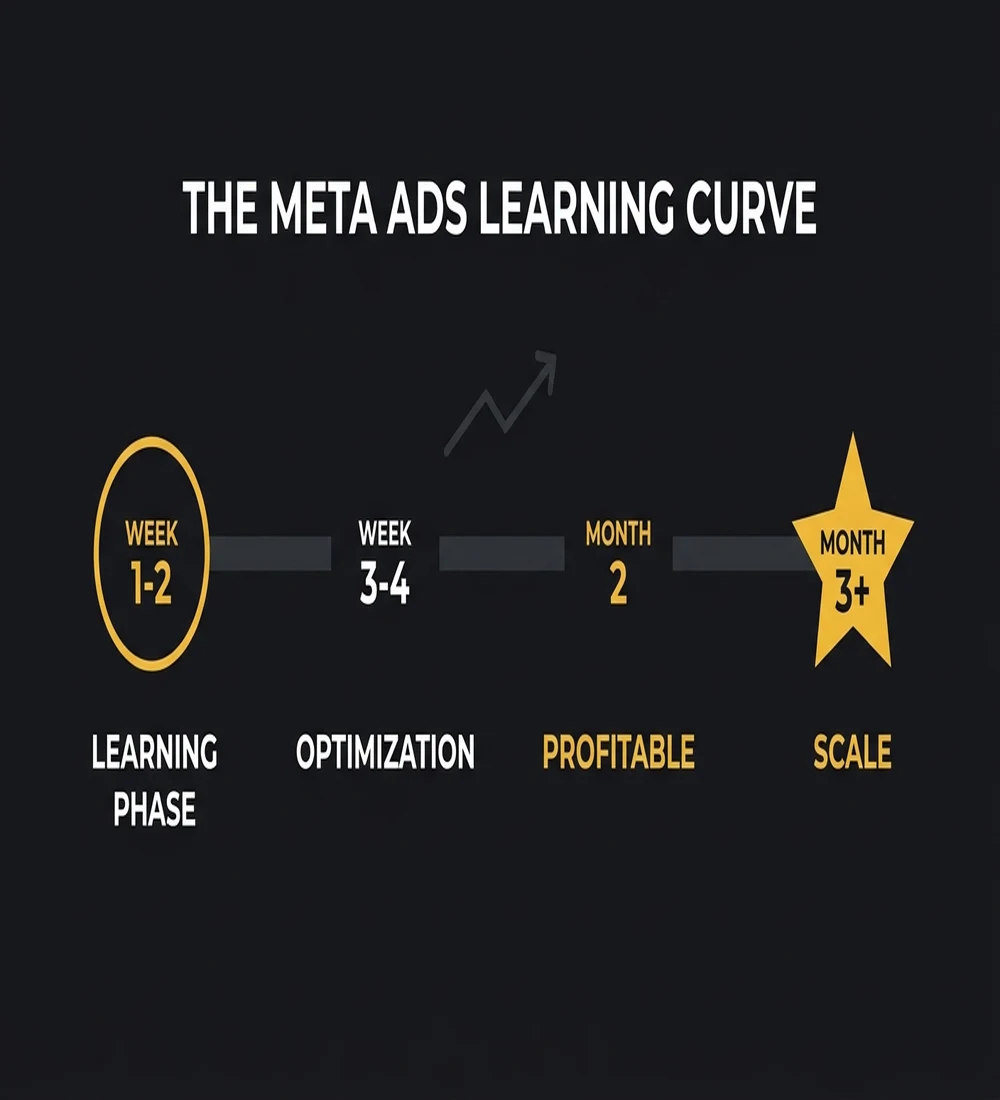 The Meta ads timeline: Learning Phase → Optimization → Profitable → Scale. Don't pull the plug before week 4.
 Track cost per booking, not cost per lead: the metric that actually tells you if your Meta ads are profitable.