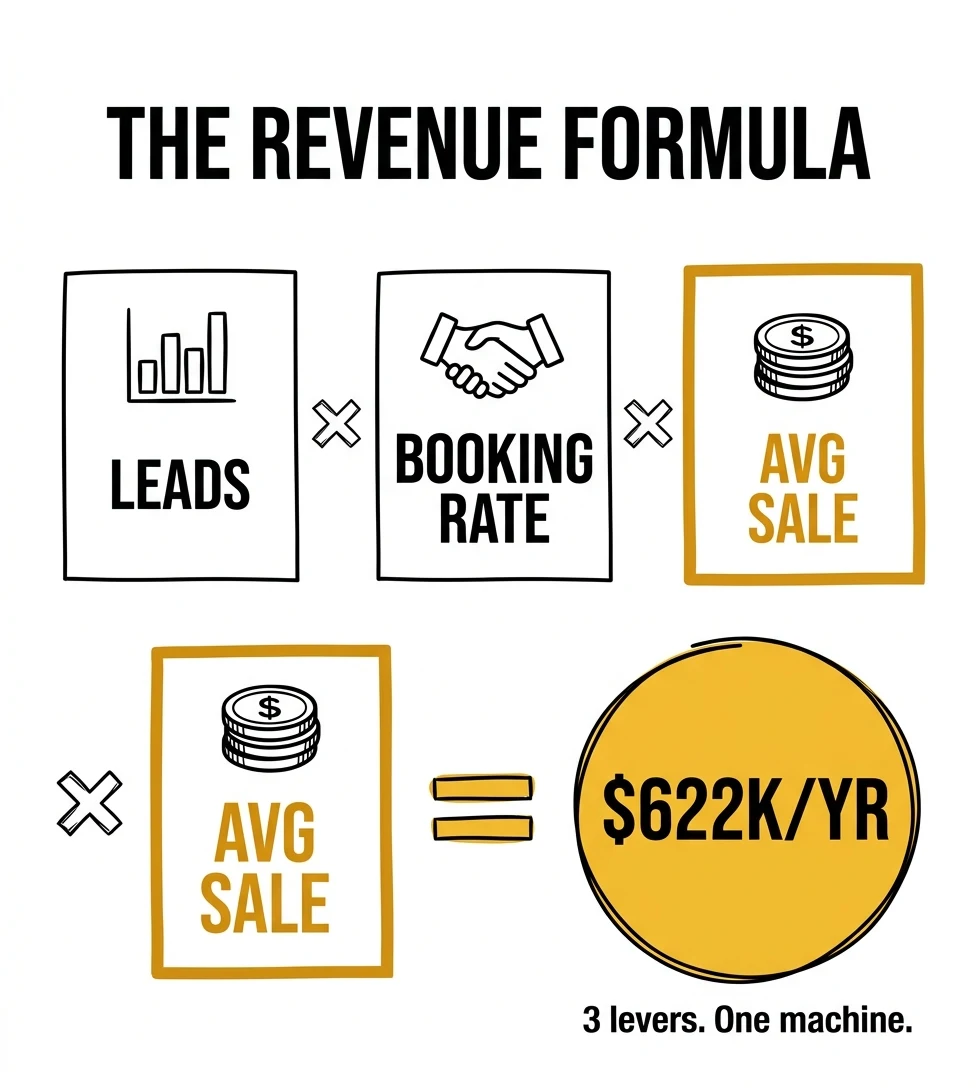
Say you're at 50 leads per month, a 15% booking rate, and a $4,000 average sale. That's 7–8 bookings, $30,000/month. A real business. And the exact plateau where most photographers get stuck for years.
Now improve each number by just 20%. Not double. Not triple. Twenty percent. Leads go from 50 to 60. Booking rate from 15% to 18%. Average sale from $4,000 to $4,800.
New math: 60 × 18% × $4,800 = $51,840/month. $622,000/year. A 73% increase from three 20% improvements. That's the compound effect, and it's the entire premise of this guide.
Key Takeaways
- Photography revenue is controlled by exactly three numbers: Leads, Booking Rate, and Average Sale. A 20% improvement in each produces a 73% revenue increase, no new tactics required.
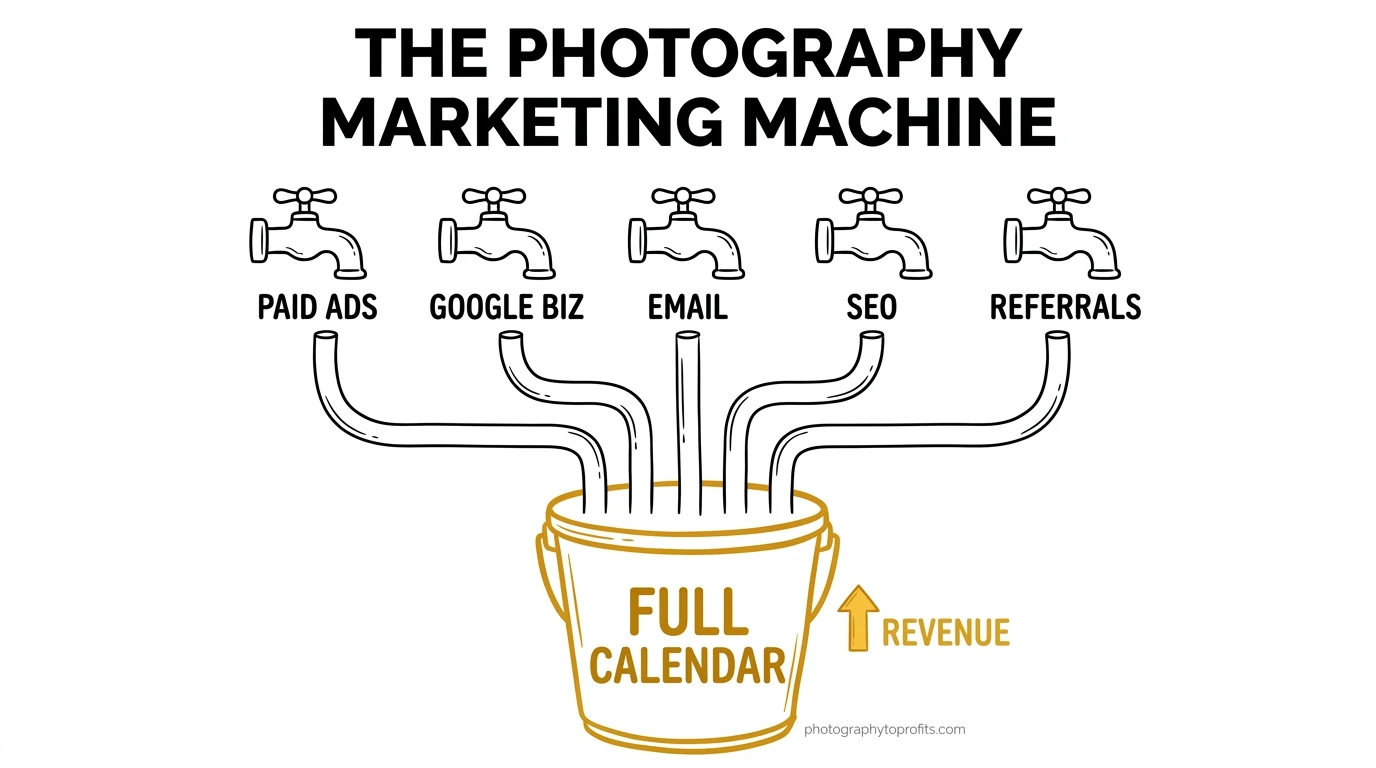
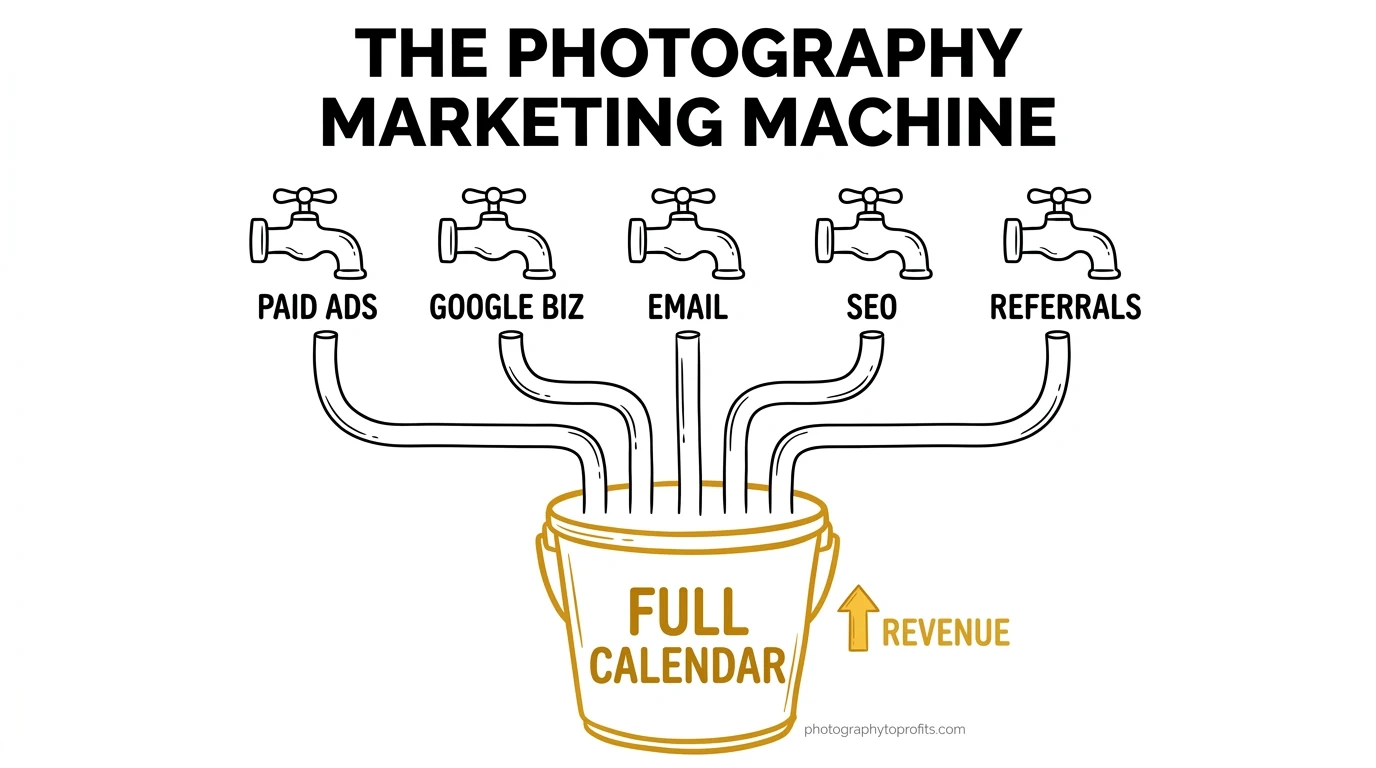
- Studios running 4+ coordinated marketing channels fill their calendars 2× faster than single-channel studios. Instagram alone isn't a marketing strategy in 2026.
- Humberto Garcia, founder of Photography to Profits, uses a 5-stage framework to diagnose exactly which number a studio needs to fix, and which channels solve it.
- Photographers who respond to inquiries within 5 minutes book 6–8× more consultations than those who wait. Speed-to-lead is the most underrated variable in the whole system.
- If your current marketing isn't producing consistent leads, the problem is almost never the channel. It's the system connecting the channels. Get a free marketing audit →
The Only Formula That Matters
Everything in photography marketing comes down to one equation:
Revenue = Leads × Booking Rate × Average Sale
You don't need to do everything. You need to improve each of those three numbers. The compounding isn't additive. It's multiplicative. Which means the weakest number is always the most important one to fix first.
Low leads? Your visibility is the problem. Paid ads, GBP, and prospecting are the fix. Low booking rate? Your follow-up speed and consultation skills are the bottleneck. Low average sale? Your pricing structure and ordering process need work before more leads will help. Adding volume to a leaky bucket doesn't make the bucket fuller. It just makes the leak more expensive.
Dave and Mel went from $93,000 shooting families and sports to almost $500,000 in boudoir, with fewer clients. Not because they found a magic niche. Because they restructured their pricing for high-ticket sales and built an in-person ordering system that closed at those numbers. The genre is almost irrelevant. The average sale is everything.
Why Instagram Alone Isn't Booking Photography Clients in 2026
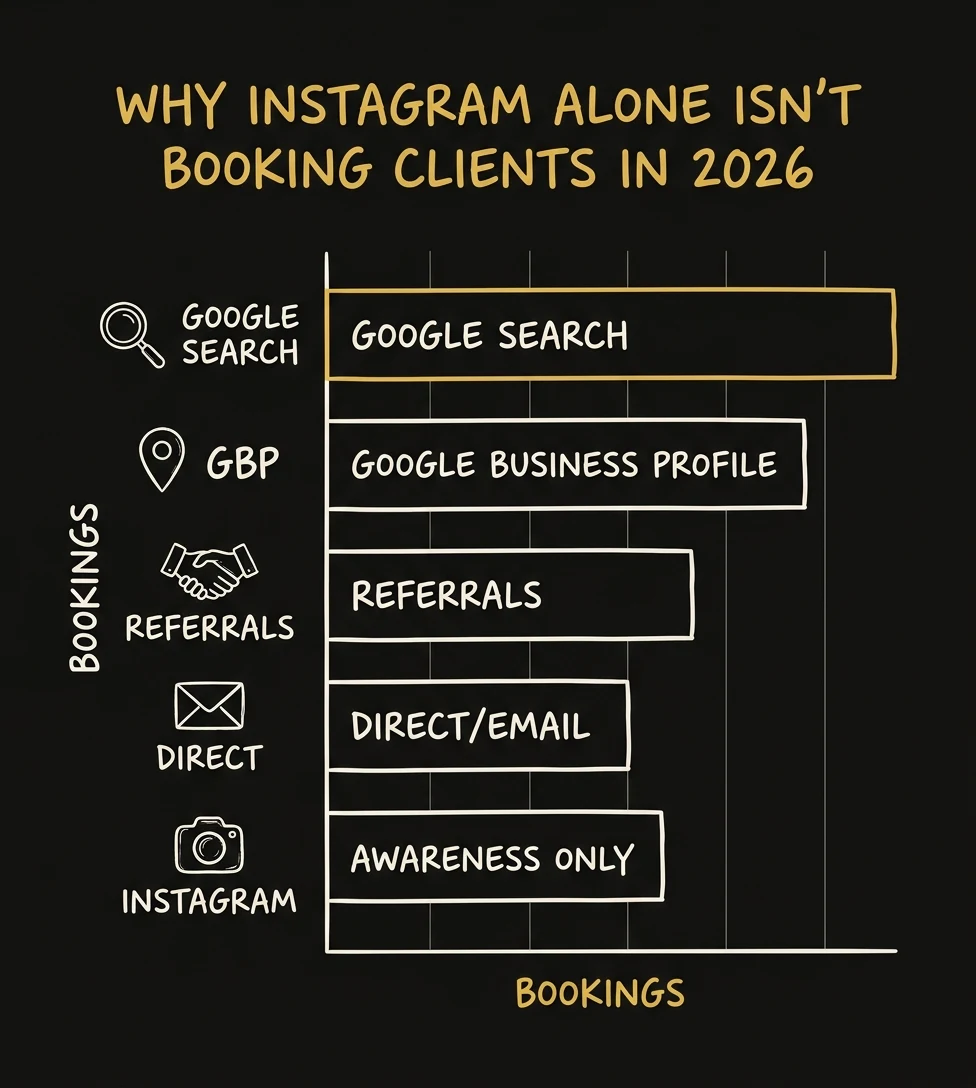
One portrait studio in the Southeast tracked their results over a 60-day window. $700 in ad spend produced 148 leads. During that same period, organic Instagram produced 7. That's more than 20× the lead volume for less than $12/day.
This isn't an argument against Instagram. It's an argument against Instagram as your only strategy. The studios filling their calendars in 2026 are running 4+ coordinated channels and filling calendars 2× faster than single-channel studios. According to the Zenfolio 2025 State of the Photography Industry report, 65% of photographers use social media for marketing, but social media alone rarely produces consistent bookings. When one channel slows, the others carry the load.
Instagram's algorithm in 2026 rewards completion rate and watch time (35% of ranking weight) and saves to collections (25%). That means 60–90 second Reels outperform short clips, and content that stops the scroll matters more than content that chases followers. But even perfectly optimized Instagram content doesn't replace a follow-up system, a conversion-ready website, or a Google Business Profile showing up for "photographer near me" searches.
The photographers who burned out on social media were playing a visibility game without the infrastructure to convert visibility into revenue. Likes don't pay. Bookings do.
If Instagram is your main channel and your calendar isn't full, the fix isn't posting more. It's building the system around it. Get a free marketing audit →
The 5 Stages Every Photography Studio Goes Through
Every photography studio (from a hobbyist charging $300 to a seven-figure operation) passes through the same five stages. Each stage has a different problem, and each problem has a different fix. The most common mistake: applying a Stage 4 solution to a Stage 2 problem.
- Stage 1 (Nobody knows I exist): Visibility problem. Fix: paid ads, GBP, direct prospecting. No amount of conversion optimization helps if no one finds you.
- Stage 2 (People visit but don't inquire): Conversion problem. Fix: quiz lead magnet, website copy, clear offer. Your traffic exists but your site leaks it.
- Stage 3 (I get leads but can't book them): Follow-up and sales problem. Fix: speed-to-lead, the 5×7 follow-up rule, consultation script. You're getting inquiries and losing them.
- Stage 4 (I book clients but don't make enough per session): Backend revenue problem. Fix: pricing restructure, in-person ordering system, collections. Volume is there but revenue per client is too low.
- Stage 5 (I'm maxed out and exhausted): Systems and delegation problem. Fix: automations, hiring, SOPs. You're at capacity but the ceiling is your hours.
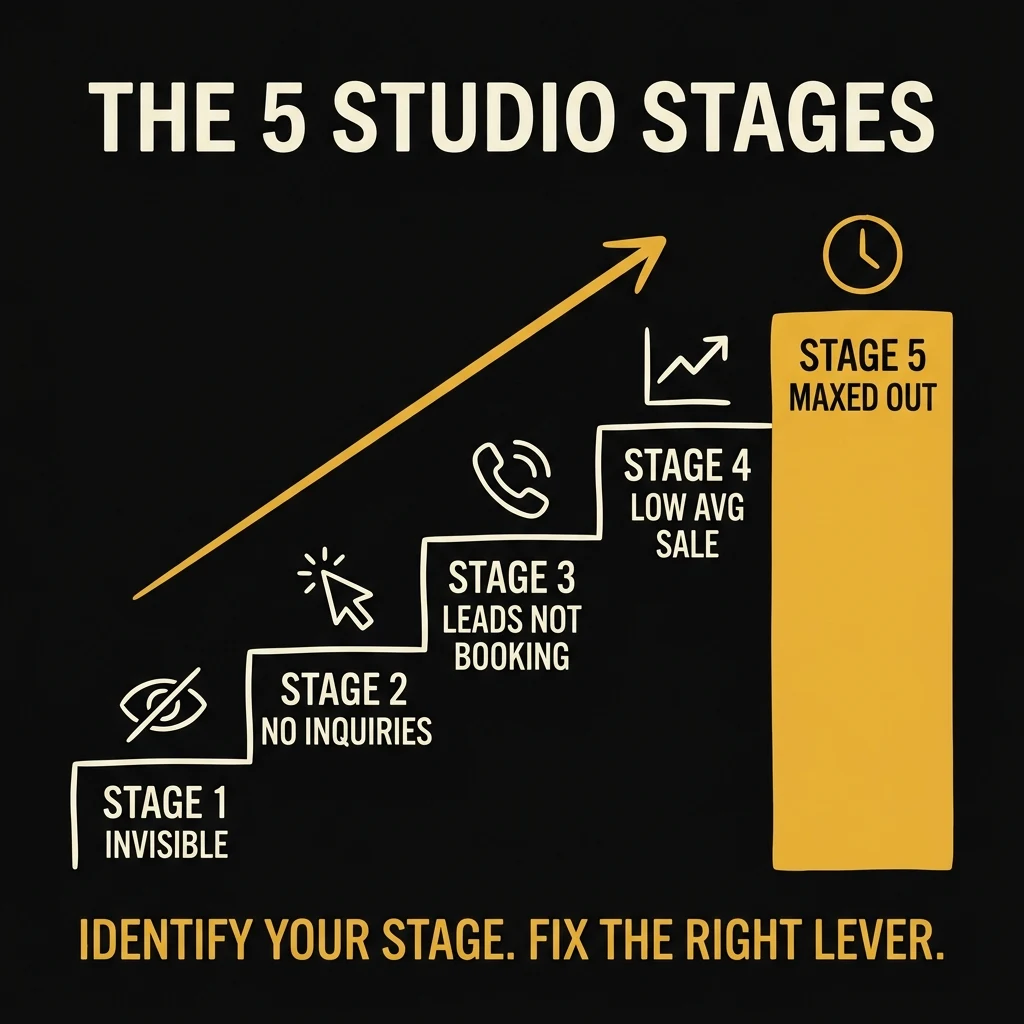
Humberto breaks down the exact fix for each stage in the 7-Figure Studio program, including which marketing channels solve which stage. The framework changes how you look at every marketing decision: instead of asking "should I try TikTok?" you ask "which stage am I in and what does that stage actually need?"
The 5 Marketing Channels That Actually Move the Needle
These aren't the only channels that exist. They're the five that consistently produce results across hundreds of portrait, boudoir, and wedding studios in the P2P network.
Photo: Alexander Polous / Unsplash
1. Paid Advertising (Fastest Path to Leads)
The Proof-to-Paid Loop is the framework behind every successful paid campaign we've run: post proof content organically → watch for buyer signals (saves, DMs, "pricing?" comments) → turn the winners into paid ads → let your follow-up system close. The content that wins organically is almost always your best-performing paid ad. You're not guessing. You're confirming.
Quinn ran one Meta campaign (total spend: $115) and produced over 500 leads. She booked 30 sessions in ten days. Her first seven sessions totaled $29,540. That's not typical. But it shows what happens when the offer is right, the follow-up is fast, and the system is built. For most studios: start with retargeting ($3–5/day to warm audiences), add Google Ads for genre-specific searches ("boudoir photographer near me"), then scale Meta for volume.
See the full breakdown in our guide to paid and organic advertising for photographers.
2. Google Business Profile (Free High-Intent Leads)
GBP is the most underutilized channel in photography marketing. A fully optimized profile ranks for "photographer near me" searches without ad spend, and the leads it generates are high-intent, actively searching for what you offer.
The data: businesses with high-quality images on their GBP receive 42% more direction requests and 35% more click-throughs than those without (Google Business Profile data). Studios that enable messaging see an average of 18 new message leads within 60 days, with a 60% conversion rate. Weekly posting is now a top-tier ranking signal: one post per week minimum, using real session photos with location context.
Three non-negotiables: respond to every review within 24 hours, use the Q&A section to preemptively answer your top objections, and post 2–5 new session photos every week. Studios hitting these benchmarks see 40–60% more profile views within 90 days.
3. The Quiz Inquiry Machine (Converts Traffic You Already Have)
A standard contact form converts under 2% of visitors to inquiries. A well-built quiz converts 3–10%. One studio went from 1 inquiry per week to 9 (same traffic, no new ads) after installing a quiz. By the time someone finishes answering questions about their goals, concerns, and timeline, they've already sold themselves. The form feels like the obvious next step, not a leap of faith.
Quizzes also segment your list automatically (separating wedding from portrait from boudoir intent), so every follow-up sequence that fires is relevant to what they actually want.
4. Email + SMS Follow-Up (Converts the Leads You Already Have)
If you're getting 100 inquiries per month and booking 10, 90 people raised their hand and disappeared. Most didn't book another photographer. Most just needed someone to follow up. Evoke Boudoir, a $500K/year studio, implemented email follow-up and booked 10 sessions in one week from leads already in their system. Some replied saying "I was still interested. Nobody got back to me."
The full email and SMS system (including the 5 sequences, quiz integration, and 70-touch follow-up framework) is covered in our email marketing guide for photographers.
5. SEO + Content (Long-Term Authority)
AI Overviews have absorbed "what is" and "how to" searches, but local searches ("best portrait photographer in [city]"), venue-specific content, and comparison searches still land on real websites. Every real session you shoot is an SEO opportunity: a dedicated page with venue/location tags, session context, and optimized images compounds for years. Studios that publish one location-specific or session-type page per month consistently outrank studios with beautiful portfolios and no text content. For a full breakdown of on-page optimization and local search, read our complete SEO guide for photographers, or have us do it for you.
Speed-to-Lead: The One Variable Most Studios Ignore
Nothing else in this guide is this cheap to fix, and almost nobody fixes it. Photographers who respond to new inquiries within 5 minutes book 6–8× more consultations than those who respond the next day. Not 6–8% more. Six to eight times more.
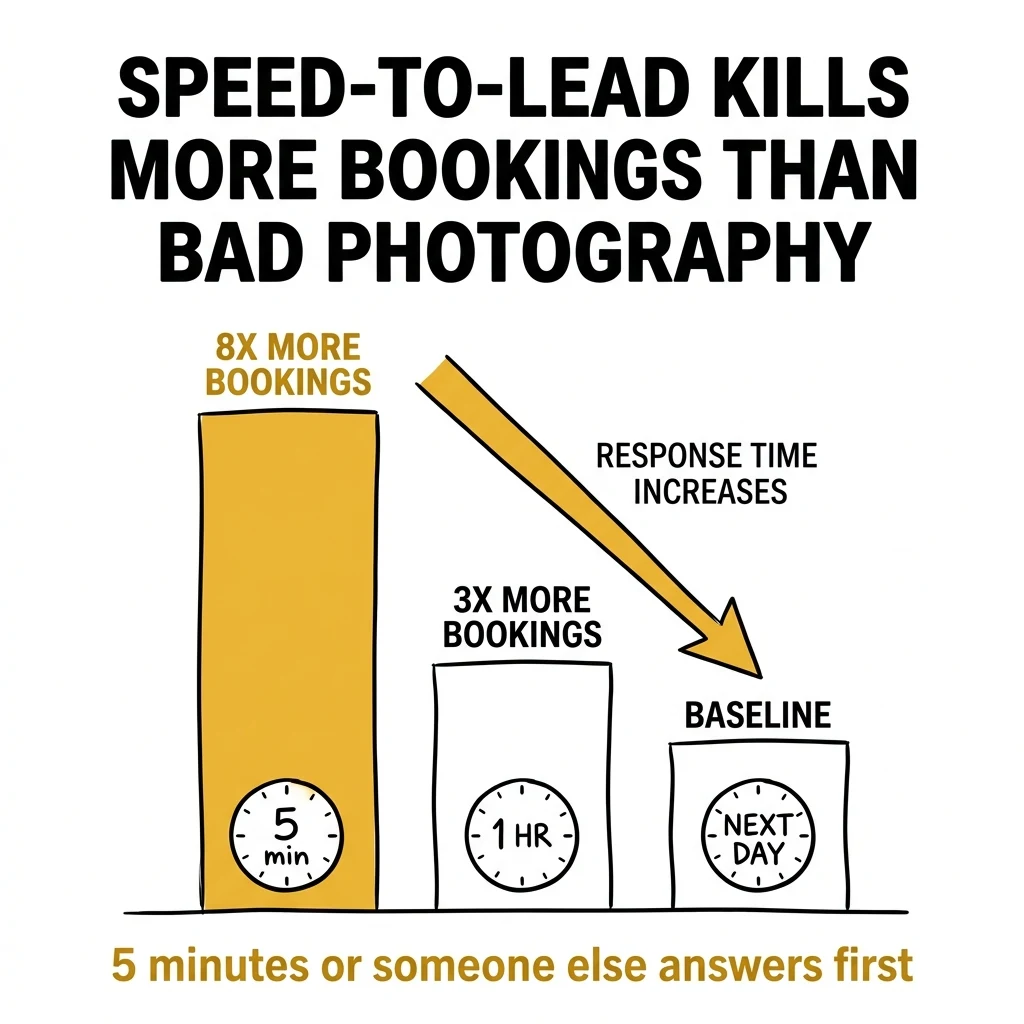
The reason: a person who just filled out your contact form is at peak emotional readiness. They've been thinking about this. They finally did something about it. Every hour that passes, life takes over: the kids need dinner, the boss calls, the partner has opinions. By day three, they've forgotten they inquired. By day five, they've booked someone who answered faster.
Humberto's 5×7 Rule from the 7-Figure Studio methodology: make five contact attempts in seven days before considering a lead dead. Different times of day. Text before calling. A short voicemail followed immediately by a second call (never a second voicemail). Studios that implement this alone routinely double their booking rate without a single new lead.
The studios running this consistently don't rely on memory or willpower. They use automated SMS sent within 60 seconds of inquiry, followed by a personal call. The text warms the number. The call converts it. See how this connects to the follow-up system that stops losing leads to silence.
The High-Ticket vs. Volume Decision
Two very different paths to $300K/year:
| Model | Sessions/Year | Avg Sale | Revenue |
|---|---|---|---|
| Volume Studio | 300 | $1,000 | $300,000 |
| High-Ticket Studio | 100 | $3,000 | $300,000 |
| Premium Studio | 60 | $5,000 | $300,000 |
Photo: Vitaly Gariev / Unsplash
The same revenue, but radically different businesses. The volume studio is exhausted. The premium studio has breathing room, margin, and the time to deliver an experience that earns referrals.
The single most powerful lever for average sale isn't raising your prices. It's the in-person ordering appointment (IPS). Most photographers deliver a digital gallery and hope clients order. The photographers consistently hitting $3,000–$8,000 average sales sit with clients, guide them through their images, and present wall art collections in a structured reveal. The emotion in that room does the selling. Humberto calls this "the most profitable hour in your business." It's covered in depth inside the 7-Figure Studio program.
If your average sale is below $2,000, your pricing structure, not your photography, is the bottleneck. Get a free strategy call →
The Compound Machine: How All 5 Channels Connect
Here's what the full system looks like when it's running:
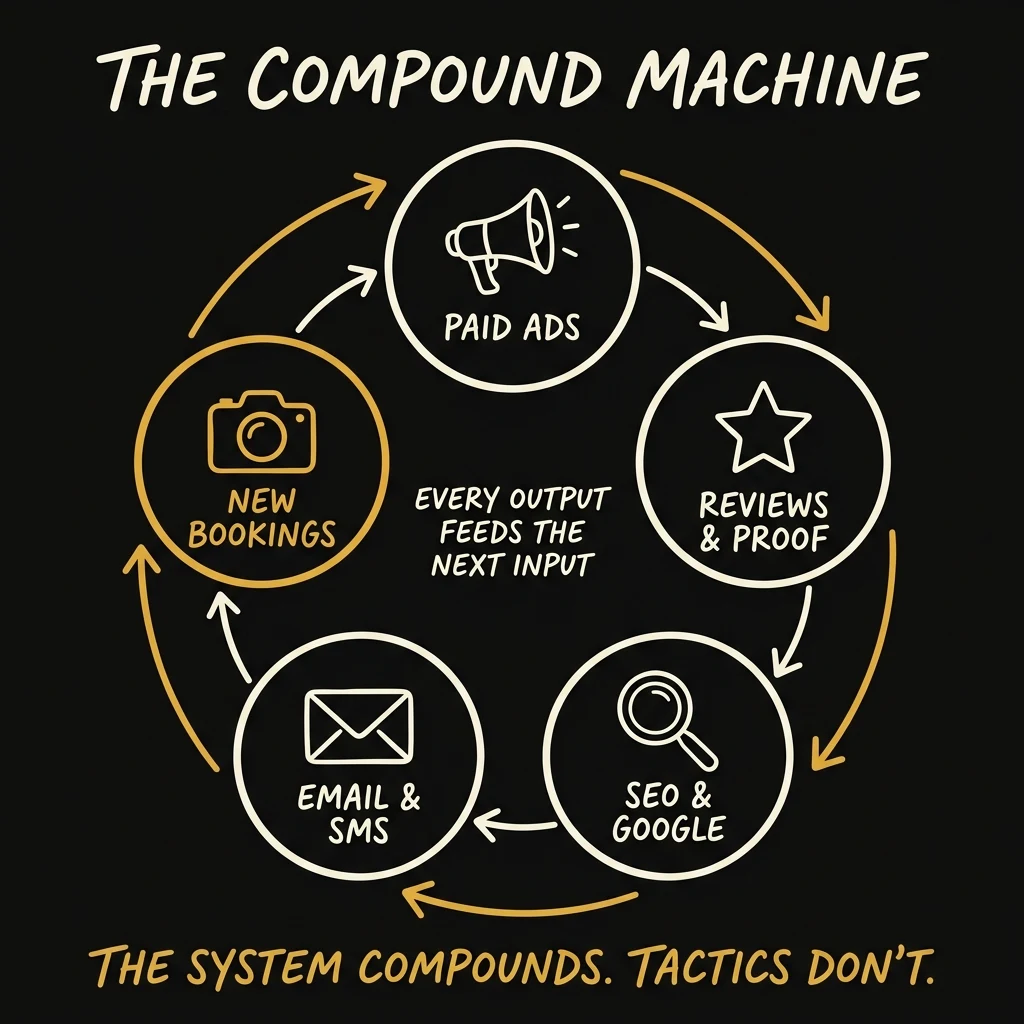
Prospecting and paid ads bring in new leads and build your proof assets (portfolio, reviews, testimonials). That proof goes on your website. Your website converts more traffic. The quiz captures the leads your website doesn't convert directly. Those leads enter an automated follow-up system: texts, emails, calls within five minutes. Booking rate climbs. Clients go through an in-person ordering appointment with structured collections. Average sale goes up. Those clients leave reviews and tell their friends. Your GBP ranking climbs. SEO compounds. Organic reach grows.
Now you add paid ads on top of that foundation. Meta creates demand. Google captures it. Both channels feed a website that converts, a quiz that captures, and a follow-up system that never lets a lead go cold. For the full Meta side of this equation, see our Facebook Ads for photographers guide. Every output becomes the next input.
Caroline Winata built a boudoir studio to $1.3 million in a single year, with MS, with a full team she built around her limitations. "Don't talk to me, talk to Kayla. She runs everything. I just work here." Same system. Different ceiling. The machine runs whether you're in the room or not.
The 30-Day Plan for Photographers Who Want to Start Now
Photo: Brad Neathery / Unsplash
- Week 1 (Get your phone ringing): Optimize GBP (upload 20+ session photos, write Q&A, enable messaging and booking link). Run a reactivation text to any unbooked leads in your phone. If you have budget, launch retargeting at $3–5/day to website visitors.
- Week 2 (Connect the systems): Install the quiz on your website. Set up your CRM pipeline stages. Write your first automated follow-up sequence: text fires within 60 seconds of inquiry, email fires within 5 minutes, call follows immediately after.
- Week 3 (Start the list): Write and schedule your first 4 weekly emails (value first: a client story, a tip, a behind-the-scenes moment). Run a reactivation campaign to cold leads from the last 90 days.
- Week 4 (Launch a campaign): One offer, one genre, one dedicated landing page. Run it through the full system: ad → quiz → follow-up → consultation → ordering appointment. Track your four numbers: cost per lead, cost per booking, average sale, ROI.
Want to skip the 30-day build and have us set it up for you? See how done-for-you works →
What the Best Studios Actually Do Differently
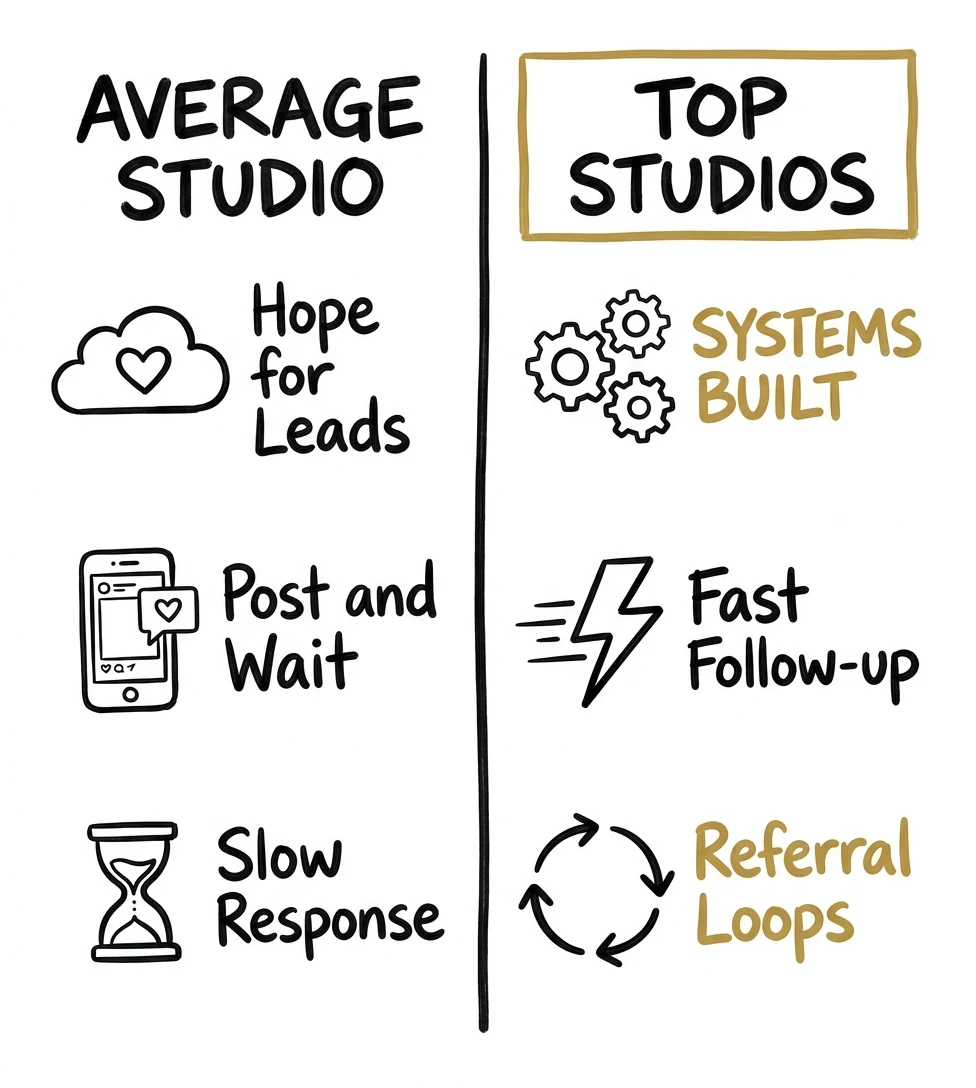
The photographers who succeed long-term aren't the most talented, and they don't have the best gear or the biggest city. They're the ones who kept showing up.
The studio that wins is the one that answers the inquiry within five minutes. That follows up every single lead five times in seven days. That sends the weekly email. That practices the consultation until it's second nature. Not some secret tactic. The fundamentals, done right, done consistently, done long enough that the compound effect takes over.
Astrid's first big sale was $2,000. Not because the number was huge, but because it proved someone loved her work enough to invest in it. "So I just have to start believing." She built the system piece by piece. The confidence grew with the revenue. A $2,000 sale gave her the courage to raise her prices. That gave her the confidence to invest in ads. Ads brought enough bookings to justify a commercial lease. The system started feeding itself. That's what the compound effect looks like from the inside.
For the full multi-channel breakdown (referrals, partnerships, word of mouth), see our guide to building a photography referral machine.
Conclusion: The Photography Marketing System That Actually Works in 2026
Photography marketing in 2026 is not about finding the right platform. It's about building a system where every channel feeds the next one: leads become proof, proof fuels ads, ads generate leads, leads enter follow-up, follow-up produces bookings, bookings produce referrals, referrals reduce your cost per lead. The machine compounds.
Photography to Profits, founded by Humberto Garcia, has built this system with hundreds of portrait, boudoir, and wedding studios across every market and price point. The formula doesn't change: Leads × Booking Rate × Average Sale. What changes is which number needs work, and which channel solves it.
Find your stage. Fix the right number. Build the machine one channel at a time. The studios that do this (even slowly, even imperfectly) consistently outperform the ones chasing tactics on social media. Consistency compounds. Tactics don't.
Using AI tools to run your photography business operations? See how we do it end-to-end in our guide: Claude Code for Photography Studios: The Complete AI Tools Guide.
Frequently Asked Questions
How long before I see results from photography marketing?
Paid ads: 2–4 weeks for initial data, 60–90 days to optimize for consistent ROI. GBP: 60–90 days for meaningful ranking improvement. Email: immediate impact on existing leads, 3–6 months to build a list that converts consistently. SEO: 4–12 months. The studios that quit at month 3 never see the compounding returns from channels that take time to build.
How do I know which marketing channel to prioritize?
Look at your three revenue numbers. Low leads = fix visibility first (paid ads, GBP, prospecting). Low booking rate = fix speed-to-lead and your consultation process. Low average sale = fix your pricing structure and add an in-person ordering appointment. Applying the right solution to the right number is more important than any specific channel.
Should I hire a photography marketing agency?
Only after your offer is proven and your follow-up system is built. An agency running ads to a funnel that leaks leads is an expensive lesson. Build the machine first, prove it converts with your own effort, then hire to scale what's already working.
How many marketing channels should a photography studio use?
Start with one and do it well, then add. The compound machine has five channels, but trying to run all five simultaneously with limited time and budget produces mediocre results everywhere. Most studios start with GBP (free) + email (low cost), then add paid ads when the follow-up system is ready to handle the volume. Studios using 4+ channels fill calendars 2× faster, but that's the destination, not the starting point.
Is Instagram still worth it for photographers in 2026?
Yes, but not as your primary lead source. Instagram is a proof and trust channel. It builds awareness, warms audiences for retargeting, and generates referrals from past clients who share your work. Studios that treat it as their main booking channel consistently underperform studios that use it as one layer of a multi-channel system. Post consistently, use Reels (60–90 seconds outperform shorter clips in 2026), and funnel Instagram traffic to your quiz or website for conversion.
What's the single highest-ROI marketing activity for a photography studio?
For studios with existing leads: improve speed-to-lead. Responding within 5 minutes instead of the next day produces 6–8× more booked consultations from the same leads. For studios starting from zero: Google Business Profile optimization generates free high-intent leads within 60–90 days with no ongoing ad spend. For studios with a booking system already working: the in-person ordering appointment (IPS). It's the most direct path to doubling average sale without a single new lead.