
Most photographers running ads are paying to stay invisible. The ad is live, the budget is draining, and the phone isn't ringing, not because ads don't work for photographers, but because most studios skip the foundation that makes ads compound over time.
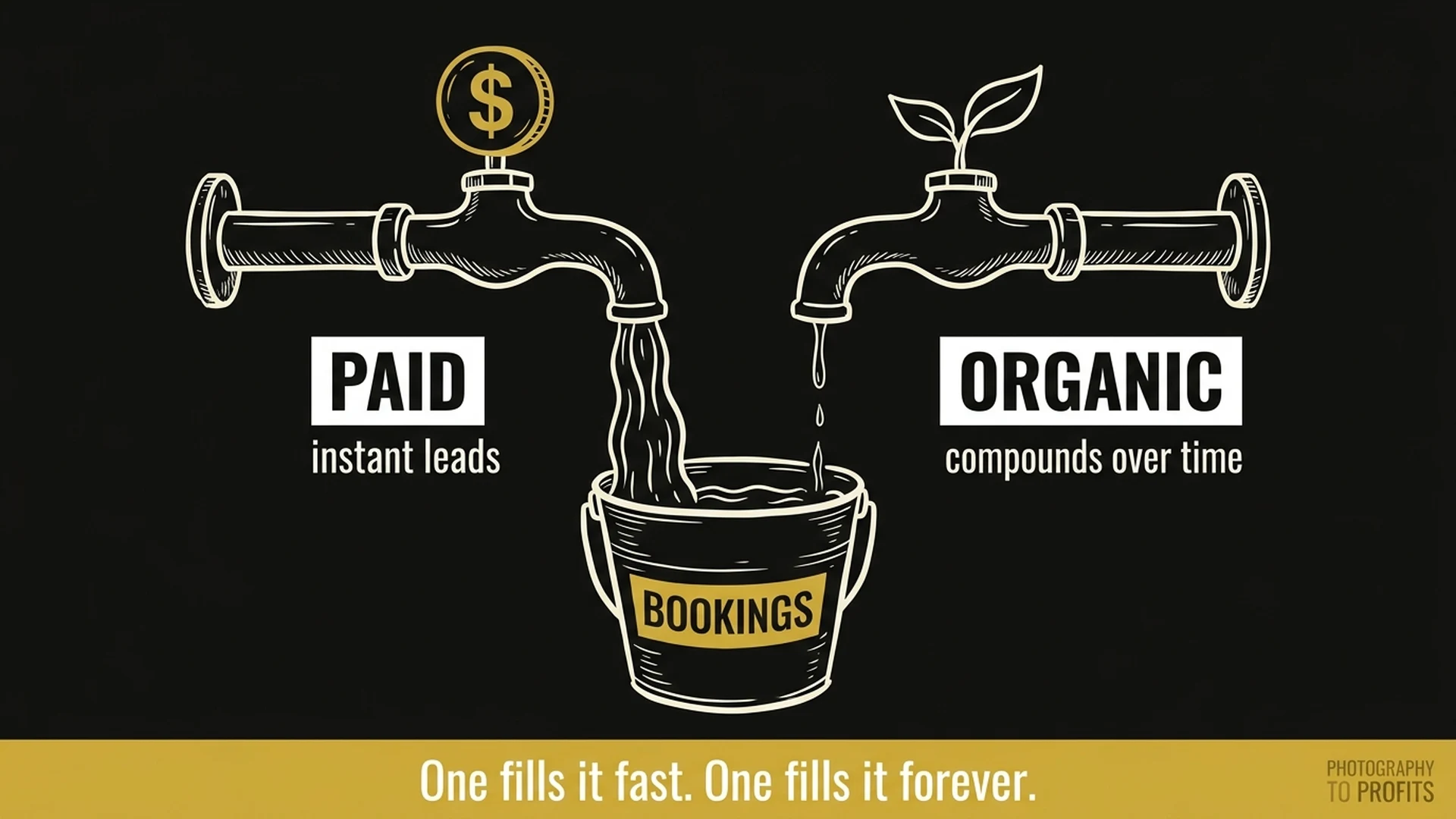
The photographers generating consistent bookings from advertising aren't spending more. They're using a smarter mix: paid channels that capture active demand, and organic strategies that build the proof base those ads run on. Together, they create a system that gets cheaper and more effective every month, not more expensive.
In this guide, you'll learn the paid advertising methods that actually move the needle for portrait and specialty photographers, the free organic strategies that build long-term authority, and how to connect both into a compounding machine. We cover the four numbers that tell you whether your advertising is working, and the exact launch sequence for photographers starting from zero.
Key Takeaways
- Advertising photography works when built in sequence: retargeting first, Google Ads second, Meta cold prospecting third. Studios that skip ahead burn budget without bookings to show for it.
- Photography to Profits studios consistently generate 20–50× ROAS when the full system (offer, creative, follow-up, and in-person sales) is in place. Humberto Garcia, founder of Photography to Profits, has helped hundreds of portrait, boudoir, and wedding studios reach this benchmark.
- The four numbers that matter: CPL ($5–$100), booking rate (10–40%), AOV ($3,000–$4,000+), and ROAS (20–50×). A $50 CPL is not expensive if the downstream math works.
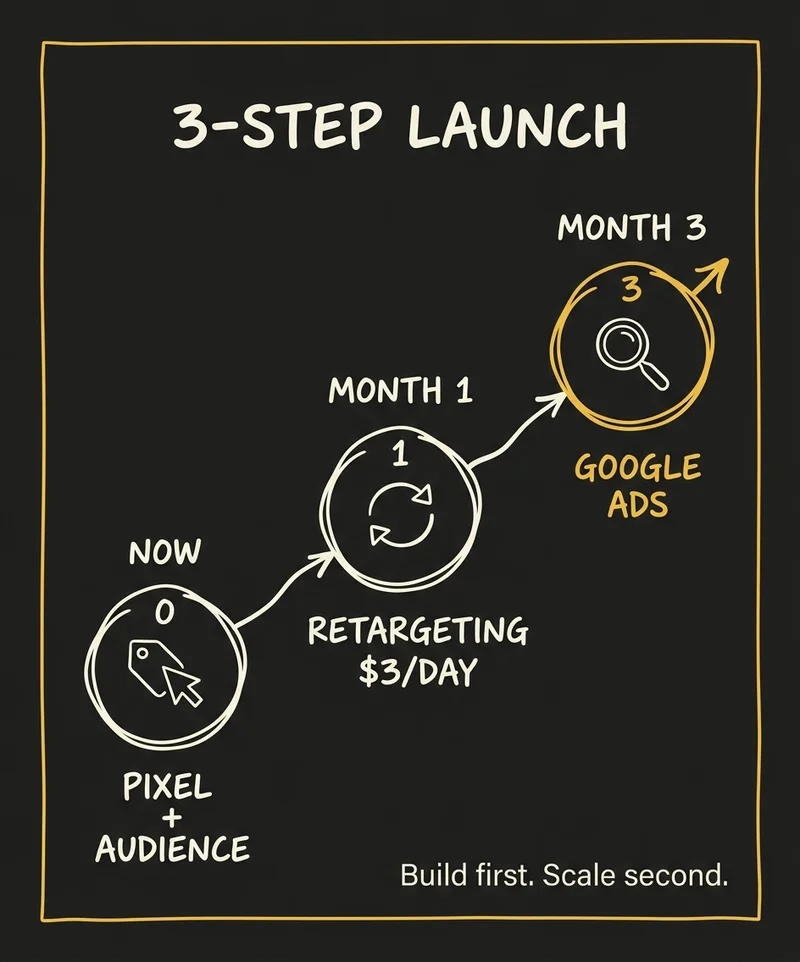
- The fastest path: install tracking pixels today, launch retargeting in 30 days, add Google Ads when retargeting is profitable, layer in Meta cold prospecting last.
Paid Advertising for Photographers
Paid advertising for photographers means paying platforms (Google, Meta, or others) to put your work in front of people who are either actively searching for a photographer or likely to need one. Done right, paid ads generate bookings predictably. Done wrong, they burn budget without a single inquiry.
Photo: Vitaly Gariev / Unsplash
Here's the sequence that works. Don't skip ahead to Level 3 before you've built Levels 1 and 2.
Level 1: Retargeting. Start Here, Not at the End
Retargeting shows ads to people who already know you exist: website visitors, video viewers, email subscribers, Instagram engagers. These are warm audiences. They've seen your work. They're not browsing; they're considering.
Warm traffic converts 3–10× better than cold traffic. A retargeting campaign costs $1–$5/day, takes an afternoon to set up, and runs forever in the background. Every new visitor to your website automatically joins your retargeting audience, so the campaign gets more powerful every week without changing a thing.
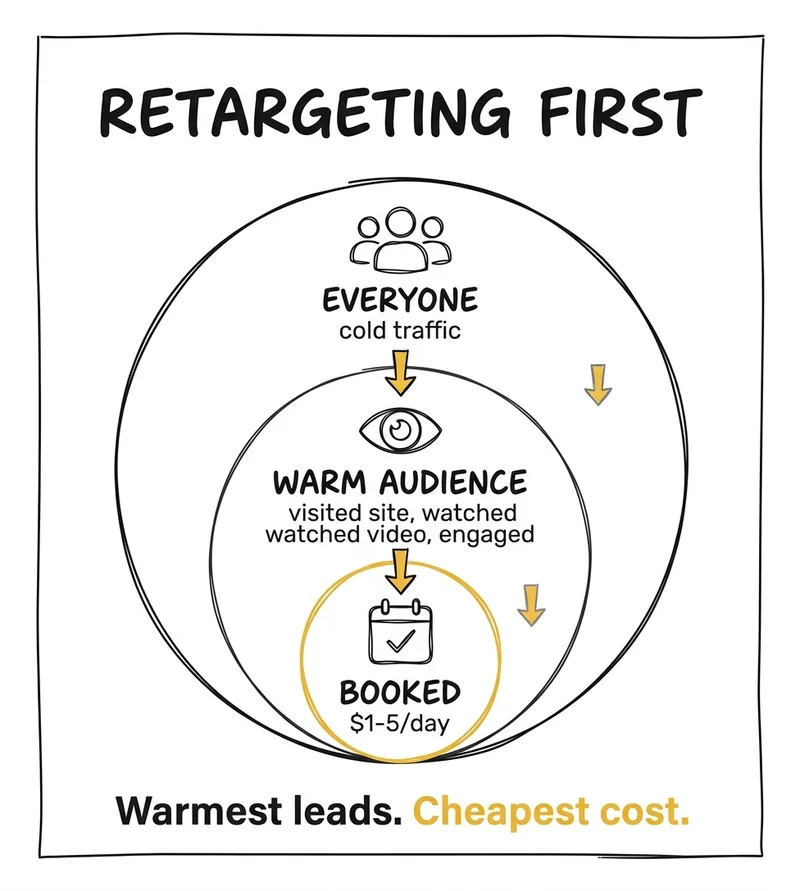
Build retargeting audiences from: 90-day website visitors, people who watched 50%+ of your videos, Instagram and Facebook page engagers, quiz starters who didn't finish, and your email list uploaded as a custom audience. Run one testimonial ad and one behind-the-scenes clip. That's the entire retargeting setup.
Level 2: Google Ads. Capture Active Demand
Google fulfills demand that already exists. When someone types "newborn photographer near me" or "boudoir photographer in Austin," they aren't browsing. They're buying. Google ads for photographers put your studio in front of that intent at exactly the right moment.
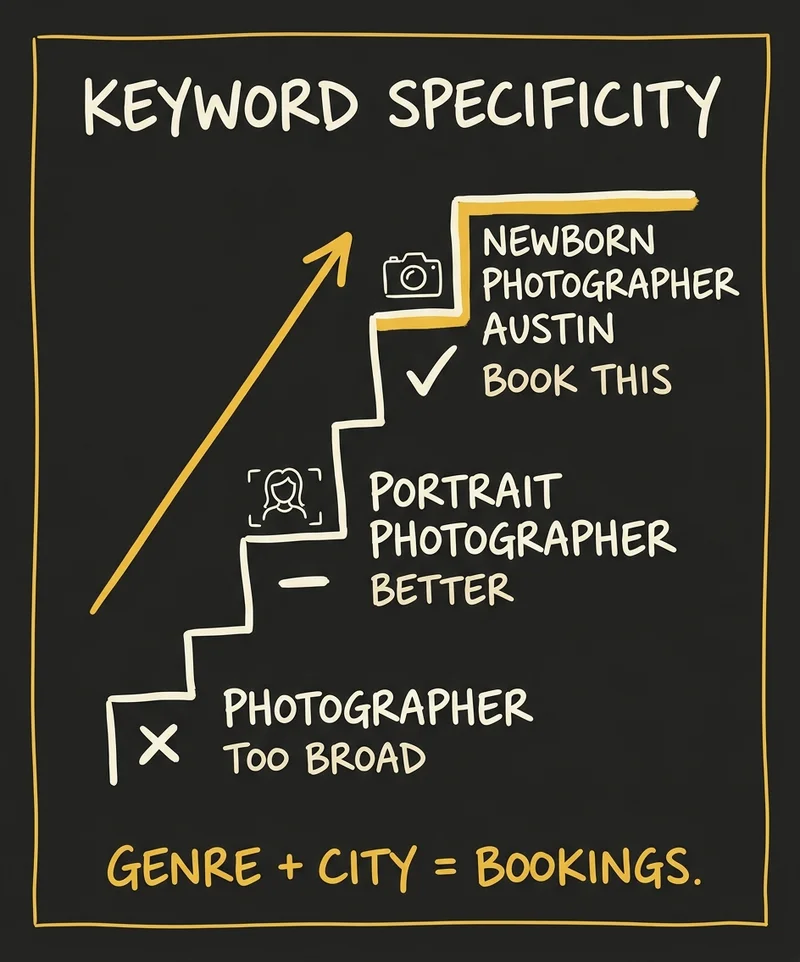
The most common mistake: bidding on "photographer near me" instead of genre-specific terms. A newborn photographer should bid on "newborn photographer [city]," not generic terms that attract browsers from every genre. Specificity drops cost per click and filters out people who'll never book.
Budget minimum: $800/month in most mid-size markets. Below that, the algorithm can't collect enough data to optimize. Leads typically run $40–$120 depending on market and genre, more expensive than Meta on average, but higher intent. The person searching is already looking; you just have to show up.
Level 3: Meta and Facebook Ads. Volume at Scale
Meta ads (Facebook and Instagram) target people by behavior, interest, and life stage, not search intent. You're reaching people who fit your ideal client profile before they've started searching. This is demand creation, not demand capture.
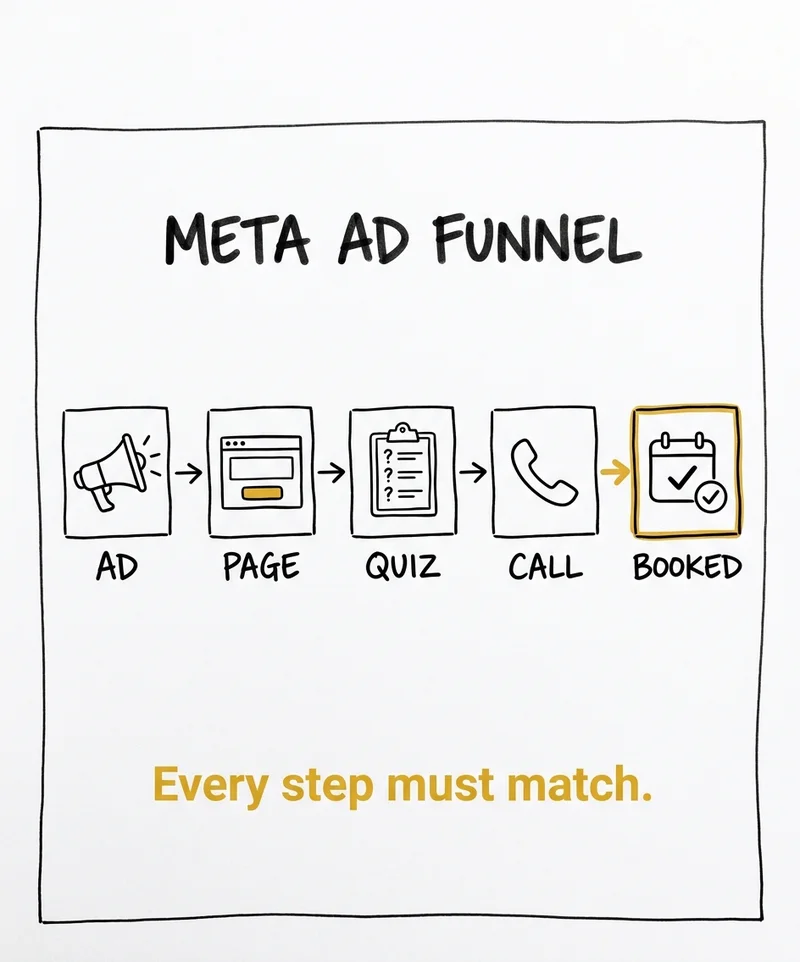
The formula: one irresistible offer (not "book a session" but something specific like "Waiving the session fee for the first 5 moms who apply") → dedicated landing page that matches the ad exactly → quiz or short form → automated follow-up sequence → phone consultation. Every step must use the same language, images, and offer. One mismatch kills the conversion.
For Meta ads for photographers, creative is 80% of the equation. The image or video you use matters more than your targeting, your budget, or your copy. The highest-performing photography ads in our network have zero text overlays: just the portfolio image and a one-sentence caption that speaks to an outcome, not a feature. "For the moms who are always behind the camera" outperforms "Now booking fall minis" every time.
What a Good Photography Ad Looks Like
Ad failure is almost always a creative problem, not a budget problem. Before adjusting your targeting or increasing spend, look at the ad itself.
Photo: Vitaly Gariev / Unsplash
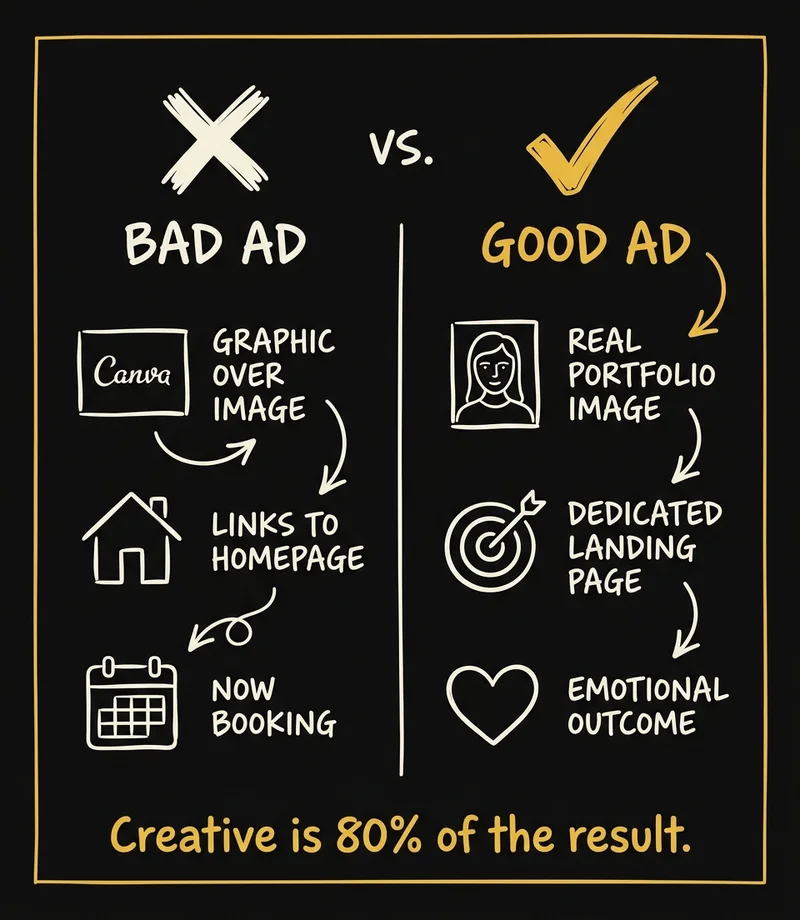
The ad that burns money:
"Fall Minis Now Booking: $200 for 20 minutes. Message to book!" → Links to a homepage listing 14 genres.
Why it fails: "Studio is open" isn't a hook. No emotional outcome. Paid traffic sent to a general homepage converts at under 1%. You're paying for attention and immediately wasting it.
The ad that books sessions:
"For the moms who are always behind the camera... When was the last time you were actually IN a photo with your kids? Not a selfie. A real, beautiful moment. We're waiving the session fee for the first 5 moms who apply." → Dedicated landing page that matches the ad exactly.
Why it works: specific audience, emotional hook, specific offer, and congruency from ad to landing page to phone script. Congruency is everything. If the ad says "40 Over 40", the landing page, images, thank-you page, and phone script all say "40 Over 40." One mismatch and the conversion dies.
Five signs your photography ad creative is working against you:
- You're using a Canva graphic instead of an actual portfolio image
- Your headline describes the session, not the outcome
- The ad links to your homepage instead of a dedicated landing page
- You have text covering more than 20% of the image
- There's no specific offer, just "book now"
Free and Organic Advertising for Photographers
Organic advertising for photographers doesn't mean slow or ineffective. It means building distribution that doesn't require a daily ad spend to maintain. The studios with the lowest cost-per-booking in our network combine paid ads with a strong organic base, because organic proof content is what makes paid ads perform.
Photo: freestocks / Unsplash
Google Business Profile: The Highest-ROI Free Channel
If you're not actively managing your Google Business Profile, you're leaving the single most powerful free advertising channel completely untapped. When someone searches "portrait photographer near me" on Google Maps, the top three results (the Local Pack) capture 44% of all clicks, before any paid ads, before any websites.
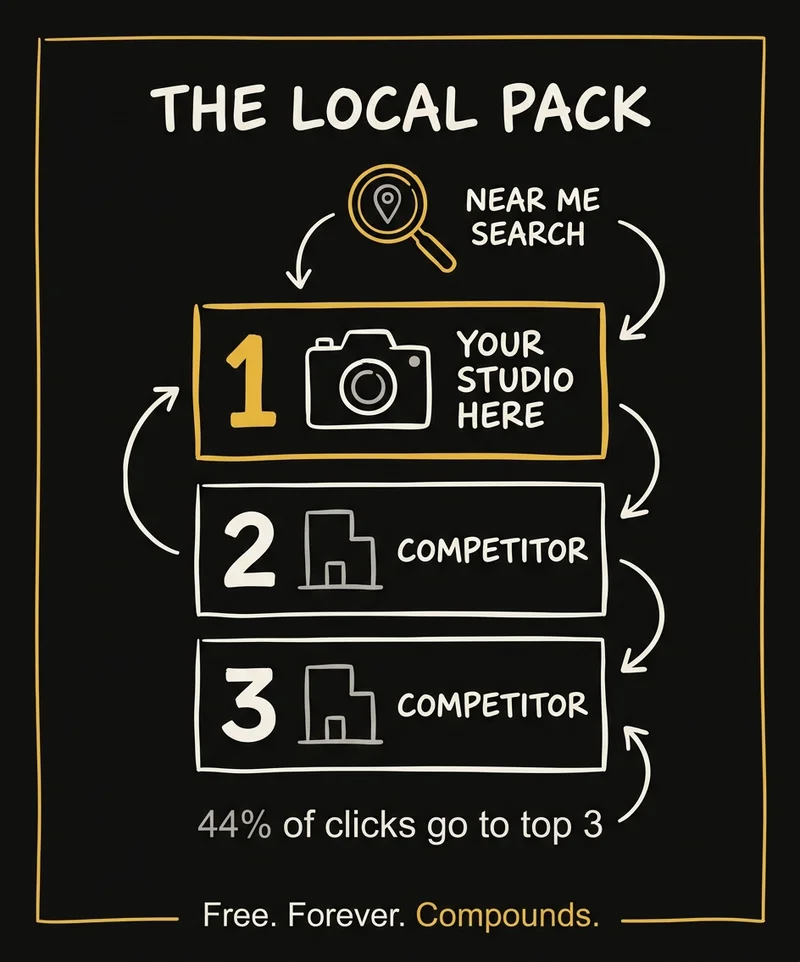
Ranking in the Local Pack requires: a fully completed GBP with your actual studio address or service area, weekly photo posts (portfolio images, behind-the-scenes), regular new reviews (5-star responses and a system for asking), and consistent NAP information (name, address, phone) across every directory. Studios that work their GBP consistently see it drive 20–40% of their total inquiries, for free, every month.
Social Proof Content: Your Organic Ad Creative
Every piece of proof content you post organically serves two purposes: it builds authority with your existing audience, and it pre-qualifies your ad creative. The posts that get saves, shares, and "where are you located?" comments are your next ads. You're not guessing at what will work. Your audience is telling you.
Humberto calls this the Compound Ad Stack, where organic proof builds the creative library that paid ads distribute. The exact sequencing framework is inside the Photography Client Machine program.
The full Compound Ad Stack framework and complete Photography Client Machine system is available with Humberto directly. Book a strategy call →
What performs organically and converts as ad creative: before-and-after reveals (not just the final image but the transformation moment), client reaction clips (genuine emotion, not staged), "how we do it differently" explanations, and objection-killers ("you don't need to be a model" for boudoir, "we work with all family sizes" for portrait). These content types work in both organic feeds and paid distribution.
SEO: Long-Game Authority That Compounds
Search engine optimization puts your website in front of photographers searching for a studio at every stage of the buying process, from "family portrait ideas" (early stage) to "family photographer in Denver prices" (ready to book). Unlike paid ads, SEO traffic doesn't stop when the budget runs out.
For local photography studios, SEO priority order: (1) your Google Business Profile ranks before your website, (2) a dedicated landing page per genre and city ("boudoir photographer in [city]"), (3) blog content targeting informational searches that warm up cold audiences. Our full guide at SEO for photographers covers the technical side. The organic win here is positioning your studio as the authoritative answer before anyone knows they need a photographer.
Referral Systems: The Cheapest Lead You'll Ever Get
A referred client books faster, haggles less, and refers others. Referrals are the only lead source with a compounding return: each one can generate 2–3 more. Most photographers leave this channel completely to chance. The studios with a consistent referral engine actively trigger it: a referral card in every order, a gift voucher system, and a follow-up email 30 days post-session asking for one name.
The math: if 20% of your clients refer one person, and your average sale is $2,400, a referral from every fifth client adds $24,000/year at zero ad cost. Implement a system. Don't hope for organic referrals.
The Proof-to-Paid Loop: Connecting Organic and Paid
The photographers compounding the fastest aren't choosing between paid and organic. They're using organic content as the R&D lab for paid ads, and paid ads to amplify what organic already proved works.
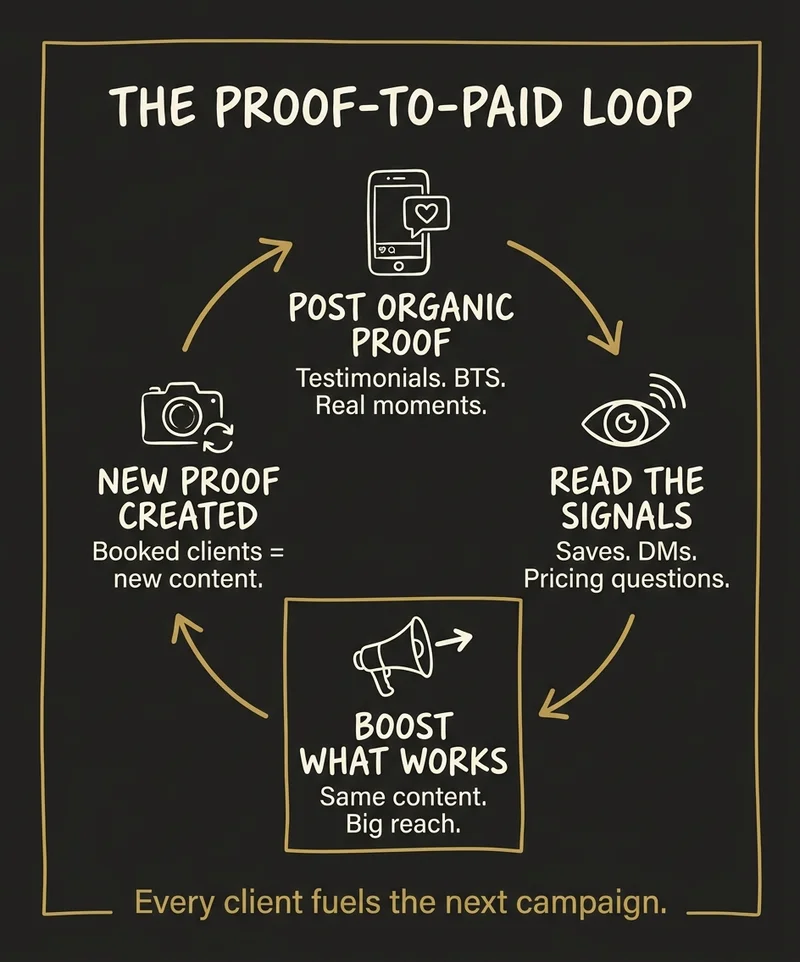
- Post proof content organically. Testimonials, behind-the-scenes clips, client reveals, objection-killers.
- Read the signal. Watch for saves, DMs, and comments like "pricing?" These tell you what resonates.
- Turn winners into ads. Same video, same vibe, minimal overlay. The creative is already proven.
- Machine books the client. Quiz → automated follow-up → phone consultation → ordering appointment.
- Every new client creates new proof content. Which feeds step one again.
Casey ran this loop consistently at $1,000/month in ad spend. Her first full year with the system: over $330,000 in gross sales. The loop compounds because the retargeting audience grows with every new visitor, the proof library expands with every new client, and the ad creative improves because you're always running what's already proven to stop the scroll.
The Four Numbers That Tell You If Advertising Is Working
Most photographers judge their ads by cost per lead alone. That's like judging a business by revenue with no reference to profit. The real metric is return on ad spend, which requires tracking four numbers together.
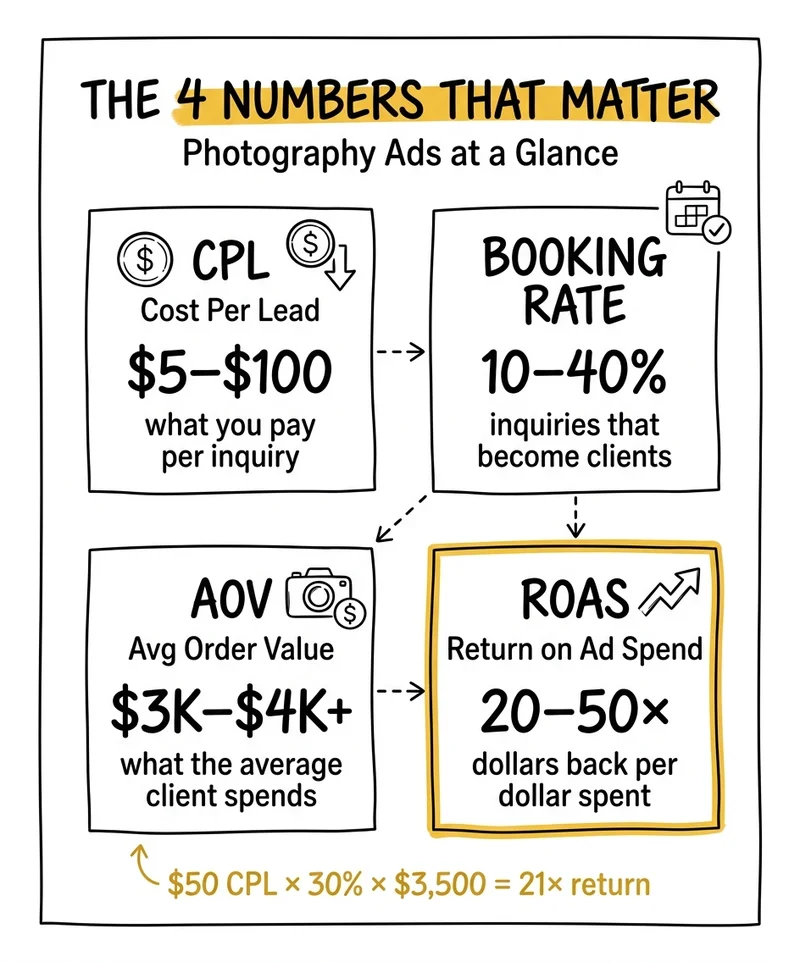
- Cost Per Lead (CPL), what you pay per inquiry: Think of this as your cost to get one person to raise their hand. A strong offer can bring this as low as $5–$20. A premium service with a niche audience might run $50–$100. Neither number is good or bad on its own. It only matters in relation to what those leads are worth.
- Booking Rate, what percentage of leads actually book: If 100 people fill out your form and 30 schedule a consultation and show, your booking rate is 30%. Studios with a solid phone process and fast follow-up typically hit 30–50%. Without a system, most studios see 10–15%, which turns a profitable campaign into a money pit.
- Average Order Value (AOV), what the average booked client spends: For our top studios, this runs $3,000–$4,000+ per session when in-person sales are done right. AOV is where the real leverage lives: doubling your average sale is often easier than halving your CPL.
- Return on Ad Spend (ROAS), how many dollars you get back per dollar spent: If you spend $1,000 on ads and generate $20,000 in sales, that's a 20× ROAS. Well-run photography ad systems with strong offers, fast follow-up, and in-person sales routinely hit 20–50× ROAS. A 4× ROAS is a floor, not a goal.
The math: $50 CPL × 40% booking rate × $3,500 AOV = $1,400 revenue per lead on $50 spent. That's 28× ROAS. A $50 CPL sounds expensive until you run the full equation, and realize the problem was never the ad cost.
Photo: Stephen Dawson / Unsplash
If your ROAS is below 20×, the issue is almost never the ad. It's usually the booking process or offer. Let's audit your setup →
When Photography Ads Stop Working
Three causes. None of them mean "ads don't work for photographers."
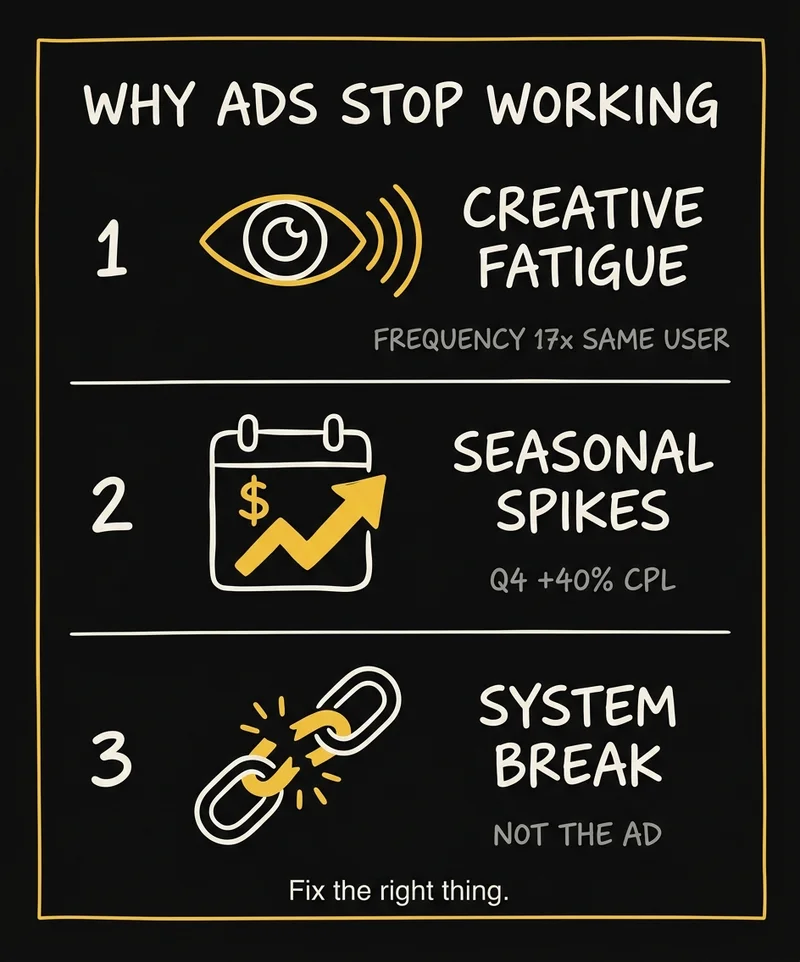
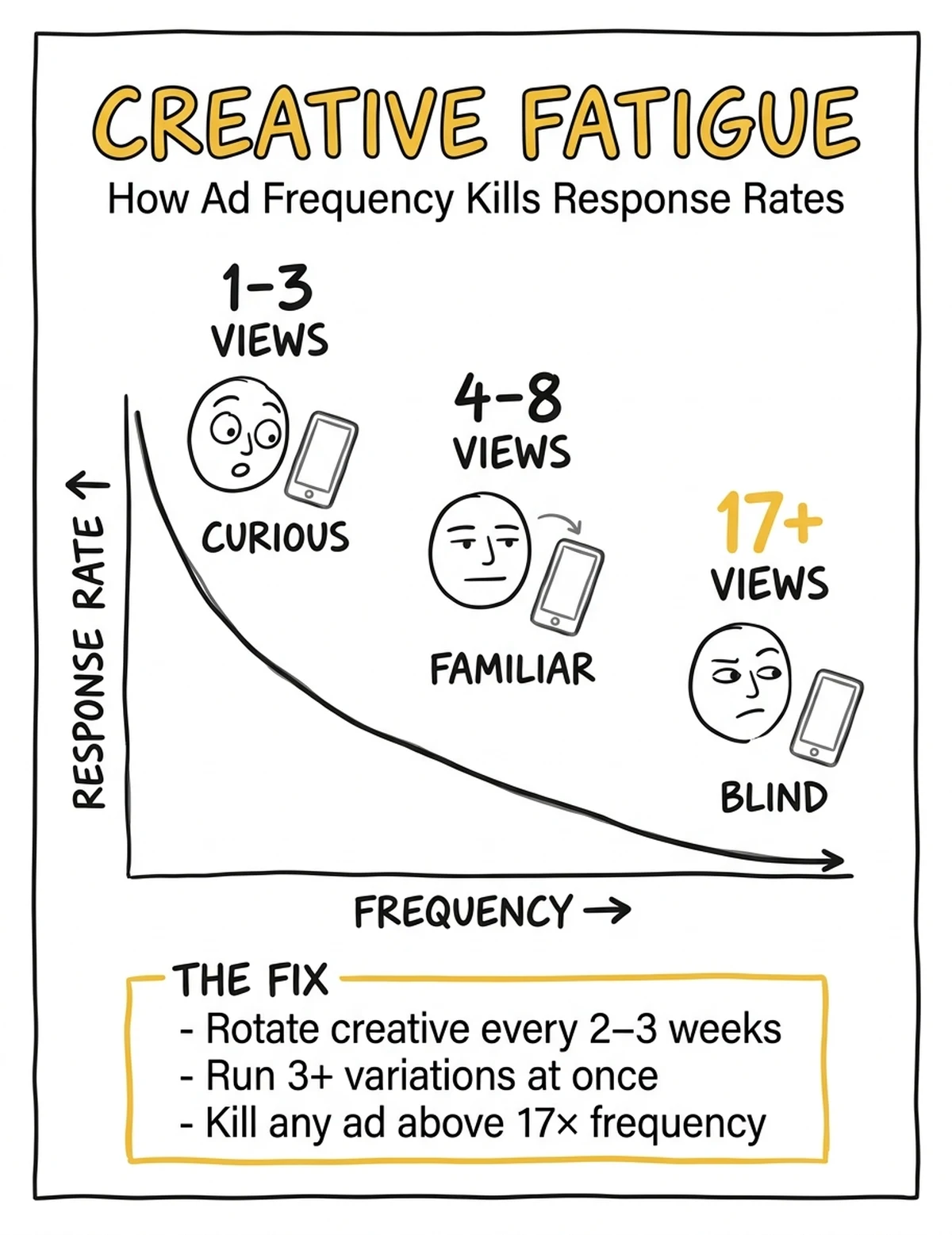
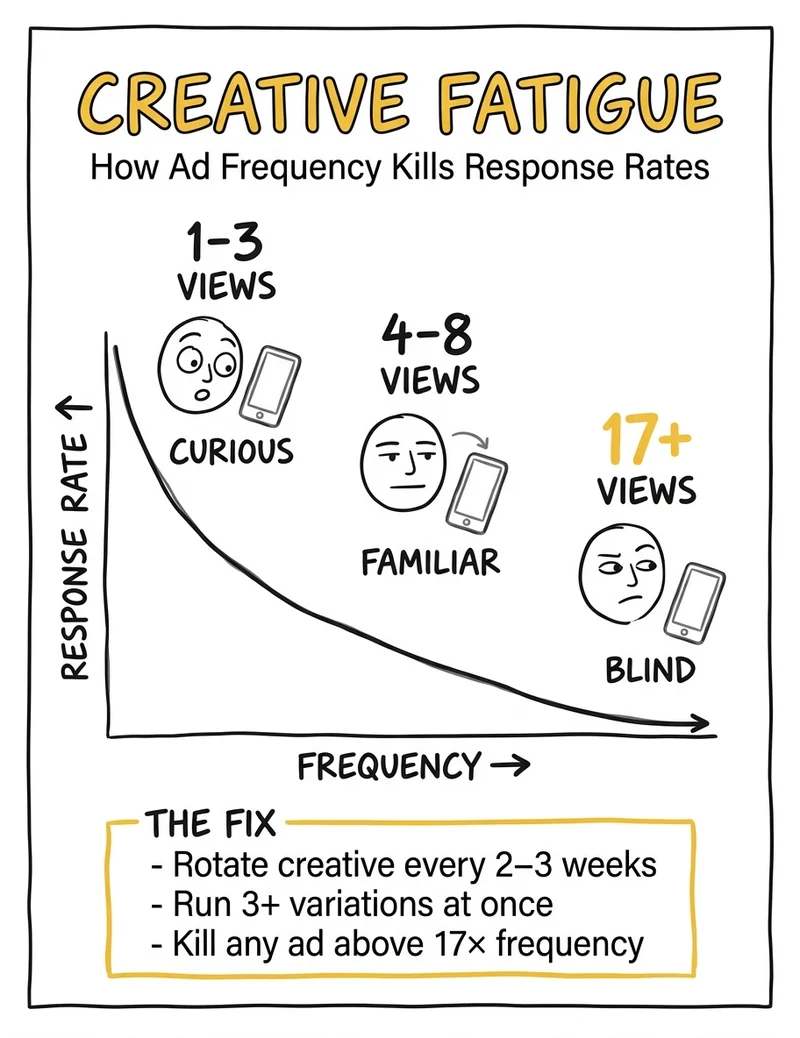
Creative fatigue: Your audience has seen the same image or video too many times. Click-through rate drops, CPL rises. Creative fatigue is a frequency problem, not an impressions problem. When the same user sees your ad 17+ times, click-through rate collapses and CPL spikes, not because the ad ran too long in total, but because it ran too many times to the same person. Watch your frequency score in Meta Ads Manager and Google's reach reports. Rotate creative when frequency hits 15, before it degrades. You don't need new sessions. Repurpose existing portfolio images into new formats (carousel vs. single image, different caption framing).
Seasonal CPL spikes: Q4 (October–December) and February drive up ad costs across all platforms. Plan for 20–40% higher CPL during peak seasons. Offset with stronger organic retargeting during high-cost periods and save your budget tests for January and August when competition drops.
System breakdown: The ad is performing but leads aren't converting. This is almost always a follow-up or phone script problem, not an ad problem. If CPL is holding steady but booking rate dropped, audit the steps after the lead arrives: response time, follow-up sequence, consultation format.
Your Photography Advertising Launch Checklist
Most photographers either skip steps or try to start at Level 3. Here's the order that actually works. Start here even if you think you're past it.
- Install tracking pixels before spending a dollar. Put the Meta pixel and Google tag on your website today. Wait 30 days until you have at least 300 website visitors in your retargeting audience. That first warm audience is your most valuable. Don't waste budget advertising to cold traffic before it exists.
- Launch retargeting first. One testimonial ad. One behind-the-scenes clip. Budget: $3–$5/day. Let it run 30 days without touching it. Warm audiences convert 3–10× better than cold traffic and give you the lowest CPL you'll ever see.
- Add Google search when retargeting is working. Genre-specific search terms only: "newborn photographer [city]," not "photographer near me." One dedicated landing page per genre. Minimum budget: $800/month. Don't add cold Meta prospecting until Google is profitable for 60 consecutive days.
- Layer in Meta cold prospecting last. Only after Steps 1–3 are producing consistent bookings. Budget: $1,500+/month. Use organic content that already performed: top reels, testimonials that got comments, posts that got saves. Don't create new creative from scratch.
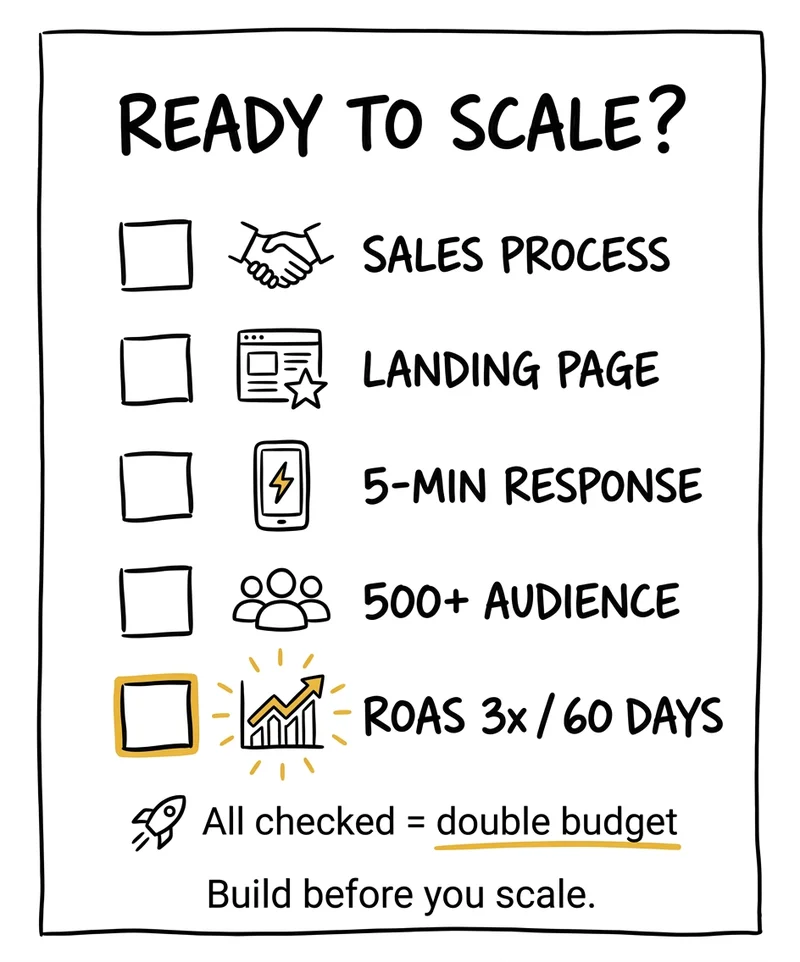
- Scale only when the booking process is dialed in. Before increasing budget, confirm: leads are responded to within 5 minutes, your landing page has 3+ real testimonials, and you have a clear sales path (consultation → ordering appointment → delivery). More ad spend into a broken booking process accelerates losses, not bookings.
The studios that build this in order have a compounding, self-funding ad machine by month 6. The ones that jump to Step 4 first are still testing audiences 12 months later.
Conclusion: The System That Compounds
Advertising for photographers works when the system is built in order: retargeting first, Google search second, Meta cold prospecting third. Studios that skip ahead to Meta cold traffic burn budget. Studios that build the foundation consistently generate 20–50× ROAS within 90 days.
The four numbers (CPL, booking rate, AOV, and ROAS) tell the full story. A $50 CPL paired with a 40% booking rate and $3,500 average sale produces a 28× return. Judging ads by CPL alone is why most photographers think advertising doesn't work for them when it actually does.
Photography to Profits, founded by Humberto Garcia, has helped hundreds of portrait, boudoir, and wedding studios build this compounding advertising machine. The studios that follow the sequence (pixels, retargeting, Google, then Meta cold) have self-funding ad systems by month 6. The ones that skip ahead are still testing audiences a year later.
The next step: install your tracking pixels today, launch retargeting in 30 days, and don't touch cold traffic until the foundation is profitable. Or have the P2P team build it for you.