
Key Takeaways
- The StoryBrand framework works for photographers because it shifts your website messaging from "look at my work" to "here is how I solve your problem," and that single shift increases inquiries without changing a single image on your site.
- Humberto Garcia, founder of Photography to Profits, teaches photographers to apply the StoryBrand 7-part framework to their studio websites so that every headline, button, and call-to-action speaks directly to the photographer's ideal client and drives them to book.
- Studios that rewrite their homepage using StoryBrand principles (positioning the client as the hero and the photographer as the guide) typically see a 20–40% increase in contact form submissions within 60 days of the rewrite.
- The most dangerous mistake on a photography website is leading with "I," as in "I am a photographer," "I specialize in," or "I have been shooting for 15 years." Every sentence that starts with "I" is one more reason for a potential client to click away.
- Rewrite your website homepage headline today: replace any sentence that starts with "I" or "We" with a sentence that describes the transformation your client will experience after working with you.

Your website is stunning. Your portfolio stops scrolls. Your editing is clean and consistent. And you are still not getting enough inquiries.
Here is what is actually happening: potential clients land on your homepage, see beautiful images of strangers, and leave. Not because your work is bad, but because your words never told them this was for them. Your website looked like a gallery. It needed to work like a salesperson.
The StoryBrand framework, developed by Donald Miller in his book Building a StoryBrand, is the fix most photographers never think to try. It is a messaging system built on one idea: your client is the hero of their own story, not you. The moment you internalize that, everything about how you write changes. Your headlines get clearer. Your calls-to-action get sharper. Your inquiries go up.
This guide covers how to apply all 7 elements of the StoryBrand framework to a photography website, with real before-and-after copy examples for each one, a breakdown of the single most common mistake photographers make (playing the hero when you should be the guide), and the specific copy formula we use at Photography to Profits to help studios rewrite their websites and book more clients without spending more on ads.
Listen to the podcast episode:
Table of Contents
- What is the StoryBrand Framework?
- The #1 Mistake: Playing the Hero When You Should Be the Guide
- The 7 StoryBrand Elements Applied to Photography Websites
- Before & After: Real Photography Website Copy Rewrites
- Applying StoryBrand Beyond the Homepage
- The P2P Messaging Formula: The "3 AM Scroll" Test
- Addressing Client Objections and Building Trust
- Emotional Engagement and Showcasing Transformations
- Common Photography Website Mistakes That Kill Conversions
- Conclusion
What is the StoryBrand Framework?
Donald Miller's StoryBrand framework is a marketing methodology that uses storytelling to clarify your message and engage customers. It structures your communication around a seven-part narrative formula (the same structure every great movie follows) that positions your client as the hero and your brand as the guide who helps them overcome challenges and achieve their goals.
The insight behind it is simple but counterintuitive: human beings are not wired to care about your story. They are wired to care about their own. When your website talks about you (your awards, your style, your passion for photography), the brain of a potential client quietly turns off. When your website talks about them (their fears, their desires, the transformation they want), they lean in.
Most photography websites fail not because of bad design or weak images. They fail because the words are about the wrong character. You are narrating your own story when you should be inviting them into theirs.
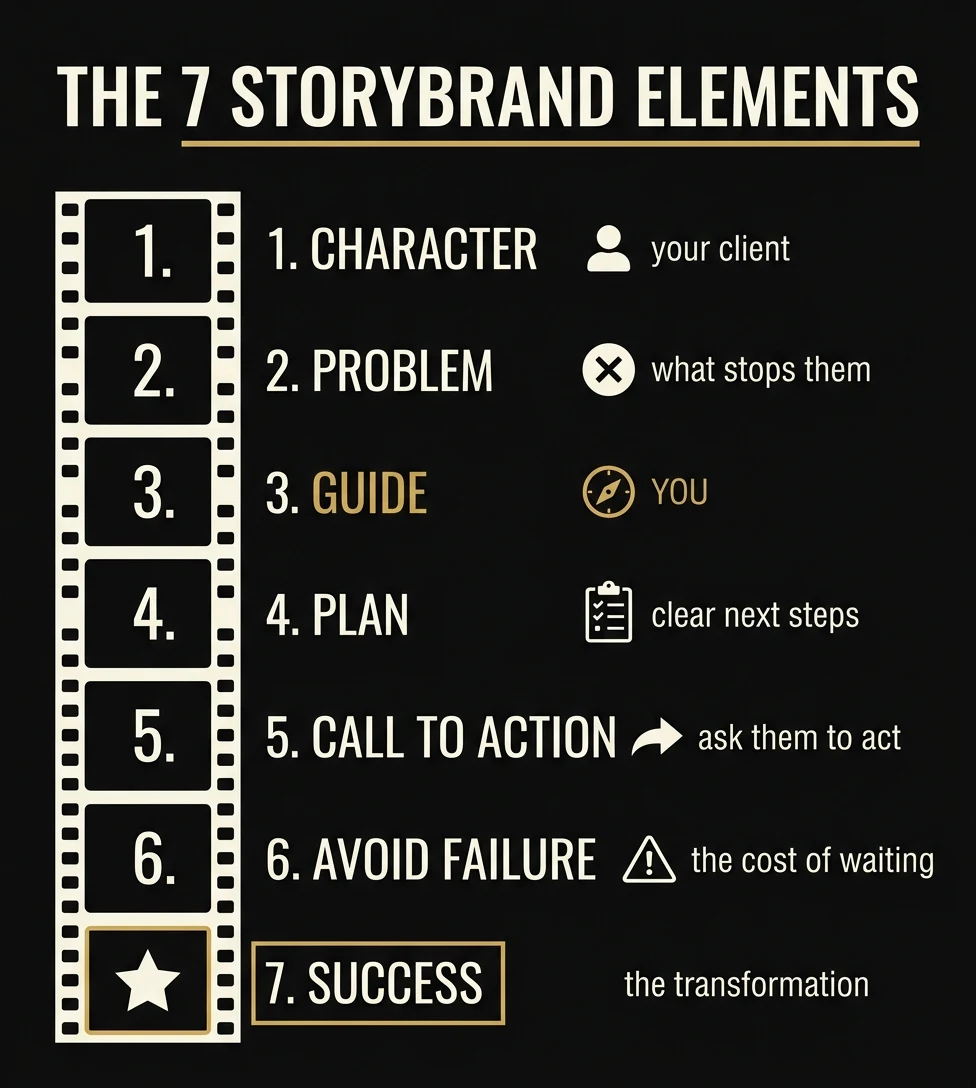
The SB7 Framework: Overview
- A Character: Your client is the hero seeking something they desire.
- Has a Problem: They face internal, external, and philosophical challenges.
- Meets a Guide: You, the photographer, act as the experienced guide.
- Who Gives Them a Plan: You provide a clear, simple path to get what they want.
- And Calls Them to Action: You ask them to take a specific, decisive next step.
- That Helps Them Avoid Failure: You help them sidestep the outcome they fear.
- And Ends in Success: Together, you achieve a transformative, positive result.
Every element matters. Most photographers accidentally apply one or two and wonder why the rest of the website still is not converting. Below we will go through all seven, with photography-specific examples and before/after copy for each.
The #1 Mistake: Playing the Hero When You Should Be the Guide
Open your website right now. Read your homepage headline. Does it start with "I" or "We"?
"I am a portrait photographer in Chicago."
"We specialize in boudoir and maternity."
"I have been photographing families for over a decade."
Every one of those sentences puts you in the spotlight. And that is the exact opposite of what works.
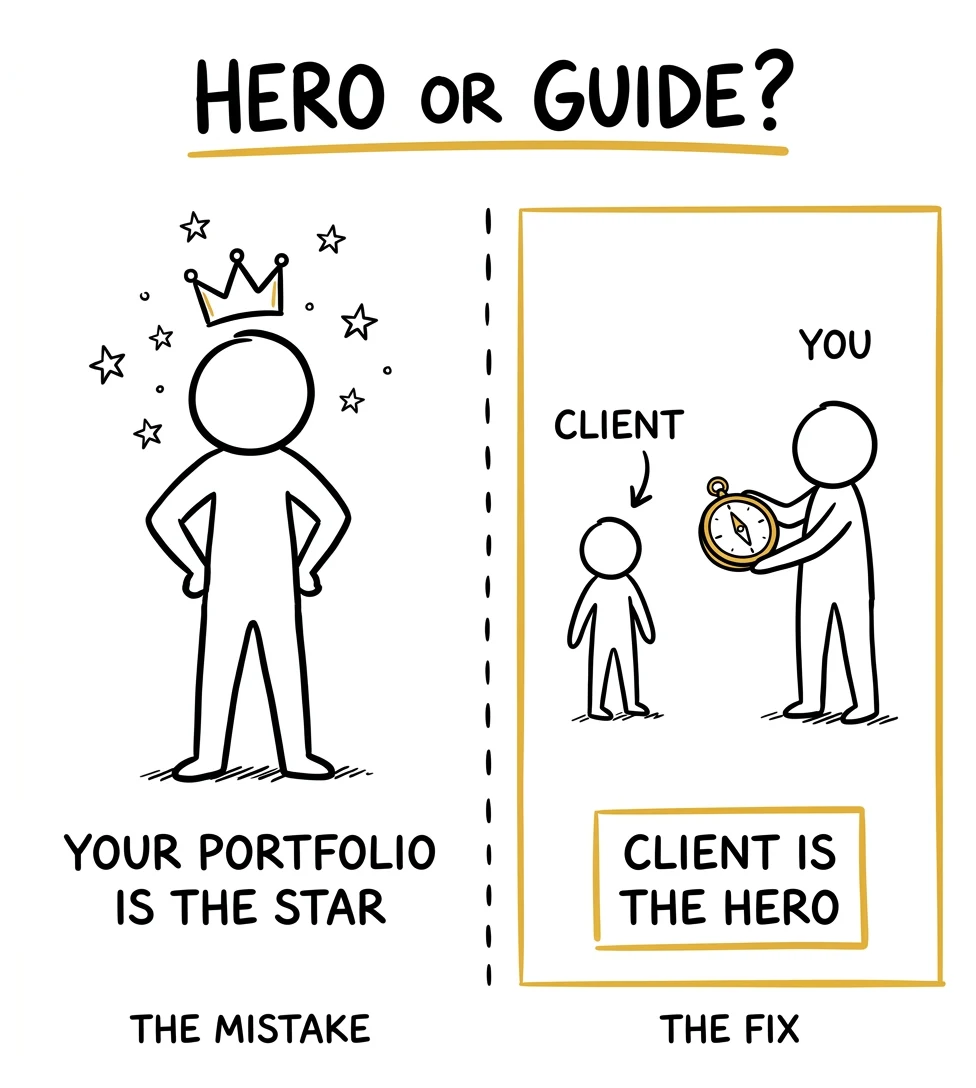
In every great story (every movie, every novel, every campaign that ever converted), the hero is the customer. The guide is the one who has been through it before, knows the path, and shows the hero how to get there. Think Gandalf and Frodo. Yoda and Luke. The mentor who has already won the battle and is now helping someone else win theirs.
Your role in your client's story is Gandalf. Not Frodo. The moment you write your homepage like you are the main character, you have already lost the visitor. They came to their own story. They will not stay for yours.
The photographer-as-hero mistake in the wild:
"Hi! I'm Sarah, and I am so passionate about photography. I have been capturing love stories for eight years, and I believe every family deserves beautiful images that last forever. I would love to be a part of your story!"
That is the about page from roughly 90% of photography websites. It is warm, genuine, and completely ineffective as marketing copy. Sarah is the hero of that paragraph. The visitor, who was looking for a reason to book, closed the tab.
The guide rewrite:
"Most families have a hard time getting everyone to cooperate for photos. Between the reluctant husband, the fidgety toddler, and the teenager who would rather be anywhere else, it feels like a setup for stress. Our sessions are built for real families, not perfect ones. We do the wrangling so you can just show up and enjoy it."
Same photographer. Same service. Different character at the center of the story. The visitor's brain reads that second version and thinks: this is for me.
Want a free audit of your homepage headline? We review your current copy and rewrite it using the StoryBrand guide framework. No pitch, just feedback.
Book a Strategy Call →The 7 StoryBrand Elements Applied to Photography Websites
Let us go through every element with photography-specific examples. For each one, you will see the mistake most photographers make and the corrected version that actually converts.

Element 1: A Character. Define Who Your Hero Is
The character is your ideal client. Not every person with a camera budget. The specific human being who is lying awake at night thinking about this. The more precisely you define them, the more powerfully your copy lands.

StoryBrand version: "For moms who want to stop being the one behind the camera and finally be in the photos with their kids."
The second version makes a mom of two feel like you wrote that sentence just for her. She is not a demographic. She is the hero. Name her. See her. Write for her.

For wedding photographers: "For couples who want their day to feel candid, not choreographed, and do not want to spend the whole reception posing."
For newborn photographers: "For first-time parents who Googled 'how do those pretzel newborn poses even work' at 2 AM and need to know their baby will be safe."
Element 2: Has a Problem. Name the Real Fear
StoryBrand breaks problems into three levels: external, internal, and philosophical. Most photographers only address the external problem. The internal problem is what actually makes someone book.
External problem (the surface-level thing): "I need professional photos."
Internal problem (what they are actually feeling): "I am afraid I will spend all this money and not like how I look in the photos."
Philosophical problem (the bigger stakes): "Every mother deserves to be in the memories, not just the one holding the camera."
Mistake version: "Tired of blurry iPhone photos? Book a professional portrait session today."
StoryBrand version: "You have 4,000 photos of your kids on your phone. You are in almost none of them. Let's fix that."
The second version names the internal problem: the quiet guilt of the mom who documents everyone else and disappears from the family record. That hits differently than "blurry iPhone photos."
For family photographers: the internal problem is usually the reluctant dad, the uncooperative kids, or the fear that "we are not a photogenic family."
For boudoir: it is "I need to lose 15 pounds first," the story she tells herself that keeps delaying the booking.
For wedding photographers: it is "will my fiancé be awkward and ruin our engagement photos?" Address it directly. Watch your inquiry rate go up.
Element 3: Meets a Guide. Establish Authority AND Empathy
The guide has two jobs: show you have the authority to solve the problem, and demonstrate you understand the emotional weight of it. Most photographers nail one and miss the other.
Mistake (authority only): "With 12 years of experience and over 500 sessions, I bring professional expertise to every shoot."
Mistake (empathy only): "I know how nerve-wracking it can be to be in front of a camera! I get it!"
StoryBrand version: "We have walked over 300 women through this exact moment, the one where you are not sure this is for you. Every single one of them walked out feeling like themselves again. We know this feeling. And we know how to get to the other side of it."
Authority without empathy feels cold. Empathy without authority feels unqualified. You need both in the same paragraph.
Element 4: Who Gives Them a Plan. Remove the Friction of "What Happens Next"
One of the biggest reasons people do not book from a photography website is fear of the unknown. They want the photos but they do not know what happens after they click the button. A clear, simple plan dissolves that anxiety.
Three steps is the sweet spot. More than three feels like a process. Fewer than three feels incomplete.
Mistake: "Fill out my inquiry form and I'll get back to you soon!"
StoryBrand version:
- Fill out the short form. Tell us what you are imagining and when works for you.
- We chat for 15 minutes. No pressure, just a conversation to see if it is a good fit.
- Show up and be yourself. We handle everything else. You just enjoy it.
The plan does two things: it makes the next step feel manageable, and it removes the fear that booking triggers some complicated, uncomfortable process. For photographers who do IPS (in-person sales), the plan should include the ordering appointment. Do not hide that step. Name it clearly and frame it as a good thing. "See your images on a big screen and pick what you love" is a better description than "sales appointment."
Element 5: And Calls Them to Action. Be Direct, Not Clever
Your website should have one clear call to action repeated three to five times down the page. Not a different CTA on every section. One.
Mistake CTAs photographers use: "Learn More," "See the Gallery," "Let's Connect," "Inquire Here."
StoryBrand version: "Check Availability" or "Book Your Session" or "Get Started Today."
The research from Donald Miller is consistent on this: vague CTAs kill conversion. "Learn More" tells the brain "I am not ready to act yet." "Check Availability" creates soft urgency: it implies spots are limited and implies taking a concrete first step without the commitment of "Book Now."
There is also a secondary CTA strategy for people who are not quite ready: a lower-commitment option like "Download Our Guide" or "See Pricing." Keep the primary CTA dominant and the secondary CTA smaller and less prominent. Never let two CTAs compete at the same visual weight.
Element 6: That Helps Them Avoid Failure. Name the Stakes
What happens if they do not book? Not in a manipulative, fear-mongering way, but in a truthful, stakes-raising way. This element is often skipped entirely on photography websites, which is a missed opportunity. It is the thing that creates genuine urgency.
For newborn photographers: "Your baby will never be this small again. The window for these first-days photos is about 14 days. After that, this specific moment is gone."
For family photographers: "Your youngest is three right now. You have been saying 'we should do family photos' every year. Every year the kids look different in the school pictures. This is the year."
For maternity: "Your bump is at its most beautiful right now, right this week. The window closes faster than you think."
Notice the tone: these are not threats. They are truths delivered with warmth. The goal is not to manipulate. It is to be honest about the actual cost of waiting, which is a real cost for time-sensitive photography genres.
Element 7: And Ends in Success. Paint the After Picture
The final element is the transformation. Not the photos themselves: the feeling, the memory, the specific outcome. What does their life look like after working with you?
Mistake (describing the output): "You will receive a full gallery of 50+ edited images delivered in 2 weeks."
StoryBrand version: "Two weeks from now, you open your gallery and see your family, really see them, the way everyone who loves you sees you. You print the big one for the living room wall. Your husband orders a copy before you even ask. Your kids ask to see the photos every time a friend comes over. You stop feeling invisible in your own family's story."
That is the success picture. Not the file count. Not the turnaround time. The feeling. The outcome. The life change. Write that.
Before & After: Real Photography Website Copy Rewrites
Theory is useful. But seeing the transformation in actual copy makes it click. Here are three before-and-after rewrites using the StoryBrand principles above.

Rewrite #1: The Homepage Hero Section
Before (what most photographers write):
"Welcome to Sarah's Photography. I am a Boston-based portrait photographer specializing in families, newborns, and maternity. I believe every family deserves beautiful, timeless photos to treasure forever. Contact me today to schedule your session!"
After (StoryBrand guide framework):
"Your family is growing up faster than any of you realize.
Professional family portraits in Boston that capture who your family actually is right now, not a stiff pose, a real moment.
Check Availability →"
The "before" version is about Sarah. The "after" version is about the family. Same photographer. Completely different emotional register.
Rewrite #2: The About Page Opening
Before:
"Hi, I'm Jessica! I am so passionate about photography and have been capturing beautiful portraits for over seven years. I specialize in natural light and love creating a fun, relaxed atmosphere for every session. I can't wait to meet you!"
After:
"Most photographers will tell you to just relax in front of the camera. If that worked, you would not be reading this.
We have photographed over 400 families in the Boston area. What we know for certain: the best photos come from the sessions where people forgot a camera was there. That is what we build. Not a 'shoot,' an afternoon. You leave with photos you actually love, because you were actually yourself.
That is why we are here."
Rewrite #3: The Call-to-Action Section
Before:
"I would love to work with you! Fill out my contact form and I will get back to you as soon as possible to discuss your photography needs. Looking forward to hearing from you!"
After:
"Here is how this works:
1. Fill out the short form. Takes 90 seconds.
2. We have a quick 15-minute call. No pressure, just a conversation.
3. You show up, we handle everything, you walk away with photos you will hang on the wall.
Spots go fast, especially September through December.
Check Availability →"
We have rewritten hundreds of photography websites using this exact framework. The studios that act on it see measurable results: more inquiries, higher conversion, fewer price shoppers.
Book a Strategy Call →Applying StoryBrand Beyond the Homepage
The StoryBrand framework is not just a homepage exercise. It is the architecture for every piece of content that touches a potential client. Here is where the 7 elements show up across your full photography marketing system.

Ads (Google and Meta)
Every ad should open on the character's problem or desire. Not on your studio name. Not on your years of experience. On the specific fear or aspiration your ideal client is sitting with right now.
Good Google ad headline: "Boston Family Photographer: Real Moments, Not Stiff Poses"
Good Meta ad hook: "You have been saying 'we should do family photos this year' for three years. Your kids looked different last fall. They look different right now."
The character, the problem, the transformation: all in two sentences. That is the entire framework compressed into a scroll-stopping ad.
Email Subject Lines
Subject lines that convert are written from inside the character's head. They sound like a thought she was already having.
- "You are in your third trimester and still haven't booked."
- "What if the photos don't look like me?"
- "The reluctant husband problem, solved."
- "She almost cancelled three times."
At Photography to Profits, we call this the 3 AM Scroll, the internal monologue your client is running late at night, scrolling her phone, when the objections and fears are loudest. Write from inside that monologue and your emails get opened and your inquiries go up. (More on this below.)
Social Media Captions
The most effective social captions follow the Before → During → After arc from the StoryBrand success element. Name the fear. Show the experience. Deliver the transformation.
"She texted us at 38 weeks in a panic. 'I should have booked this months ago. Is it too late?' She showed up exhausted. Within twenty minutes, she was laughing while her little one slept through the whole session. When she came back for her reveal, she cried. 'I didn't think we could look like this.' She ordered the 30-inch canvas for the nursery wall."
That caption does more selling than "Now booking newborn sessions! Link in bio" ever will. The client is the hero. You are the guide. The transformation is the product.
The P2P Messaging Formula: The "3 AM Scroll" Test
At Photography to Profits, Humberto Garcia teaches photographers a specific messaging diagnostic called the 3 AM Scroll Test. Here is how it works.

Picture your ideal client. It is midnight. She is lying in bed, phone in hand, in the exact mindset she will be when she eventually finds your website. What is she thinking? What fears are running through her head? What desires is she quietly carrying?
For a newborn photographer's client: "I'm already 34 weeks. Every good photographer is probably full. What if my baby screams the whole time? We've already spent so much on the nursery. My husband thinks we can just use the iPhone."
For a boudoir photographer's client: "Maybe if I lose 15 pounds first. I've been saying that for two years. What if the photos don't look like me? I don't know if I'm the type of person who does this."
For a family photographer's client: "My kids are impossible in front of cameras. My husband will look like a hostage. The last photographer looked miserable by the end."
The test: Read your homepage headline. Does it sound like it was written by someone who has been in that 3 AM headspace with your client? Or does it sound like it was written by a photographer describing their services?
If the answer is the latter, that is the rewrite. Not your images. Your words.
The framework from 7-Figure Studio, the book behind Photography to Profits' coaching methodology, goes further: every piece of copy you write should pass the "So What?" test. "We provide 50+ edited digital images." So what? "Expert retouching on every image." So what? When you can answer "so what?" in a sentence that names the specific emotion your client feels, you have copy that converts. When you cannot answer it, cut the line.
Learn more about how to get more photography clients using the messaging and marketing systems we build at Photography to Profits.
Addressing Client Objections and Building Trust

1. Identify Common Objections by Genre
Every photography genre has its own set of objections that live in the character's problem layer of StoryBrand. The key is to surface them explicitly on your website. Do not make a potential client carry an unanswered fear all the way to the inquiry form. Address it on the page.
- Boudoir: "I'm not confident enough." | "I'm worried about privacy." | "I need to lose weight first."
- Newborn: "What if the baby won't cooperate?" | "Are those pretzel poses actually safe?" | "I'm already 34 weeks. Is it too late?"
- Family: "My kids won't sit still." | "My husband hates photos." | "We're not a photogenic family."
- Wedding: "Will my fiancé be awkward?" | "Can you shoot our wedding too?" | "What if it rains?"
Every objection is a section of your website waiting to be written. Not as an FAQ buried at the bottom, but woven into the copy itself, right where the visitor is most likely to be having that thought.
2. Reframe, Do Not Just Dismiss
The StoryBrand way to handle an objection is not to argue against it. It is to reframe it as part of the transformation.
"You might think you need to feel confident before booking a boudoir session. But what if the session itself is what creates the confidence? Our clients who were most nervous almost always produce the images they love most. The nervousness is not a disqualifier. It is how most great stories start."
The objection ("I don't feel confident") becomes the opening beat of the hero's journey. The photographer is the guide who knows how this story ends.
3. Build Authority With Specifics, Not Adjectives
The difference between a claim and proof is specificity. "Amazing photographer" is a claim. "347 families have walked into our studio nervous and walked out with a canvas on the wall" is proof.
- Number of sessions completed in your genre
- Specific awards or features (not just "award-winning")
- Video testimonials from real clients: one real person looking into a camera and describing their experience before and after will do more for your conversion rate than a paragraph of polished copy
Emotional Engagement and Showcasing Transformations

The Before → During → After Story Arc
Every client story, testimonial, and social caption should follow this arc. It is the StoryBrand "success" element in narrative form.
Before: She was nervous. She almost cancelled. She kept putting it off. She was not sure this was for her.
During: She made me feel comfortable. It was actually fun. The baby slept the whole time. My kids actually cooperated.
After: I can't believe that's us. Best money I've ever spent. I wish I'd done it sooner. Every family needs this.
Here is the template in plain form:
"Before she booked, she was worried about ___. Here's what actually happened: ___. She walked away with ___."
Use it for your website testimonials. Use it for your Instagram captions. Use it for the case study section on your homepage. It works everywhere because it is literally the structure of every story the human brain finds compelling.
Client Story: The Boudoir Transformation
"Jessica arrived at our studio as a nervous bride-to-be. Her bridesmaids had gifted her the session and she had been dreading it for three months. 'I've always been self-conscious,' she said, 'and the thought of being photographed in lingerie was overwhelming.'
Within twenty minutes, she was laughing. By the end of the session, she was doing her own posing. When she came back for her reveal, she brought her maid of honor and they both cried.
'I couldn't believe that was me,' she said. 'I looked like someone I'd always wanted to be.' The album became her wedding gift to her husband, but more than that, it was the first time she had ever seen herself the way other people see her."
That is the success element delivered as a story. Jessica is the hero. The photographer is the guide. The transformation is specific, emotional, and impossible to fake. That is what converts.
Client Story: The Empty Nester's Rediscovery
"Linda had just sent her youngest to college when she saw our ad. 'I had spent 25 years being Mom,' she said. 'I had no idea who I was outside of that.'
She was nervous that she was 'too old for boudoir.' She mentioned it four times before she booked. On the day of the session, she walked in quietly and walked out telling every woman in the parking lot to do it.
'They helped me see the beauty in my laugh lines and the strength in a body that carried three children,' she said. 'I saw a woman who was strong and full of life. Not in spite of my age. Because of it.'"
Common Photography Website Mistakes That Kill Conversions
If you want to avoid the most costly photography website mistakes that kill bookings, StoryBrand is the diagnostic tool. Almost every common website failure maps back to one of the seven elements being absent or out of order.

- No clear hero: the homepage tries to speak to everyone (families, seniors, couples, pets) and speaks to no one powerfully enough to convert.
- No named problem: the website describes the service without naming the fear. The client's internal objection goes unacknowledged and they leave still carrying it.
- No visible plan: the visitor does not know what happens after they click the button. Anxiety about the unknown is one of the most common reasons photography websites fail to convert despite good traffic.
- Weak or absent CTA: "Contact me" and "Let's chat" are not calls to action. They are invitations to think about it later. "Check Availability" is a call to action.
- No failure stakes: nothing on the site communicates what is lost by waiting. Urgency that does not exist on the page has to be manufactured on the phone call, and by then, you have already lost most of the leads who bounced.
- No transformation: the gallery shows beautiful images but the copy never translates those images into the feeling the client will have. Features listed. Benefits missing.
Audit your website against all six of these before you spend another dollar on ads. Every dollar you put into driving traffic to a broken message is a dollar that cannot convert.
Conclusion: StoryBrand for Photographers, the Definitive Verdict
The StoryBrand framework is not a hack. It is not a copywriting trick. It is an alignment of your website's words with how the human brain actually processes and responds to messaging. And for photographers, whose clients are making emotionally charged decisions about intimacy, trust, and transformation, that alignment is not optional. It is the difference between a website that books and a website that impresses.
The photographers Humberto Garcia and the Photography to Profits team have worked with who applied this framework (all the way through, not just the homepage headline) consistently see 20 to 40 percent more contact form submissions within 60 days without increasing ad spend. Same traffic. Different words. Different outcome.
The fix is not a new portfolio. It is not a rebrand. It is not more Instagram posts. It is putting the right character at the center of your message and writing every word from their perspective instead of yours.
Your client is the hero. You are the guide. Your website should make that unmistakably clear from the first sentence.
Start there. Then keep reading.