AEO (answer engine optimization) is how photographers get recommended by ChatGPT, Claude, and Perplexity, not just found on Google. AI assistants are already referring clients to businesses every day, and I can prove it: I track every AI bot that hits my website (and my clients' sites; we build custom React sites, so we have full control). In the walkthrough above I show the live dashboard and the exact features that get a photography studio recommended by AI. Below is the written version, with the data, the transcript, and the honest ranking of what actually moves the needle in AEO.
Key Takeaways
- In 20 days, AI and search bots visited our site 14,000+ times, and OpenAI's ChatGPT crawler was the single most active bot, ahead of Google. Nearly half of all bot traffic (47%) is AI assistants. They're already crawling your photography website; the only question is whether they can read it.
- AEO and SEO overlap heavily: to get recommended by ChatGPT, an AI retrieves candidates much like Google does (profiles, maps, directories, links, reviews), then reads the pages. The work you already do for SEO does double duty for AEO.
- The agent-ready stack has three layers: Discovery (robots.txt, sitemap, llms.txt), Understanding (schema, clean HTML, a markdown version), and Action (a /v1 API and MCP server an agent can book through).
- What actually matters for AEO: an AI-aware robots.txt + accurate schema + a clean sitemap do ~80% of the work. The simplest high-impact move: put Cloudflare in front of your site and turn on its features.
- Action step: Run the free AEO scan below to see your score, then paste the result into ChatGPT and ask how to fix it.
I'm Humberto Garcia, founder of Photography to Profits. Here's the whole thing, start to finish.
What 14,000 AI Bot Visits Taught Us About AEO
Every automated visitor to our site gets logged. In one recent 20-day window we recorded 14,000+ bot visits from 20 different crawlers, and the leaderboard tells the AEO story:
- OpenAI's ChatGPT crawler (OAI-SearchBot) was #1: more active than Googlebot or BingBot.
- Split roughly 53% search bots / 47% AI-assistant bots: ChatGPT's crawlers dominate the AI side, with Claude and Perplexity growing.
- They don't just read blog posts. They fetch our
robots.txt,sitemap, andllms.txthundreds of times. The AEO files really do get consumed.
The metric I actually care about isn't the bot count. It's the inquiries. When a lead comes in and the source is ChatGPT, that means someone asked an AI for a photographer, got handed a link to us, and clicked. That's a client AI referred. That's the whole point of AEO.
How ChatGPT Decides Which Photography Studio to Recommend (and Why It Overlaps With SEO)
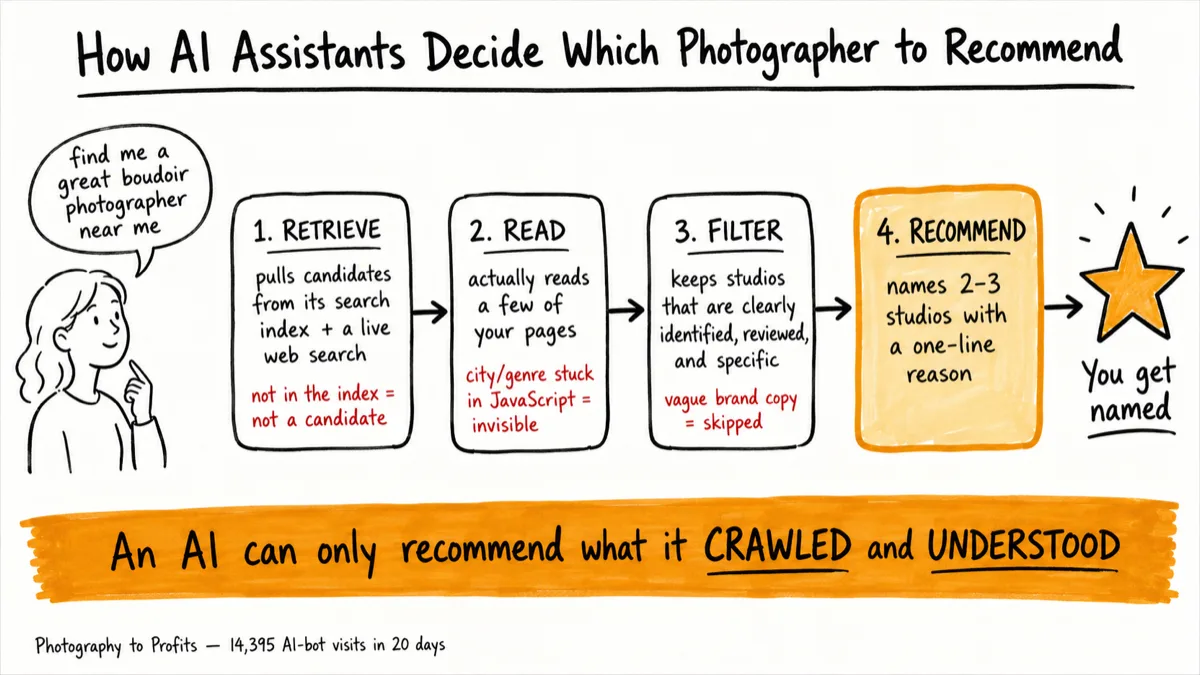
A lot of this is a black box, but for the amount of traffic and referrals we get from ChatGPT and the others, we're clearly doing something right. Here's the working model. When someone asks an assistant to recommend a photographer, it retrieves candidates much the way Google would: it looks at social profiles, Google Maps, directories, search results, reviews, and the links pointing at you, weighting whoever has the best content and the most referrers. Then it reads a few of those pages (in HTML, and increasingly in Markdown) and names the top few, with a one-line reason.
That parity is the good news: the SEO work you'd already do feeds your AEO. If you're going to invest in content and links anyway, you're most of the way to getting recommended by ChatGPT.
The Agent-Ready Website Stack: Your AEO Checklist
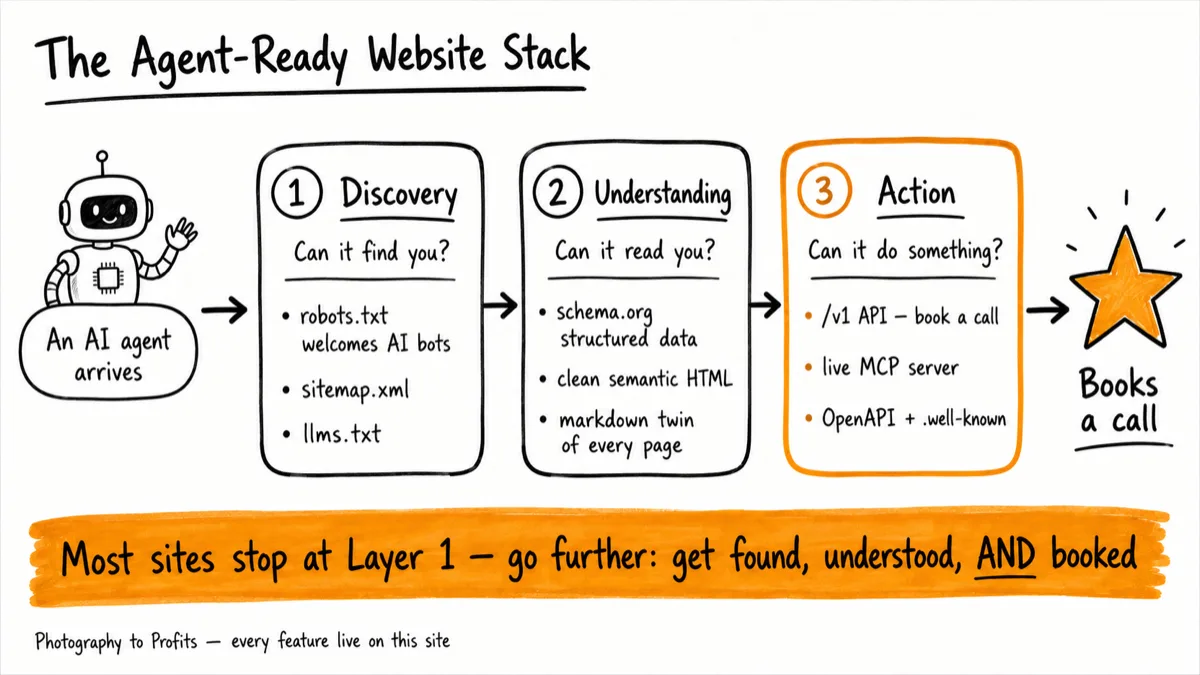
Everything you can do to get recommended by AI falls into three layers.
Layer 1: Discovery. Can the AI find you?
robots.txt is the main rulebook, a couple of lines telling bots what they can access. We use it to explicitly welcome the AI crawlers by name, plus one modern line (a Content Signal) that says "index me and cite me in AI answers, just don't train on me." Your sitemap (which you already use for SEO) lists every page so nothing gets missed. And llms.txt is like a sitemap you'd hand to a human: a cheat sheet that says "these are my best pages, start here." You can see all three live: /robots.txt, /llms.txt.
Layer 2: Understanding. Can it read you?
Schema (structured data) lets you hand the machine your facts in a structured, code-like format so it doesn't have to guess. Without it, if your phone number and address sit in the middle of a blog post, a bot might not even realize they're yours. Schema removes all doubt. Clean semantic HTML matters for the same reason: some photography sites turn words into images, which is far harder for a bot to read, so keep your text as text. And a markdown twin gives bots a clean, readable version of each page instead of raw HTML.
Layer 3: Action. Can it actually do something?
APIs are the glue of the internet, the same thing Zapier uses to pass a form submission to your email tool. Agents can use them too. Instead of making an AI point-and-click through your contact form, we expose an API endpoint with instructions for the agent, so it can submit an inquiry in "computer speak." No browser, no login. We went all the way: a full /v1 API, an OpenAPI spec, and a live MCP server. When an AI is choosing among a hundred studios, the clean, well-structured, easy-to-use one becomes a top candidate.
The Honest AEO Ranking: What Actually Moves the Needle
We built all of it, so I'll be straight about the AEO payoff order:
- Do first: an AI-aware
robots.txt, accurate schema, and a clean sitemap. That's ~80% of getting recommended by ChatGPT. - Easiest big win: put Cloudflare in front of your site as a CDN and turn on its features: free on the basic tier, faster, more secure.
- Nice to have:
llms.txtand a markdown twin, cheap and forward-looking, not needle-movers yet. - Frontier: an API and MCP server, only if you have something an agent should actually call.
See Your AEO Score
Before you change anything, find out where your photography website stands. Our free scan reads your site the way an AI agent does and gives you a breakdown of exactly what to fix for AEO.
Run the free AEO scan on your studio → Then paste your results into ChatGPT and ask "how do I fix this?" Across the 169 sites we've scanned, the average is 46/100. Most studios have room. If you'd rather we just build the whole stack (plus your Google Ads, Meta Ads, automation, and a fast custom site), that's what our AEO service does.
AEO for Photographers: Frequently Asked Questions
What is AEO for photographers?
AEO (answer engine optimization) is optimizing your website so AI assistants like ChatGPT, Claude, and Perplexity recommend your photography studio in their answers. SEO gets you into search results; AEO gets you named by the AI.
How do I get my photography studio recommended by ChatGPT?
Be findable (welcome AI bots in robots.txt, keep a clean sitemap), readable (accurate LocalBusiness schema and clean HTML), and trusted (recent reviews, consistent listings). ChatGPT can only recommend what it can crawl and understand.
Are AI bots really visiting my site already?
Almost certainly. We logged 14,000+ bot visits in 20 days, led by OpenAI's ChatGPT crawler. The question isn't whether they're crawling you. It's whether they can read enough to recommend you.
Does SEO still matter for AEO?
Completely. AI assistants lean on Google's and Bing's indexes to find candidates, so classic SEO is the foundation. AEO is the layer on top that turns "findable" into "recommended."
The Bottom Line
The robots are already at your door: ours logged 14,000+ visits in 20 days, led by ChatGPT. Getting recommended by AI isn't magic; it's being findable, readable, and (eventually) usable, and most of that is just good SEO done well. Start by seeing where you stand.
Prefer to Read? The Full Video Walkthrough (Transcript)
Here's the walkthrough above, in text, for readers and AI assistants alike.
I'm going to walk you through what it's like to focus not just on SEO, but on AEO. AI is being used a lot to refer companies to users, and I set this up on my own website and track it for client websites too, especially since we build custom React sites and have full control. We keep track of the bots and the referrers. Looking at just the last couple of days on my site, ChatGPT's users have visited around a hundred times, seeking knowledge on someone's behalf, far more than Claude. ChatGPT clearly has more users. And you'll see Bing and other places referring, too. Some of these bots are trying to serve a user an answer; some are the "who's the best at this?" queries: people typing "get me a lawyer" into Perplexity, Google, or Bing.
The cool thing is you have a lot of control over this, and a lot of it overlaps with SEO. You're searching on your computer, or using ChatGPT on your phone, and it goes and retrieves candidates, similar to what Google would do. It looks at social media profiles, Google Maps, directories, search results, and links, and weights things by what has the best content and the most referrers. There's a real parity there. It's a black box, but for the amount of traffic we get from ChatGPT and the others, we're doing something right.
It reads some pages in HTML and some in Markdown. If you get nothing else from this: use Cloudflare as a CDN and turn on all their features. It's completely free on the basic tier, it speeds things up, and it makes you more secure. Because we build custom React sites, we have even more control on top of that.
Then there's the technical layer. You have robots.txt, which is the main set of rules. On top of that, the sitemap, which you also use for SEO, lets bots and search engines know what's on your site. Then llms.txt, which is almost like a cheat sheet: imagine a sitemap you'd hand to a human, saying "these are my best pages, start with these."
Next is schema. The best way to describe it: you get to put your information into a more structured, code-like format so bots don't have to guess what your phone number or business address is. If you had an address and phone number in the middle of a blog, a bot might not realize it refers to you and not, say, the police department. Structured data removes that doubt. The other one is clean semantic HTML. This overlaps a lot with SEO. Some people make an image of a word instead of using text, and that's much harder to read, so avoid it.
Then a markdown twin for every page. If you feed a bot raw HTML, it's full of rendering instructions for a browser; in Markdown, it looks more like a clean text file for a human. If you have a paid Cloudflare account it lets you do this, and custom React sites can too. WordPress and site builders are adding it.
Finally, APIs, the glue of the internet, how things talk to each other. If you've used Zapier, it's the same idea: someone submits a form and you send it to your email tool via an API. Agents can do the same thing. So instead of an agent visually filling out your form, why not give it an API endpoint with instructions so it can submit in computer speak, without even needing to log in? If you're competing with a hundred websites, the one that's streamlined, with super clean HTML and llms.txt and everything professional about it, becomes a top candidate. When I research sites, sometimes the AI even says things like "this is really professional, well put together, great security."
You can see all the bots coming in. What matters most to me is when I look at analytics and see an inquiry whose source was ChatGPT or another assistant, that means someone asked, was handed a link, and clicked. There's a lot of overlap with SEO, so if you're going to do the work, do it for this too. Come check your score on our site, and if you want management (Facebook ads, Google ads, automation, web design), that's what we do.