Every "best time to post" chart on the internet disagrees with the next one. Later's data says 5 a.m. Sprout Social says early afternoon. Metricool says 8 p.m. They're all analyzing millions of real posts, and they still can't agree on an answer.
That's not a reason to give up on timing. It's a reason to understand what the data actually says, what it can't say, and where posting time genuinely fits for a photographer running a real business. This guide covers the 2026 numbers for photographers posting to social media (Instagram, Facebook, TikTok, and Pinterest) plus something none of the generic charts include: what happens between the moment someone sees your post and the moment they book a session.
Key Takeaways
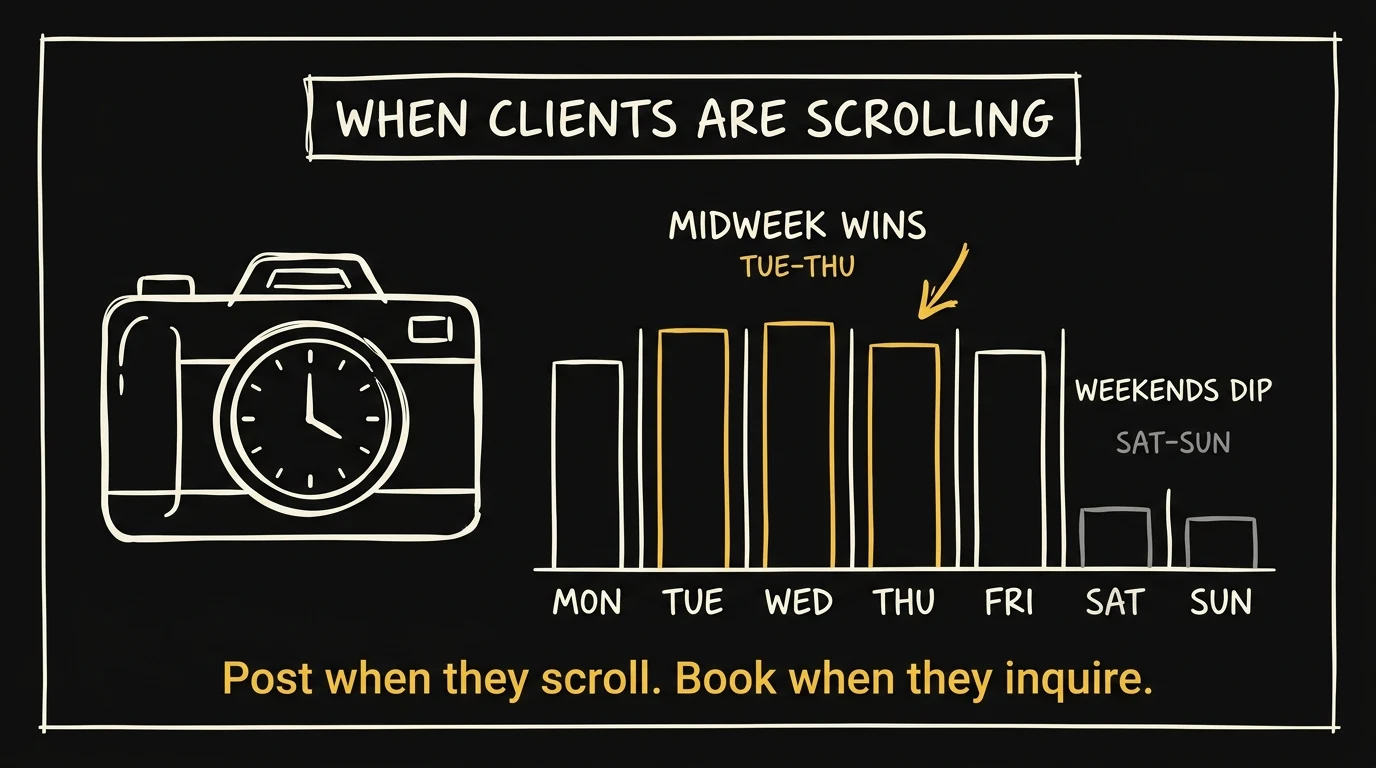
- Midweek beats weekends in every major study. Tuesday through Thursday reliably outperforms the weekend on Instagram and Facebook across Sprout Social, Buffer, Metricool, and SocialPilot, though the studies still argue about which midweek hours (and even which days) are best. The 1–5 a.m. block loses everywhere.
- The studies disagree on almost everything else. Later's 6-million-post analysis says 5 a.m. is best on Instagram while Buffer's 9.6-million-post study says evenings. Your own audience insights settle the argument; national averages can't.
- Timing is the last 10%. Content quality and a consistent 3–5 posts per week predict growth far better than clock time. Humberto Garcia, founder of Photography to Profits, has watched hundreds of studio accounts. The ones that book clients are consistent, not clock-obsessed.
- Do this today: open Instagram Insights → Total followers → Most active times, and schedule your next three posts into your audience's real peak window.
Does Posting Time Still Matter for Photographers in 2026?
Posting time still matters in 2026, but it's the smallest of three levers. Peak-window posting gives your content early engagement velocity, which platforms use to decide wider distribution. But content quality and posting consistency both predict growth more strongly than clock time. Get those right first, then optimize timing, not the other way around.
Timing still earns its place for one reason. Instagram, Facebook, and TikTok are all interest-based recommendation engines now, but recency hasn't disappeared. Buffer's 2026 analysis puts it plainly: the algorithm rewards relevance, but recency still dictates your initial reach. On TikTok, videos surfacing on the For You page are usually no more than a couple of days old, and it's the first hours of watch-time data that decide whether a video travels. Posting while your audience is actually scrolling stacks the deck for that first hour.
One honesty note you won't find in most guides: you'll see claims that perfect timing "boosts engagement 30–50%." No major 2026 study actually publishes a controlled optimal-versus-random number, not Sprout Social, not Buffer, not Metricool. What the data does show clearly is relative rankings: midweek beats weekends, waking hours beat 1–5 a.m., and dead-hour posting reliably underperforms. Treat timing as a free marginal gain, not a growth strategy.
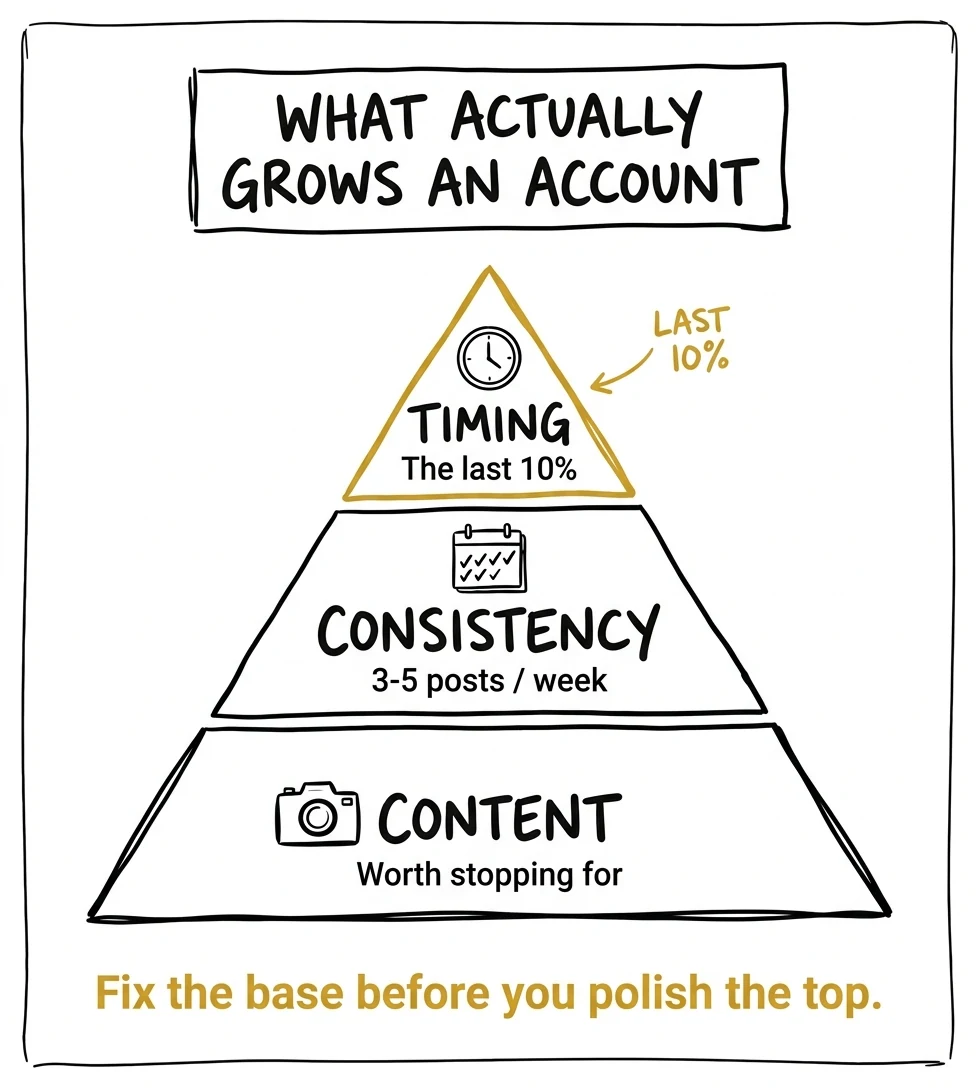
The priority order: content worth stopping for → consistency (3–5 posts per week) → timing optimization. Fix the base before you polish the top.
Best Times to Post by Platform (2026 Data at a Glance)
Here is the whole answer in one place, pulled from the 2026 studies referenced throughout this guide. All times are your audience's local time. Treat these as starting windows to test against your own Insights, not as rules:
| Platform | Best days | Best time windows | Worst windows | Source studies |
|---|---|---|---|---|
| Tuesday–Thursday | Tuesday 1–7 p.m.; Wednesday noon–9 p.m.; Thursday 9 a.m.; weekday evenings 6–11 p.m. | Friday and Saturday; the overnight block (roughly 2–5 a.m.) | Sprout Social, Buffer, Metricool | |
| Monday–Thursday | Tuesday and Wednesday noon–8 p.m.; weekdays 9 a.m.–3 p.m. | Weekends (Sunday is the weakest day) and overnight | Sprout Social, SocialPilot | |
| TikTok | Monday–Friday (weekend contested) | Tuesday 2–6 p.m.; Wednesday 1–8 p.m.; Sunday 9 a.m. and Monday 1 p.m. are Buffer's top individual slots | Sprout says weekends and early mornings; Buffer says Saturday is its best day | Sprout Social, Buffer |
| Tuesday–Thursday | 10 a.m.–1 p.m., plus evening inspiration browsing | Weekends | Sprout Social | |
| Tuesday–Thursday | Tuesday 11 a.m.–5 p.m.; Wednesday 11 a.m.–4 p.m.; Thursday 11 a.m. and 1–5 p.m. | Saturday and Sunday | Sprout Social |
Two things jump out of that grid. Midweek owns four of the five platforms, and LinkedIn's business-hours peak is almost the mirror image of Instagram's evening peak, which matters if you post to both. The rest of this guide explains where those numbers come from, where the studies fight each other, and what a photographer should actually do about it.
Why Every "Best Time to Post" Chart Disagrees
Put the 2026 studies side by side and the contradictions are almost funny:
| Study | What they analyzed | Their verdict on Instagram |
|---|---|---|
| Later | 6 million+ Instagram feed posts | 5 a.m. overall. Monday is the best day, Saturday the worst. |
| Sprout Social | Nearly 2 billion engagements across roughly 307,000 profiles | Tuesday 1–7 p.m. and Wednesday noon–9 p.m. Weekends and early mornings are worst. |
| Metricool | 24,364,803 posts from 375,118 accounts | Evenings win, with 8–9 p.m. the heaviest hour. The 2–5 a.m. block is the daily floor. |
| Buffer | 9.6 million posts from 200,000+ accounts | Thursday 9 a.m. is the single top slot, and evenings 6–11 p.m. win every weekday except Thursday. Friday and Saturday are worst. |
| Hootsuite | Published 2026 posting schedule | Monday 3–9 p.m. and Tuesday 5–8 a.m. plus 3–7 p.m., while advising you avoid before 8 a.m. and after 10 p.m. |
Read the last two rows together and the problem is obvious: Later's single best hour (5 a.m.) sits inside the window Hootsuite tells you to avoid. Platform by platform it gets worse. Buffer's separate TikTok study of 7.1 million posts crowns Saturday the best TikTok day, while Sprout Social calls weekends the worst.
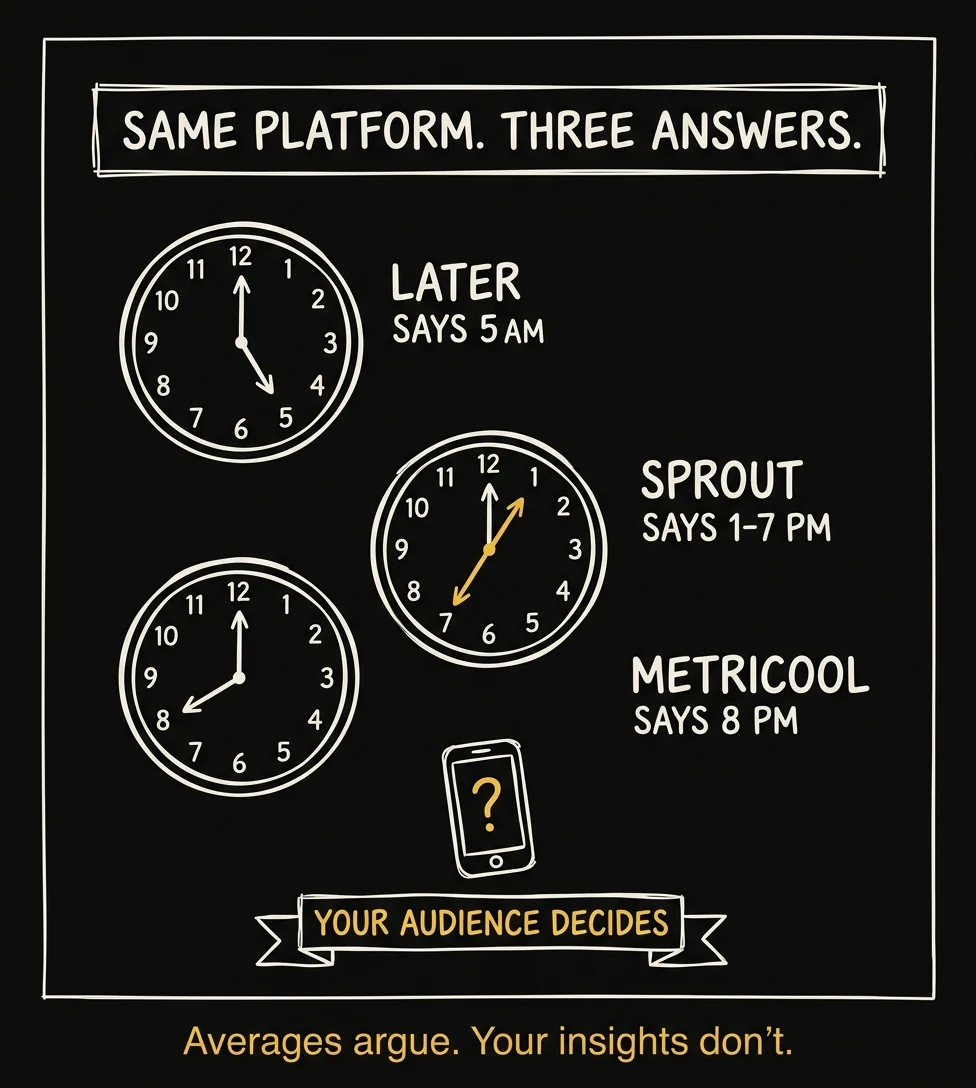
They can't all be right for your audience, and none of them is lying. Each study measures a different metric (engagement rate vs. views vs. reach), normalizes time zones differently, and averages across wildly different account types. A meme page's peak hours have nothing to do with when a mom in your city researches newborn photographers.
What survives every study is the consensus floor: midweek beats weekends on Instagram, Facebook, and Pinterest; 1–5 a.m. is dead air everywhere; and every single publisher says your own audience data beats their averages. That's the honest headline, and it's why the general windows below are starting points, not commandments.
Best Times for Photographers Posting to Instagram
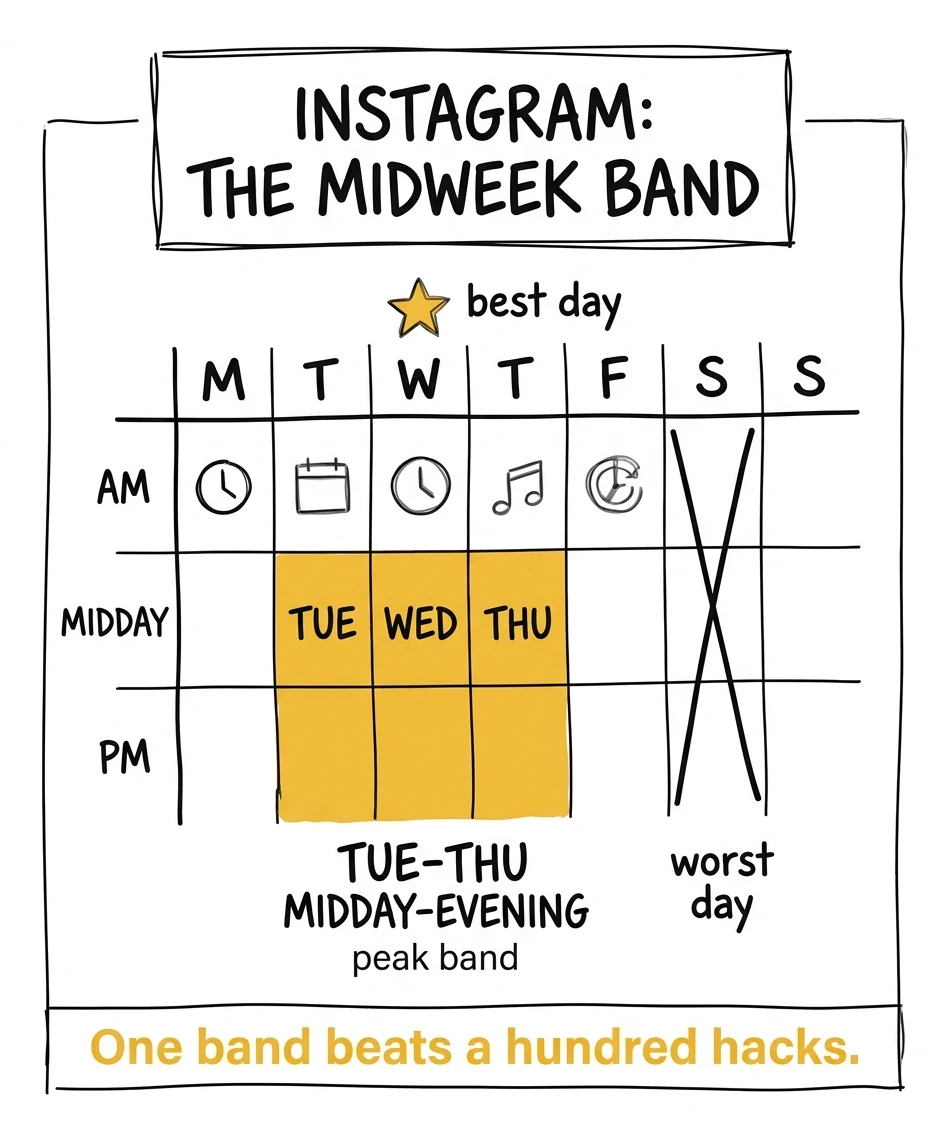
Instagram runs on an interest graph in 2026: your content reaches ideal clients who have never heard of you, as long as early engagement signals are strong. For the best starting windows, the studies converge on a midweek band:
- Wednesday, noon–9 p.m.: the strongest single day across Sprout Social, Buffer, and Metricool. Buffer's top individual slots include Wednesday noon and Wednesday 6 p.m.
- Tuesday, 1–7 p.m.: sustained afternoon engagement in Sprout's nearly-2-billion-engagement dataset.
- Thursday, 9 a.m.: Buffer's #1 individual slot, and the only weekday morning that performs in Buffer's data (Later and SocialPilot, by contrast, like early mornings).
- Weekday evenings, 6–11 p.m.: Buffer's data shows evenings winning most weekdays. This is when your clients scroll on the couch.
Worst times: Saturday is the weakest day in both Buffer's and Later's analyses, Buffer also flags Friday, and the overnight block underperforms everywhere. (Metricool, true to form, ranks Friday among its best days and puts its own floor at 2–5 a.m., another study split.)
Format still shapes results: short-form video remains the reach engine for hitting non-followers, while carousels tend to earn deeper engagement from people who already follow you. The strategic split for photographers: Reels to reach new potential clients, carousels to deepen trust with the audience you already have. If you're still building your first real audience, start with our guide to getting your first 1,000 Instagram followers.
Social media is one piece of a full photography marketing system. See how all the channels work together.
See the Full 5-Channel Marketing System →Best Time for Photographers Posting Reels
Reels deserve their own answer because Reels distribution barely resembles feed distribution. Instagram head Adam Mosseri has named the signals that carry the most weight for reach, watch time, likes, and shares (or sends), with watch time leading. A Reel that people watch to the end and forward to a friend will out-travel a perfectly timed Reel that people swipe past.
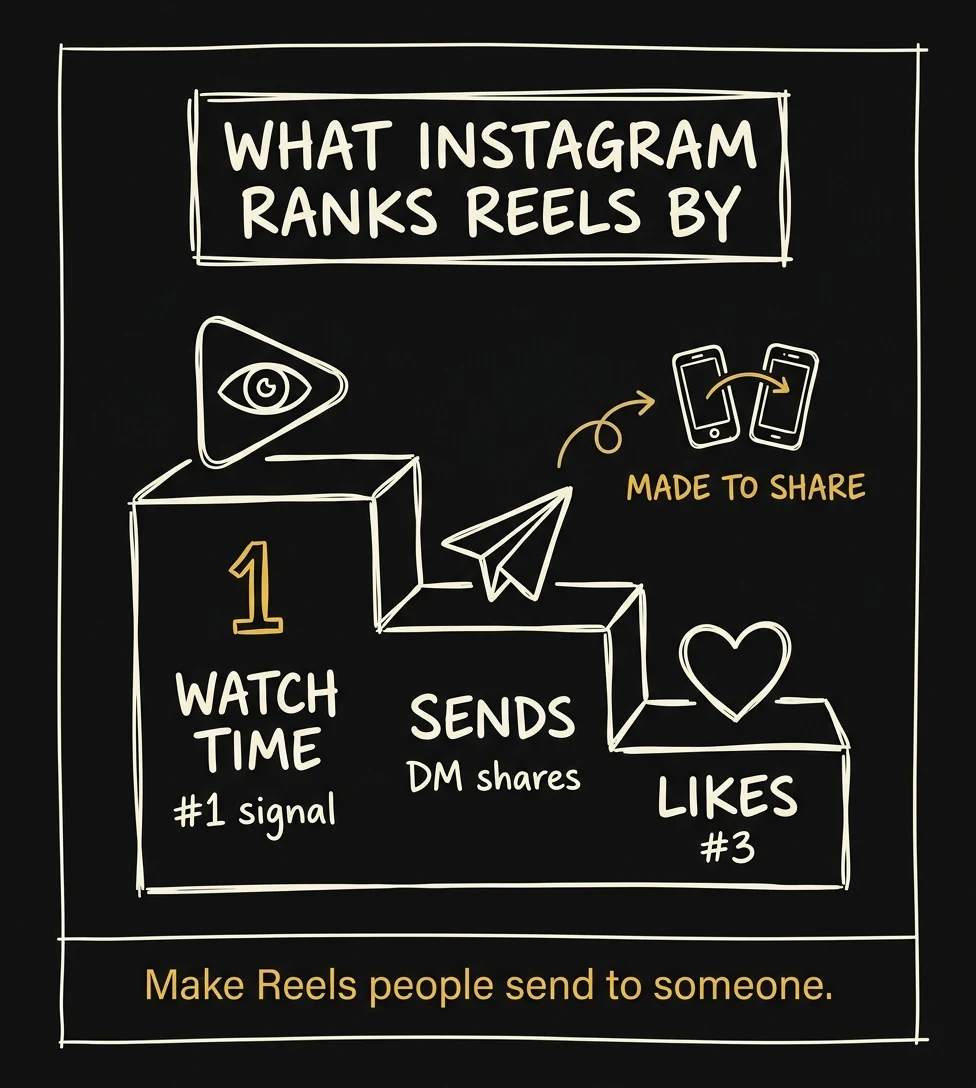
Timing still helps a Reel's first hour. Later's Reels-specific data points to late-night and early-morning posting (they put the best Reels time at midnight, and their best Reels day is Monday), while Buffer's evening windows (measured across Instagram post types) make evening Reels a safe bet. The practical move: post Reels inside your audience's active window, and build them around content people want to send to someone: posing tips a bride forwards to her fiancé, "what to wear" guides, behind-the-scenes moments that earn the "you have to watch this" share.
One warning from the DM-share era: public likes and comments have fallen across the board while private shares rise. Socialinsider's 2026 benchmark data has TikTok shares per post up 45% year over year and Instagram shares up 12%, while average comments per post fell 24% on TikTok and 16% on Instagram. Don't delete a post because its public numbers look quiet; it may be circulating in DMs right now. For the full playbook (hooks, formats, and how Reels turn into inquiries), see Instagram Reels for Photographers.
Best Times for Photographers Posting to Facebook
Facebook in 2026 is an AI-driven discovery engine: a large and growing share of what users see comes from accounts they don't follow. That's good news for a small studio page: you don't need a big following for a strong post to travel.
- Tuesday–Wednesday, noon–8 p.m.: Sprout Social's peak, a sustained block of high engagement across their 2026 dataset.
- Monday–Thursday generally: every study's best-day cluster. SocialPilot's analysis of 700,000 Facebook posts across 50,000+ accounts adds weekday 9 a.m.–3 p.m. windows and names Sunday the worst day.
- Worst: weekends and the overnight block. Sprout's data is explicit on this, and no major study makes a case for weekend posting on Facebook.
Format pressure is lower on Facebook than Instagram, and in our experience across studio accounts, a short story about a session or a direct question to your local audience regularly outperforms a polished gallery. Facebook rewards conversation, which is also why a well-run community outperforms a broadcast page. If that's your lane, here's how to build a Facebook group for your photography business.
Best Times for Photographers Posting to TikTok
TikTok rewards watch time and completion rate above everything. A video 40% of viewers finish will out-distribute one with more views that people swipe away from in 3 seconds. Timing is an odds-improver for the first few hours, not a gate.
- Tuesday 2–6 p.m. and Wednesday 1–8 p.m.: Sprout Social's core 2026 windows, the midweek afternoon slump scroll.
- Sunday 9 a.m. and Monday 1 p.m.: Buffer's top individual slots from 7.1 million analyzed posts.
- 6–8 p.m.: Metricool's evening peak from their 2-million-post TikTok study.
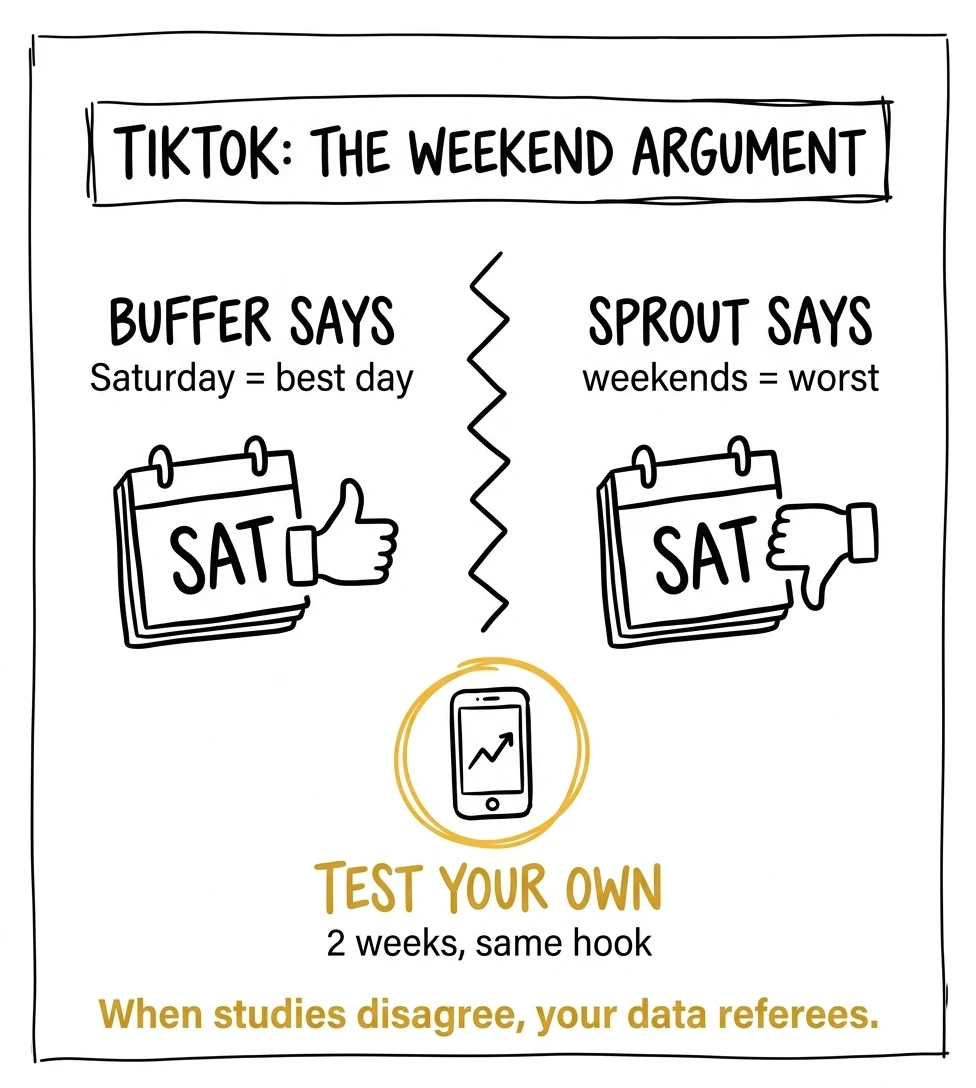
And the weekend? This is the single loudest disagreement in the 2026 data: Buffer's study names Saturday the best TikTok day, Sprout Social calls weekends the worst, and Metricool splits the difference: Friday and Saturday are its worst days, yet Sunday evening is its single best slot. When million-post studies split like that, the answer isn't picking a side. It's a two-week test on your own account: same hook style, weekday vs. weekend, compare completion rates.
One more 2026 note: TikTok's content categorization understands what your video is about regardless of captions or hashtags, and TikTok search is now a real discovery channel. Say the words your clients search ("boudoir studio in Austin," "what to wear for family photos") out loud in the video. The algorithm is listening, literally.
Best Times for Photographers Posting to Pinterest
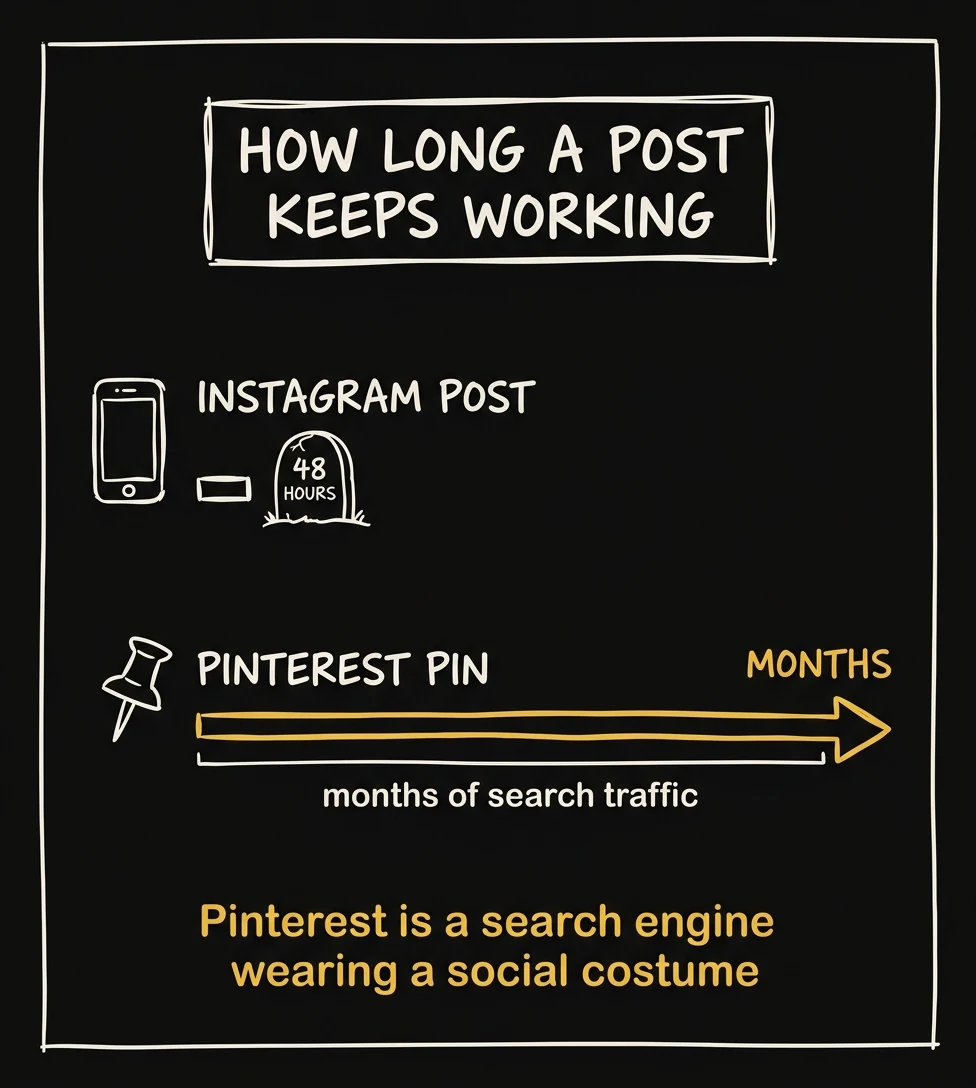
Pinterest is a search engine wearing a social costume. An Instagram post does most of its work in its first day or two; a well-keyworded pin drives traffic for months or years. For wedding, newborn, family, and boudoir photographers, that makes Pinterest the best "post once, benefit all year" platform.
- Tuesday–Thursday, 10 a.m.–1 p.m.: where Sprout Social's 2026 data lands (SocialPilot argues for evenings, another study split, and another reason consistency matters more here).
- Evenings and weekends for inspiration browsing: planning-mode users daydream on Pinterest at night. Wedding and lifestyle content sees strong 8–11 p.m. activity.
- Keywords beat timing, always: a pin titled "Outdoor Wedding Photography: Golden Hour Lake Como" reaches relevant searchers indefinitely; "Love these two ❤️" reaches no one, whenever you post it.
If you only change one Pinterest habit: write pin titles and descriptions the way your clients search, and pin consistently every week instead of hunting a magic hour.
Best Times for Photographers Posting to LinkedIn
LinkedIn is irrelevant for most portrait and wedding photographers and quietly excellent for a specific group: branding, headshot, corporate event, and commercial photographers whose buyers are marketing managers, recruiters, and HR leads. The timing rules invert because that audience is at a desk, not on a couch.
- Tuesday, 11 a.m.–5 p.m.: the strongest sustained block in Sprout Social's 2026 LinkedIn data, which calls Tuesday the "productivity powerhouse of the workweek."
- Wednesday 11 a.m.–4 p.m., and Thursday 11 a.m. plus 1–5 p.m.: the rest of the reliable midweek business-hours band.
- Worst: Saturday and Sunday. A professional audience disconnects from work content on the weekend, and LinkedIn engagement falls off with it.
The practical implication for a photographer running both accounts: your Instagram post and your LinkedIn post should almost never go out at the same hour. Corporate headshot availability, team-photo case studies, and event recaps belong in Tuesday-through-Thursday business hours. Save the emotional session films for the evening Instagram window.
When Clients Scroll vs. When Clients Book
Here's the piece every generic timing chart misses, and it changes how you read all the data above: the time your audience engages with content is not the time they book sessions.
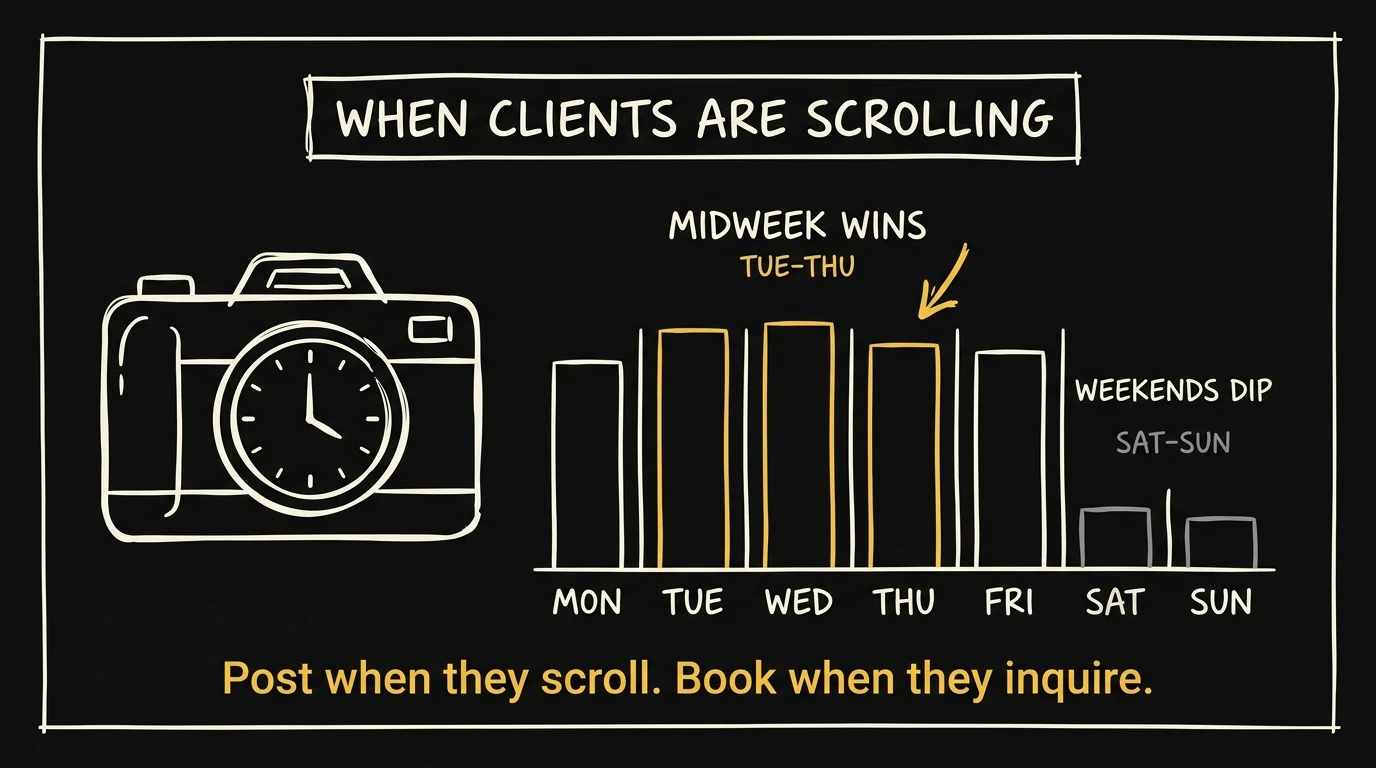
Your portrait, boudoir, and wedding clients (overwhelmingly women 25–55) scroll in relaxation mode: evenings from roughly 8 to 11 p.m., and weekends. That's discovery time, inspiration time, tag-your-friend time. But booking a session is an active decision that involves money, so it happens when people feel in control of their schedule. Scheduling-platform data consistently shows inquiry and booking activity clustering on Tuesday and Wednesday mornings through early afternoon, with a smaller evening spike.
Practical translation for your posting calendar:
- Evening and weekend posts: emotional, visual, shareable. The session film, the transformation story, the behind-the-scenes Reel. You're planting the desire.
- Midweek daytime posts: booking-oriented. Availability announcements, "two spots left in October," clear calls to action. You're catching them in decision mode.
- Always-on: answer inquiries fast. A Tuesday-morning inquiry answered Thursday night is a dead lead. Speed-to-lead is one of the biggest booking-rate levers we see across studios, which is why the Photography Client Machine system treats the first five minutes after an inquiry as sacred.
How Often Should Photographers Post to Social Media?
The 2026 frequency data is more consistent than the timing data, and it's kinder than the "post every day or die" advice you've heard:
- Instagram: 3–5 feed posts per week plus 1–2 Stories most days. Buffer's frequency analysis of 2 million posts found accounts posting 3–5 times weekly earn roughly 12% more reach per post than 1–2-times-a-week accounts, and while 10+ posts a week gets that to about 24%, the return per additional post keeps shrinking while your burnout risk doesn't.
- Facebook: 3–7 posts per week is plenty for a local studio page.
- TikTok: 2–5 posts per week. Buffer's frequency guide puts the lift from moving off a single weekly post at up to 17% more views per post; daily posting helps but isn't required to grow.
- Pinterest: steady weekly pinning beats binges, and past roughly 50 pins a day, distribution can actually suffer.
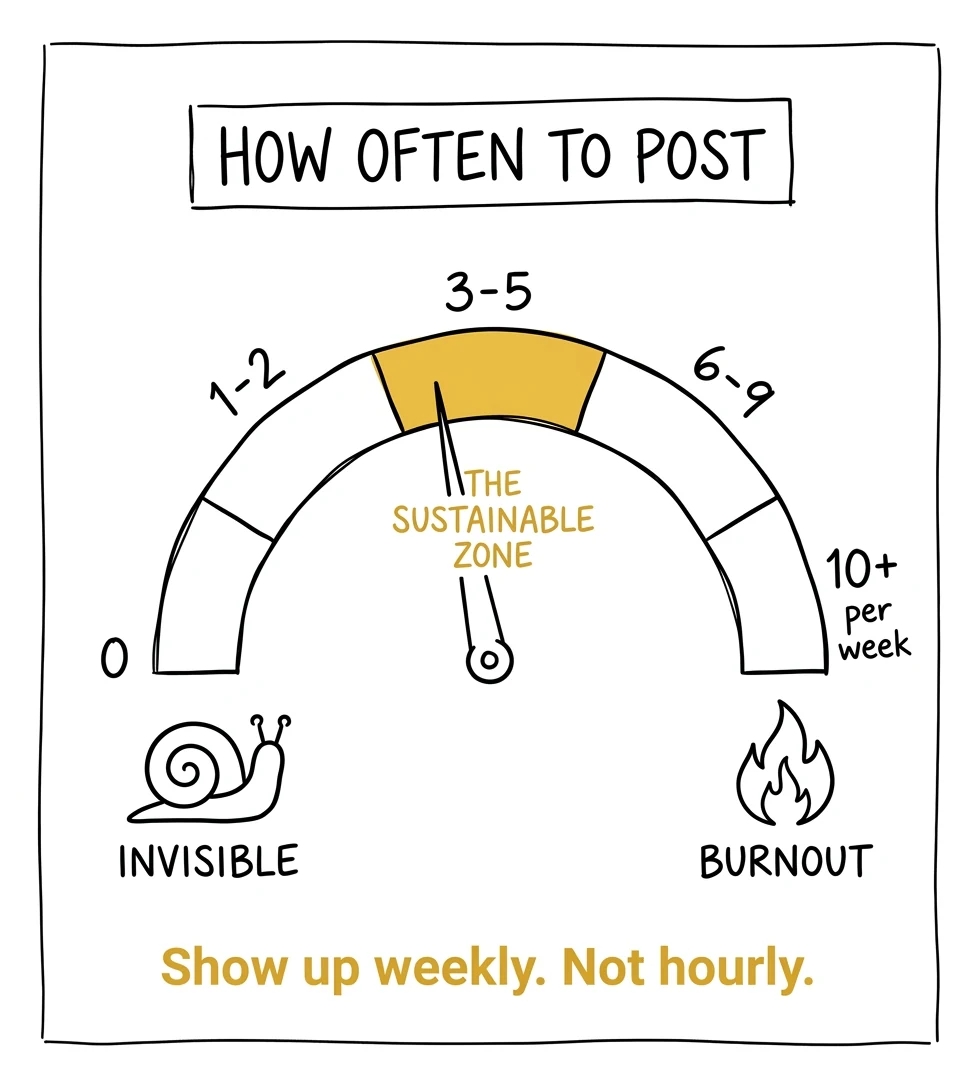
The pattern that actually kills studio accounts isn't posting too little. It's the launch-and-abandon cycle. Ten posts during fall mini-session week, then a month of silence, teaches the algorithm (and your audience) that you're unreliable. Three posts a week, every week, at reasonable times beats any heroic sprint. Consistency is the strategy; frequency is just its unit of measure.
How to Find YOUR Best Posting Times
The windows above are starting points. Your genre, your city, and your client demographic can shift them by hours. Every platform will tell you your audience's real activity pattern for free. Where to look in 2026:
Profile → Professional dashboard → Insights → tap Total followers → scroll to "Most active times." Toggle between hours and days to see exactly when your followers are online. (Requires a professional account, free to switch.) A local wedding photographer's audience will not match a national average, and this chart proves it in 30 seconds.
Open Meta Business Suite → Insights → Audience for the day-and-hour activity chart covering the last 28 days. Bonus: when you schedule a post in the Planner, Meta suggests recommended time slots based on your page's own engagement history, separately for Facebook and Instagram.
TikTok
Profile → menu → TikTok Studio → Analytics → Followers tab → Most active times, by hour and by day. While you're there, check which of your videos earned the highest completion rates. The posting hours behind those are your real peak windows.
The A/B Test Approach
Post equivalent content in your "optimal" window and at an off-peak time, alternating over 3–4 weeks, and compare average reach and saves. Most local photographers will land close to the midweek consensus. Some (especially niche or multi-time-zone audiences) will find a personal window nobody's chart predicted. Trust the test.
The 3-Hour Weekly Posting System for Solo Photographers
None of this matters if it isn't sustainable while you're shooting, editing, and running the business alone. Here's the weekly rhythm that works:
Monday morning (30 min): review last week's analytics. What earned saves and DMs? What flopped? Note it.
Monday afternoon (90 min): batch-create the week: film 3 Reels, draft every caption.
Tuesday morning (45 min): finalize and schedule everything into your peak windows using Instagram's native scheduler, Meta Business Suite, or Buffer.
Friday (15 min): confirm posts went live; reply to every comment and DM.
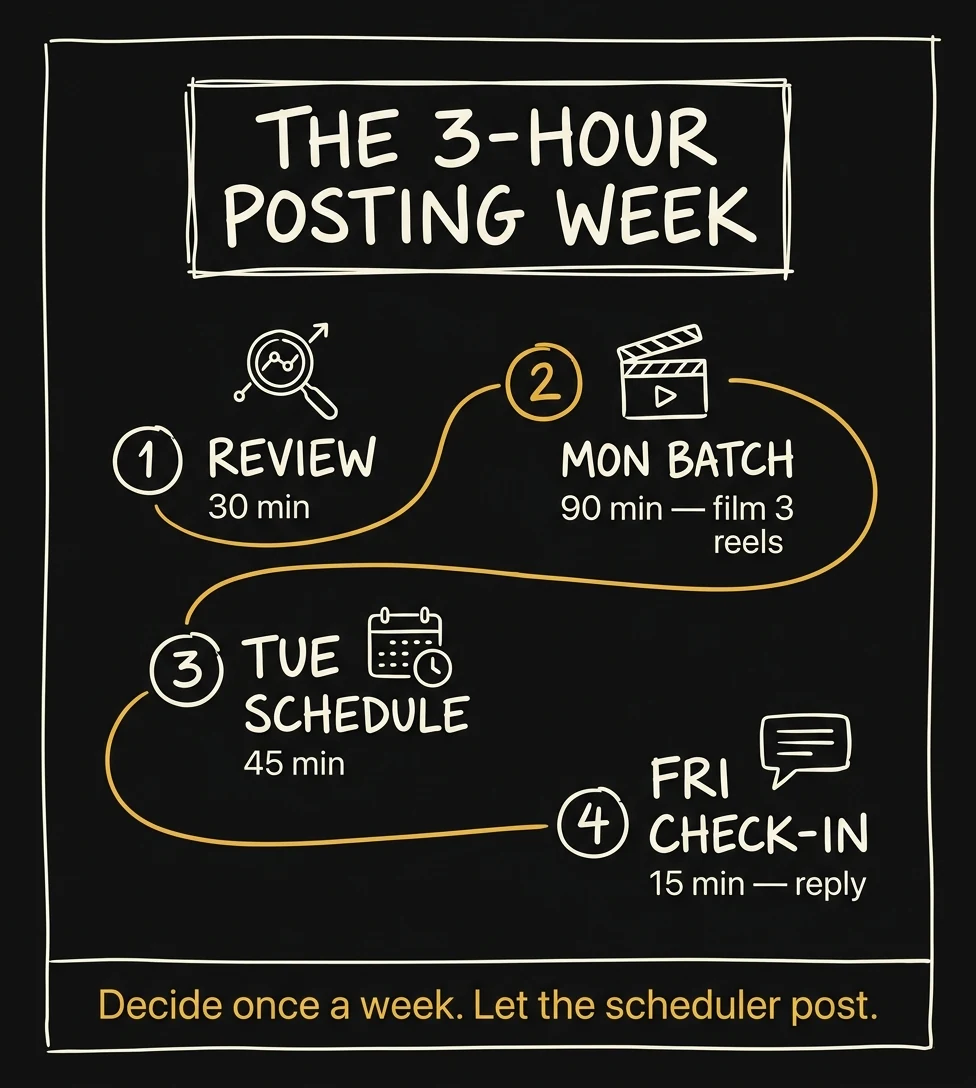
Total: about 3 hours of focused work. You make strategic decisions once a week and let the scheduler handle the clock, which means the "best time to post" question gets answered by automation, permanently, instead of by panic at 6:47 p.m. every night.
From Posting to Booking: The Part Most Photographers Skip
A perfectly timed post that earns 40 likes and zero inquiries didn't work. This is where timing advice ends and marketing begins: what happens after they engage?
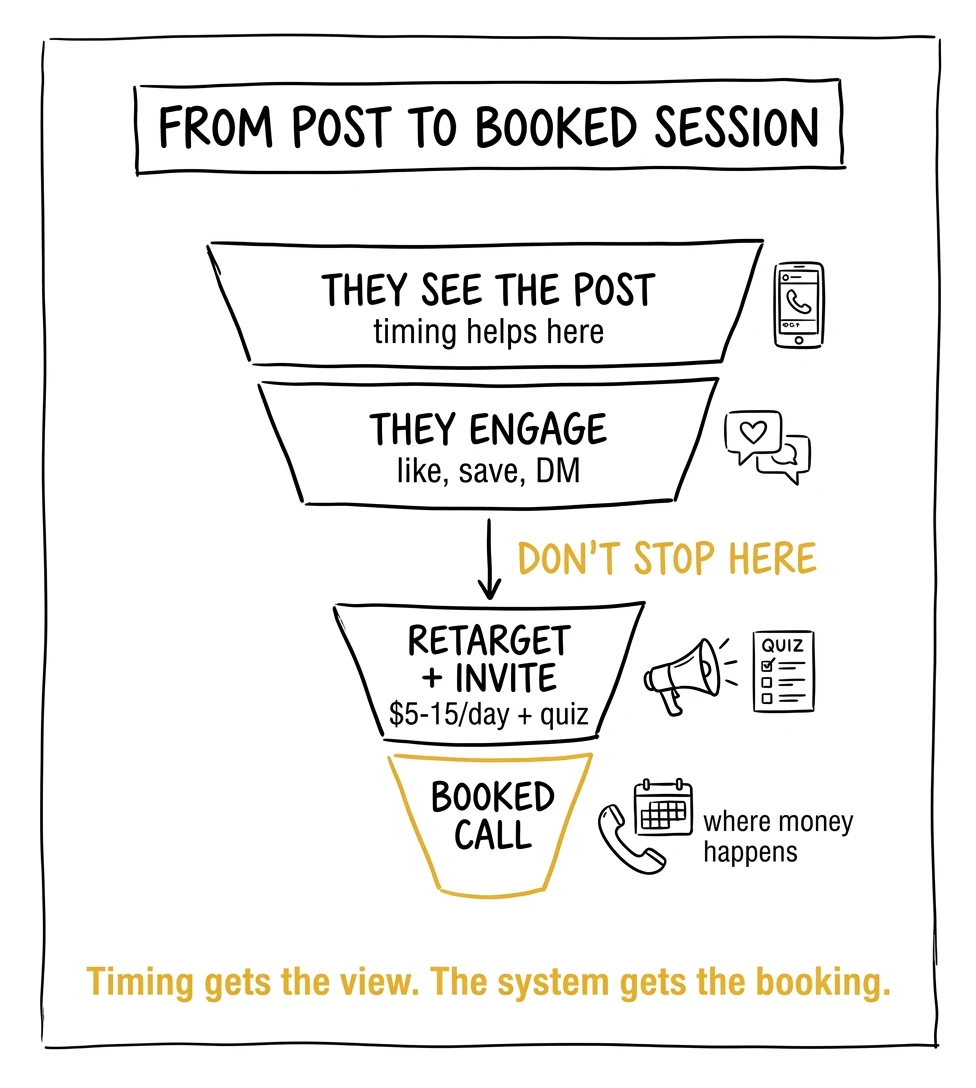
The studios we work with treat organic posting as the top of a system, not the system:
- Post consistently in your peak windows, using everything this guide covered.
- Retarget everyone who engages. A $5–15/day retargeting campaign puts your best work back in front of every person who watched your Reel or visited your profile, which makes your posting time matter less, because they'll see you again either way. That's the machine behind Meta ads for photographers.
- Give engagers somewhere to go: a pinned offer, a link-in-bio quiz, a clear "DM me BOOK" call to action, then move the conversation to a real inquiry.
- Answer fast and call. Inquiries cluster midweek during decision hours; studios that respond within minutes and get leads on the phone book dramatically more of them. That's the phone consultation system, and it's where the money actually happens.
- Own the relationship off-platform. Algorithms change; your email list doesn't. Social is rented land. Use it to fill assets you control.
Conclusion: The Data Agrees on Less Than You Think, and That's Freeing
The honest 2026 verdict for photographers posting to social media: midweek beats the weekend on Instagram and Facebook in every major study, even while those studies argue about the exact hours. TikTok peaks midweek afternoons with a genuinely contested weekend. Pinterest rewards keywords and consistency over any clock. Beyond that consensus floor, the big studies openly contradict each other, which means your own Insights tab outranks every chart on the internet, including the ones in this guide.
At Photography to Profits, Humberto Garcia works with photographers who are done guessing at their marketing. Posting time is one small dial. The dials that move revenue are whether your content converts viewers into inquiries, how fast you respond, and whether a system, not an algorithm, controls your lead flow.
Start with one action today: open Instagram Insights, find your audience's top activity window from the last 30 days, and schedule this week's three posts into it. One change, based on your data, this week.