
You booked $100,000 in photography revenue last year. You worked every weekend from February through November. You answered a thousand emails, edited ten thousand images, and drove to shoots in three different counties. And when January rolled around, you looked at your bank account and thought: where did it all go?
If that sounds familiar, you are not bad at photography. You are not bad at business. You are running on a broken financial model, the same one that keeps photographers perpetually busy and perpetually broke. The good news: there is a fix. It is called Profit First, and implementing it in your profit first photography business is the single most impactful financial move most photographers will ever make.
Revenue is vanity. Profit is sanity. This post walks you through the exact system, the numbers that matter, and how to set it up this week.

Photo: Jakub Żerdzicki / Unsplash
Key Takeaways
- Most photographers earning $100K+ are still broke because they are running on the old formula: Revenue – Expenses = Profit. Profit First flips it: Revenue – Profit = Expenses. Profitability becomes automatic, not accidental.
- Humberto Garcia, founder of Photography to Profits, has coached hundreds of photographers to implement financial systems that make their studios sustainably profitable, not just busy with sessions.
- The 5-account Profit First setup (Income, Profit, Owner's Pay, Tax, Operating Expenses) takes one afternoon to open and creates behavioral guardrails that eliminate the "where did my money go?" problem permanently.
- Action step: Open a separate savings account labeled "Profit" today. On your next client deposit, move 1% of the amount before paying any business expense. That one habit, started today, is how every photographer who masters their finances began.
Why Most Photographers Are Broke at $100K Revenue
Imagine two photographers. The first, Sarah, shot $150,000 last year. She booked 80 weddings and portrait sessions, worked nearly every weekend, and felt constantly behind. Come December, after gear purchases, software subscriptions, studio rent, advertising, and taxes, her bank account had less than $5,000. She worked herself to exhaustion for $5,000 in actual kept money.
The second photographer, Marcus, brought in $80,000. He shot fewer clients (about 40 sessions) and took intentional weeks off. He drove home from every shoot knowing exactly where his money was going. At year end, he had $18,000 in profit, $12,000 in his tax account, and $42,000 in owner's pay. He took a real vacation.
This is the income illusion. Revenue is a vanity metric. A photography business that grosses $150,000 but keeps nothing is less profitable than one that grosses $80,000 and keeps $18,000. Yet almost every conversation in photography communities focuses on revenue: how to book more, charge more, earn more. Nobody talks about what percentage of that revenue actually stays with the business owner.
The root cause is structural. Most photographers run their finances the way most small businesses do: all income lands in one checking account, bills get paid when they come due, and whatever is left at the end of the month is vaguely called "profit." The technical term for this model is accounting by hope.
According to the Professional Photographers of America, the majority of photography businesses that fail do not fail because of a talent problem. They fail because the owner never had a clear picture of their actual profitability. When all your money lives in one account, spending feels justified as long as the balance looks okay. The problem is that "looks okay" is not a financial strategy.
If you want a guided walkthrough of your specific studio numbers (not generic advice), Photography to Profits works directly with photographers to build their financial foundation.
Book a Strategy Call →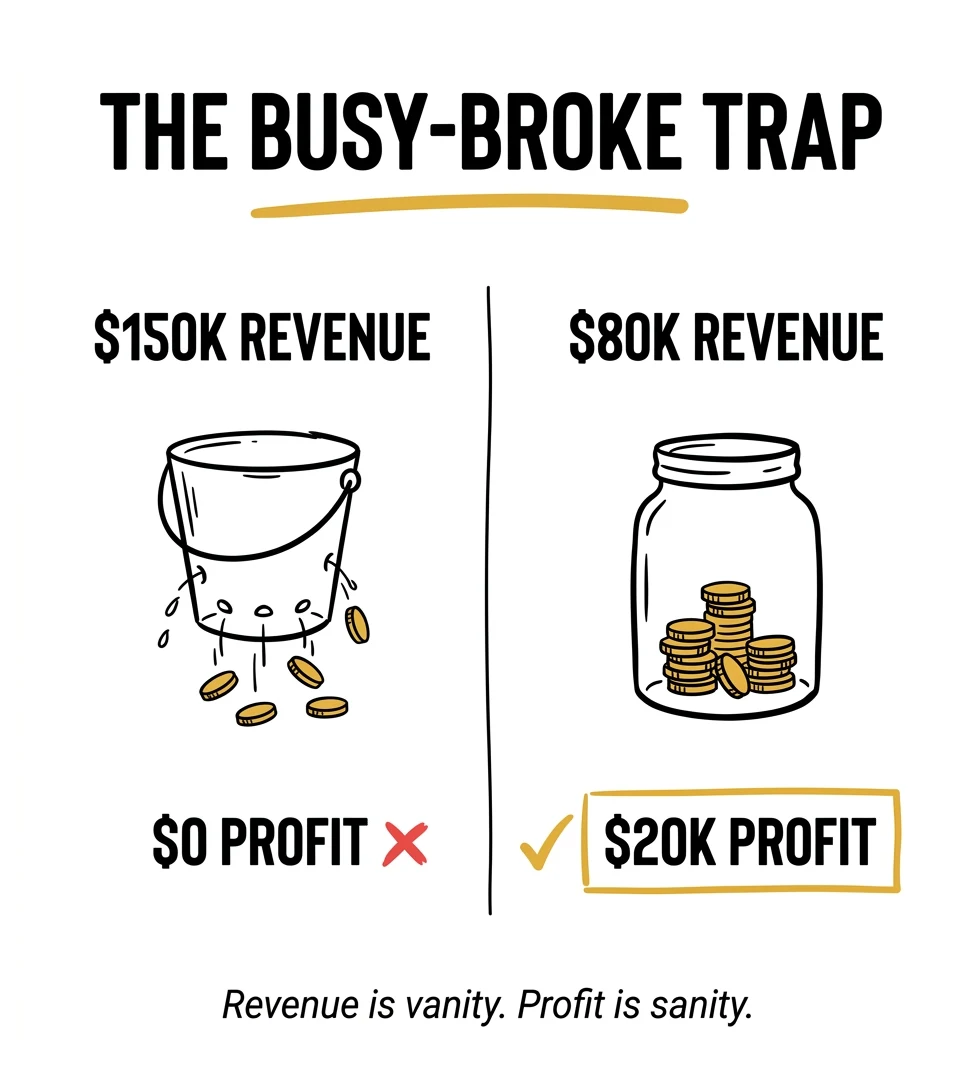
What Profit First Actually Is
Profit First is a cash management system created by author and entrepreneur Mike Michalowicz, detailed in his book Profit First: Transform Your Business From a Cash-Eating Monster to a Money-Making Machine. In 2024, Venus Michael, a photographer-turned-accountant, released Profit First for Photographers, which applies the full system specifically to photography studios.
The core insight is behavioral, not mathematical. Michalowicz observed that most business owners spend whatever is available. If $20,000 is in the checking account, it feels like $20,000 to spend. The expenses expand to fill the available cash. This is called Parkinson's Law applied to money: work (spending) expands to fill the time (money) available.
The Profit First solution is simple: remove the money before you can spend it.
Instead of one checking account where everything flows in and out, you open multiple bank accounts, each representing a different financial obligation. Every time revenue comes in, you immediately distribute it to those accounts according to pre-set percentages. Now when you look at your Operating Expenses account, you see only the money actually available for expenses. The profit is already separated. The taxes are already set aside. Your pay is already earmarked.
The old formula: Revenue – Expenses = Profit (profit is an accident, whatever is leftover)
The Profit First formula: Revenue – Profit = Expenses (profit is guaranteed, expenses work within the constraint)
This is the CAPS method: allocate Cash As Percentages on a Schedule. Every 10th and 25th of the month, you distribute whatever landed in your Income account into your other accounts. Then you run your business on what is left in Operating Expenses. The constraints force smarter spending decisions automatically: without willpower, without budgeting spreadsheets, without discipline you do not currently have.

Photo: Kelly Sikkema / Unsplash
The 5 Accounts Every Photography Studio Needs
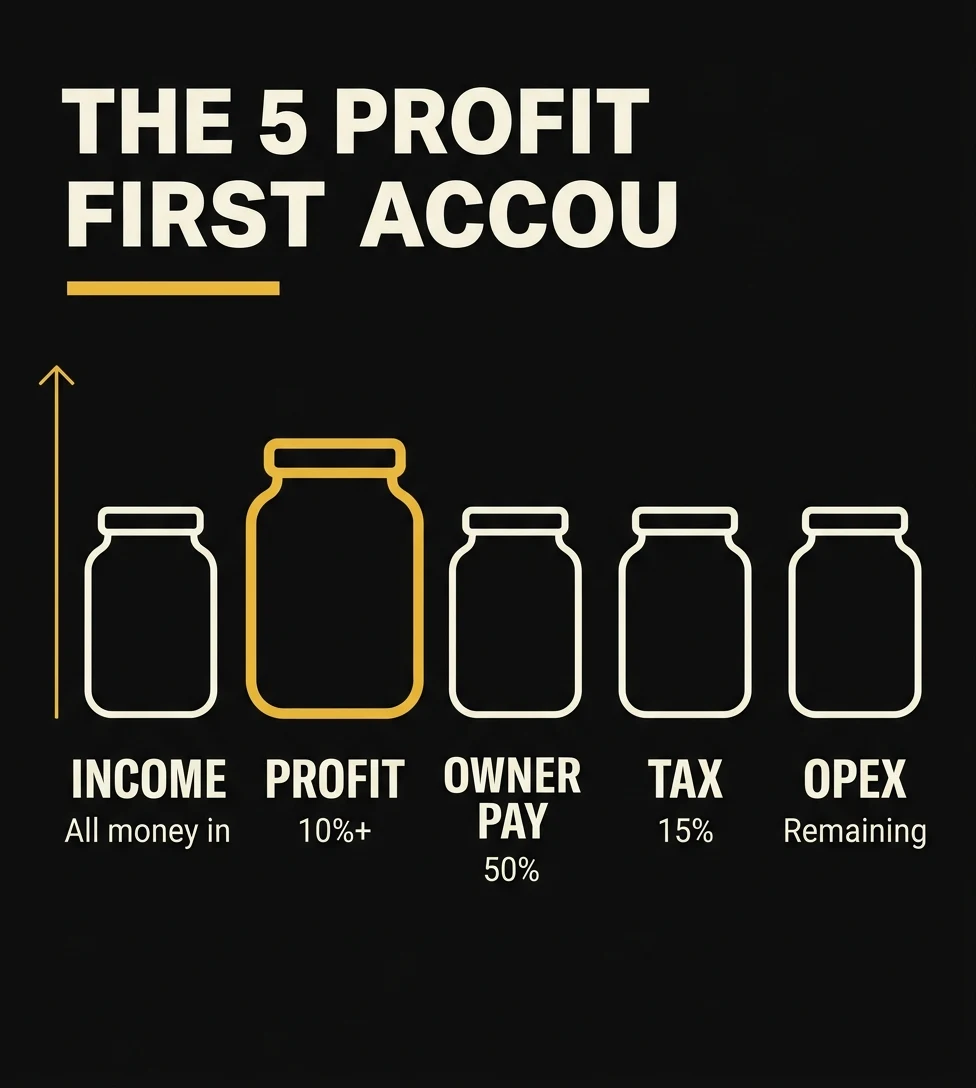
Here are the five accounts and what each one does. You can open these at any bank. Many photographers use free checking accounts at a second bank specifically to keep this money psychologically and physically separate from their operating account.
1. Income Account (All Revenue In)
Every single dollar your photography business earns lands here first: session fees, print sales, album orders, licensing, tips, all of it. This account acts as a holding area only. You never pay bills from it directly. It is a collection point. On your twice-monthly distribution days (the 10th and 25th work well), you sweep the balance into your other accounts according to your target percentages.
2. Profit Account (10%+, start at 1%)
This is the account that changes everything psychologically. Most photographers have never seen a line-item called "profit" in their finances. This account makes profit real and tangible. Michalowicz recommends starting at just 1% (an amount so small it barely registers) and increasing by 1% every quarter. Long-term target for a healthy photography studio is 5–10% of revenue.
This account is for two things only: quarterly profit distributions (a real reward for owning your business) and emergency reserves once you have built up three to six months of operating expenses. Keep this at a separate bank with no debit card if possible. Friction protects it.
3. Owner's Pay Account (Target: 50%)
This is your salary as the person running the business. Not a draw from the operating account when cash looks good. A structured, predictable percentage of every dollar that comes in. The long-term target is 50% of revenue, but most photographers starting out will be closer to 30–40%. The goal is to move toward 50% intentionally over 12–24 months.
Paying yourself a real salary from a dedicated account creates an important mental boundary: you are an employee of your business. Your business is supposed to support your life. If it cannot consistently fund your Owner's Pay account, that is diagnostic data. It tells you exactly where the business needs to grow or trim.
4. Tax Account (15%)
Self-employed photographers owe both income tax and self-employment tax (currently 15.3% on net earnings up to the Social Security wage base). The IRS requires quarterly estimated payments if you expect to owe more than $1,000 for the year, due April 15, June 15, September 15, and January 15.
The most common financial catastrophe for photographers is a surprise tax bill in April. This happens when all the money was in one account and got spent throughout the year. A dedicated Tax account with 15% of every deposit flowing into it prevents this entirely. Keep this account at a different bank than your operating account. When the quarterly payment is due, the money is already there.
5. Operating Expenses Account (Remaining, target: 25%)
Every legitimate business expense (gear, editing software, CRM subscriptions, marketing spend, studio rent, contractors, insurance) comes from this account. The target long-term is 25% of revenue. Most photographers starting Profit First will discover their current operating expenses are significantly higher than 25%. That is not a crisis; it is a diagnosis. You now have a specific target to work toward.
When the Operating Expenses account is running low, you do not move money from Profit or Tax. You make harder decisions about what actually needs to be spent. The constraint is the system working correctly.
The hardest part of Profit First is setting your starting percentages honestly. Most photographers underestimate their expenses. We can help you audit your numbers and build a realistic allocation plan.
Book a Strategy Call →Paying Yourself First: What the Numbers Should Look Like
Let's run the Profit First system through a real photography studio scenario.
A portrait photographer brings in $6,000 in a typical month. On the 10th, $4,200 lands in the Income account from two sessions. On the 25th, $1,800 lands from a print order and a deposit. Total for the month: $6,000.
Using starting percentages (adjusted from ideal to realistic startup numbers):
- Profit (3%): $180 → Profit account
- Owner's Pay (40%): $2,400 → Owner's Pay account
- Tax (15%): $900 → Tax account
- Operating Expenses (42%): $2,520 → OpEx account
Notice what happened: the photographer's salary ($2,400/month, $28,800/year) is built into the system before any expense gets paid. Taxes are automatically set aside. Profit is accumulating even at a modest 3%. And the business runs on $2,520 per month for all operating costs.
If $2,520 is not enough to cover current operating expenses, that is the signal to audit the expense list, not to skip the Owner's Pay allocation. Most photographers who do this exercise discover they are paying for software they do not use, subscriptions that auto-renew, and gear payments for equipment that does not generate revenue. The constraint reveals the waste.
As revenue grows to $8,000, $10,000, $15,000 per month, the percentages become the engine of wealth-building. At $15,000/month with mature allocations (10% profit, 50% owner's pay, 15% tax, 25% opex), you are setting aside $1,500/month in profit, paying yourself $7,500/month ($90,000/year), covering $2,250 in quarterly taxes automatically, and running the business on $3,750/month for expenses. That is what financial sustainability looks like for a photography studio.

Photo: Brad Neathery / Unsplash
How to Set Up Profit First in One Afternoon
The following setup is designed to take you from zero to fully operational in one sitting. No accountant required at this stage, though if you work with a bookkeeper, loop them in after you have set up the accounts.

Step 1: Calculate your current real allocations. Look at the last 3 months of bank statements. Add up total revenue. Add up every business expense category. Divide each category by total revenue to see your current percentages. Most photographers are shocked: operating expenses often consume 60–80% of revenue, leaving almost nothing for owner's pay and taxes.
Step 2: Open your 5 accounts. You need one income account, one profit savings account (preferably at a second bank), one owner's pay account, one tax savings account (also at a second bank), and your existing operating expenses checking account. Many photographers use free checking at a local credit union or an online bank like Relay, which was specifically designed for small business Profit First implementation.
Step 3: Set your starting percentages. These should be realistic, not aspirational. If you are currently spending 70% on operating expenses, do not immediately move to 25%. Start at 65% and reduce by 5% every quarter. The goal is sustainable progress, not a system you abandon in 60 days because you could not pay your bills.
Step 4: Set your distribution calendar. Block the 10th and 25th of every month in your calendar as "finance day." On those days, you log into your Income account, calculate the current balance, and move the percentages to each account. This takes 15 minutes maximum once the system is running.
Step 5: Automate what you can. Many banks let you set up automatic percentage-based transfers. Even if you cannot automate fully, the calendar system ensures you are touching your finances twice a month, which alone is more financial intentionality than most photographers exercise in a year.
Step 6: Run a quarterly review. Every 90 days, assess: Are your percentages moving toward your targets? Is your Profit account growing? Is Owner's Pay sustainable? Increase Profit and Owner's Pay by 1–2% each quarter, funded by reducing Operating Expenses. This is the slow compound growth that eventually gives you real financial freedom.
The Three Numbers Every Photography Studio Owner Must Know
Profit First handles the financial structure of your business: how money is allocated once it arrives. But there is a deeper layer that controls how much money arrives in the first place. In my book The Photography Client Machine, Chapter 2 lays out the revenue formula that drives every photography studio's income:

Revenue = Leads × Booking Rate × Average Sale
These three numbers (leads coming in, the percentage you convert to bookings, and how much each client spends) are the three levers that determine whether your Profit First accounts are filling up or staying empty. You can have the most disciplined financial allocation system in the world, but if revenue is too low, no amount of percentage-shuffling fixes it.
Consider: a portrait photographer with 20 leads per month, a 25% booking rate, and a $1,500 average sale generates $7,500/month. If they improve their booking rate to 35% through a better phone script and follow-up process, monthly revenue jumps to $10,500, a 40% increase without booking a single additional lead. Combined with Profit First's allocation discipline, that extra $3,000/month means an additional $1,500/year in profit, $18,000/year more in owner's pay, and $5,400/year more set aside in taxes. The systems compound.
The book covers all three levers (how to generate more leads, how to improve your booking rate, and how to increase average sale through in-person sales) and gives you a diagnostic tool to find which number is your current bottleneck.
Want to know which of the three numbers is holding your studio back? The answer changes how you spend your next 90 days of business building.
Book a Strategy Call →Common Profit First Mistakes Photographers Make
After helping hundreds of photographers set up financial systems, these are the mistakes that derail the most people:

Mistake 1: Starting with ideal percentages instead of real ones. If you open five accounts and immediately try to allocate 50% to Owner's Pay when your current expenses consume 70% of revenue, you will not be able to cover your bills. You will raid the Profit account, lose trust in the system, and abandon it. Always start with your actual current percentages, then move toward targets incrementally.
Mistake 2: Keeping accounts at the same bank. If your Profit and Tax accounts are at the same bank as your checking account, transfers happen in seconds and the temptation to borrow is always present. Moving these to a separate institution creates friction that protects the money. Even a 2-3 business day transfer delay is enough to interrupt impulsive spending decisions.
Mistake 3: Using the Profit account as an emergency fund too soon. The Profit account has one purpose: quarterly profit distributions to you, the business owner. It is a reward for running a profitable business. Only after you have 3–6 months of operating expenses saved separately should you repurpose any excess profit as an emergency reserve. Taking quarterly profit distributions, even small ones, reinforces the habit of owning a profitable business.
Mistake 4: Not adjusting percentages as the business grows. A photographer at $3,000/month needs different percentages than one at $15,000/month. Michalowicz calls the long-term targets "Instant Assessment" numbers, and they assume a mature, higher-revenue business. At lower revenue levels, operating expenses naturally consume a larger percentage. Do a quarterly review and adjust as revenue grows.
Mistake 5: Treating photography gear as operating expense when it is capital investment. A new camera body, a lens, or a studio strobe is a capital investment. It generates revenue over years, not one billing cycle. Funding significant gear purchases entirely from the monthly Operating Expenses account can hollow it out. Consider a separate savings account for capital equipment funded at 3–5% of revenue, and make gear purchases intentionally rather than reactively.
Mistake 6: Skipping the tax account during slow months. This is the one that creates April disasters. Slow months feel like permission to skip the tax allocation. But the IRS calculates estimated taxes based on your prior year liability. They do not care that January was slow. Transfer the tax percentage on every single deposit, even small ones. A $200 deposit should still send $30 to the tax account. The habit matters more than the amount during slow periods.
Conclusion: Profit First Is the Financial System Every Photography Studio Needs
The income illusion is the most expensive mistake in photography. Revenue without a system for allocating it produces exhausted, broke photographers, even ones billing $150K a year. Profit First solves this by making profitability the first decision, not the last one.
Set up your five accounts. Fund Profit on day one, even at 1%. Run your business on what remains. Raise the percentages by 1% every quarter until you hit your targets. This is not complex. It is a discipline. The photographers who implement it stop working weekends out of financial fear and start working them by choice.
Photography to Profits, founded by Humberto Garcia, teaches Profit First as part of a complete business system for portrait and boudoir photographers. Humberto has worked with hundreds of studios that went from broke at high revenue to genuinely profitable at sustainable volume, and the system starts with one afternoon and five bank accounts.
Your next step: open the accounts today. Not this weekend. Not when things slow down. Today.