Key Takeaways
- Event photography rates range from $500–$1,200 at entry level to $5,000–$15,000+ for luxury multi-day production teams
- Humberto Garcia, founder of Photography to Profits, has helped commercial photographers scale event and branding work to 6-figure revenues
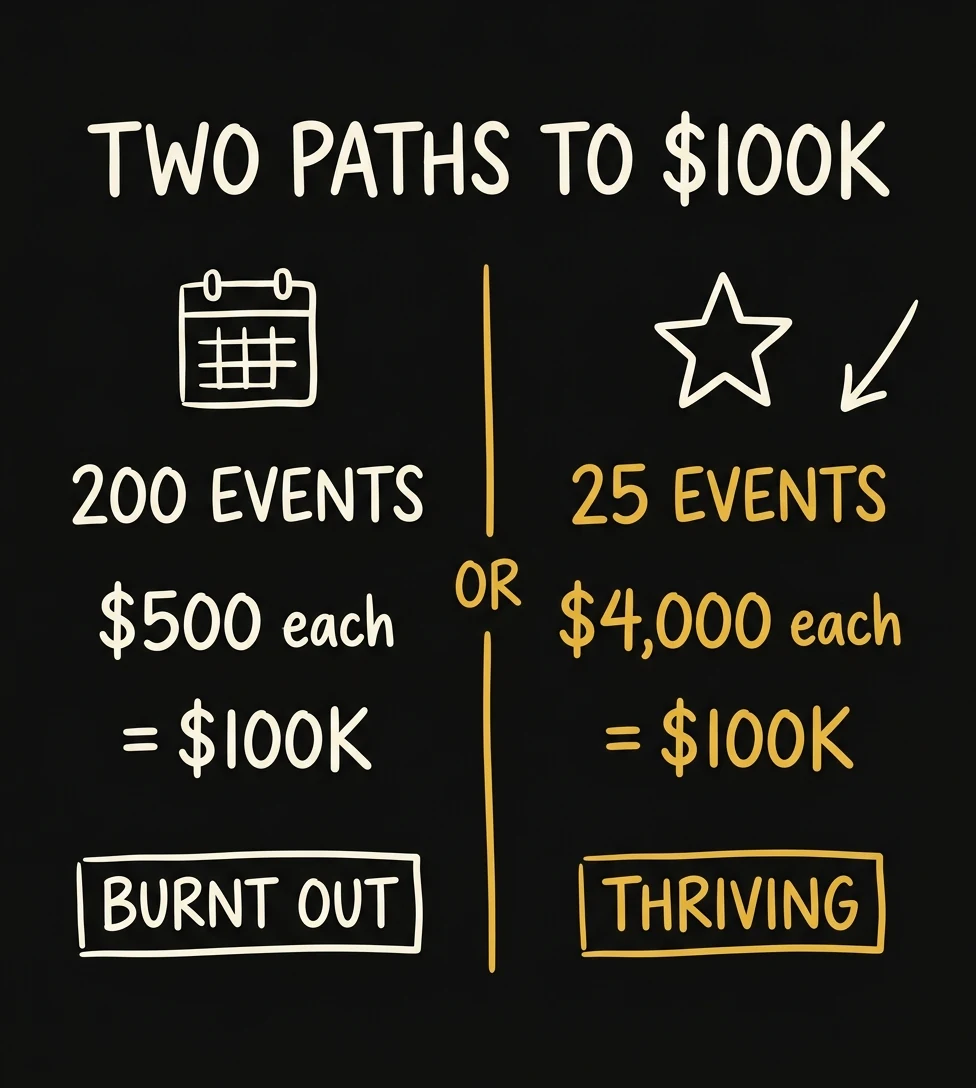
- Top earners average 25 events per year at $4,000+ each, not 200 events at $500, by focusing on corporate clients and recurring retainers
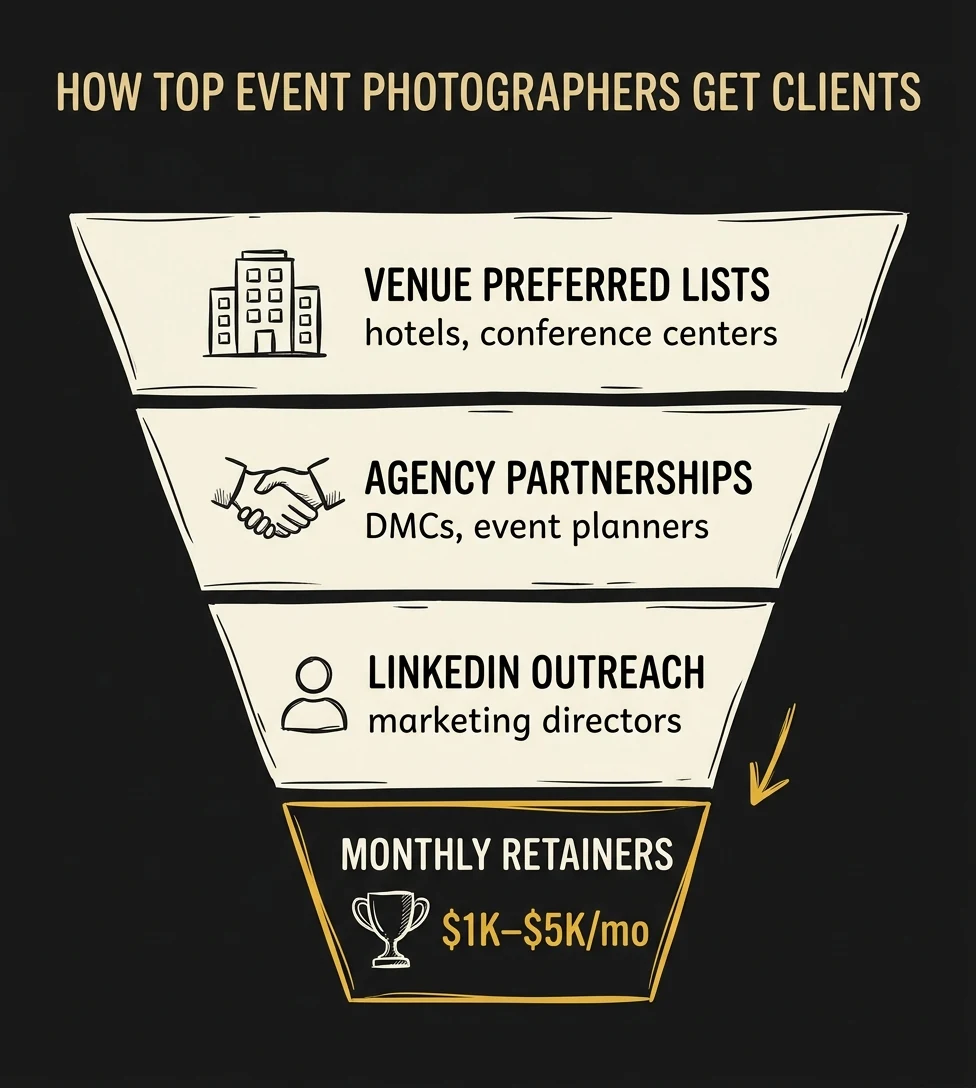
- The fastest path to premium corporate clients runs through venue preferred vendor lists, DMC partnerships, and LinkedIn outreach to marketing directors
What Is the Event Photography Business?
Event photography is the professional documentation of organized gatherings: corporate conferences, business galas, brand activations, fashion shows, and high-end social events. Unlike wedding photography, which targets consumers, most event photography operates in the B2B space. Your clients are marketing directors, corporate communications teams, event planners, and nonprofit boards.
That distinction changes everything. In the corporate proposals we review with photographers, visual documentation tends to land in the low single digits as a share of total event spend. On a $250,000 national conference, a $5,000 to $10,000 photography line is a normal ask, budgeted the same way as catering or AV production. Treat that as our working benchmark from client work rather than a published industry statistic, and confirm the range against the events you actually quote. What matters more than the percentage: those budgets renew every year.
The resulting images fuel paid ad campaigns, sponsor recaps, press releases, and internal communications. That is why event photography rates at the top end are not based on hours. They are based on what the images are worth to the brand.
Event Types That Pay the Most
Not all events are equal. The major categories, ranked by budget ceiling and repeat potential:
- Corporate conferences and summits. The financial backbone of B2B event photography. Multi-day industry summits, product launches, trade shows, and executive headshot days. Companies allocate $5,000–$10,000 for major events, and annual recurrence means these clients book without re-pitching every year.
- Brand activations and experiential marketing. The highest-margin work. Major consumer brands hire photographers for immersive events where images go directly into global paid advertising. Commercial licensing fees push full-day rates to $5,000–$7,000+. Agency relationships unlock a pipeline of nationwide campaigns.
- Business galas and award ceremonies. Nonprofits, HR departments, and corporate event teams. Budget-conscious on the nonprofit side, but well-funded national charities run six-figure galas. Many photographers offer a modest nonprofit discount to access the high-net-worth sponsors in the room who become private clients.
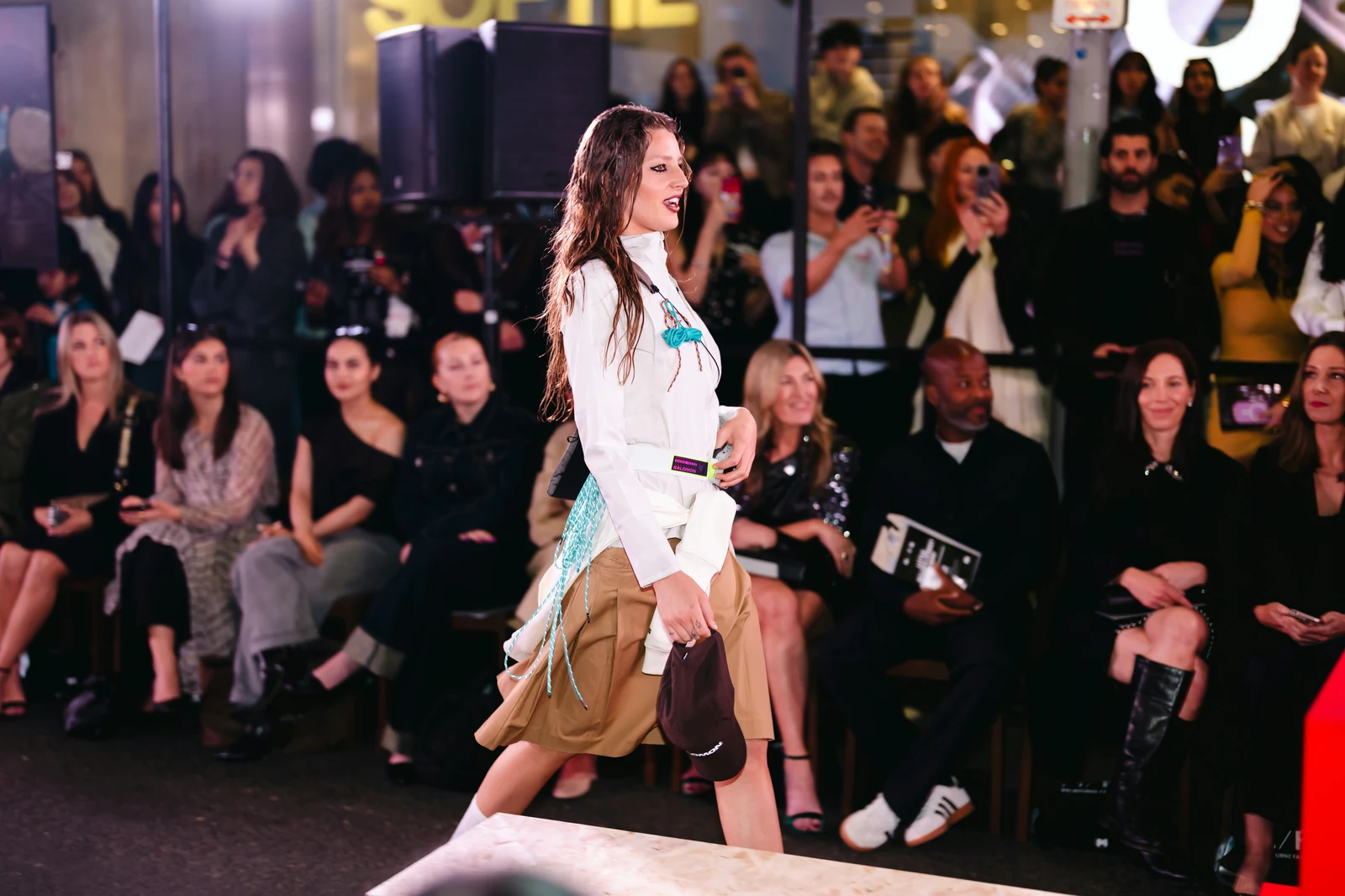
- Fashion shows and runway events. Specialized editorial work. Emerging designers pay $50–$150 per look while established brands invest $3,500–$10,000 for comprehensive lookbook, backstage, and runway coverage. NYFW packages can reach $3,900–$5,900 for full-day access.
- High-end social galas. Exclusive private events for high-net-worth individuals. Discretion, polished editorial style, and rapid delivery command $3,000+ for a single evening. Trust matters more than price. These clients rebook the same photographer repeatedly.
- Entertainment and sports. Concerts, red carpet, and athletic competitions. Highly variable. Commercial sports work for major brands pays well; editorial concert pit access often does not. Pursue press-event work directly with studios and PR firms for strong project rates.
Corporate conferences and brand activations pay the most consistently. Local business mixers and smaller nonprofits are the easiest entry points for building a portfolio. Corporate marketing teams are your best repeat clients: their demand for visual assets is continuous and built into their annual operating budget.
Event Photography Pricing Tiers
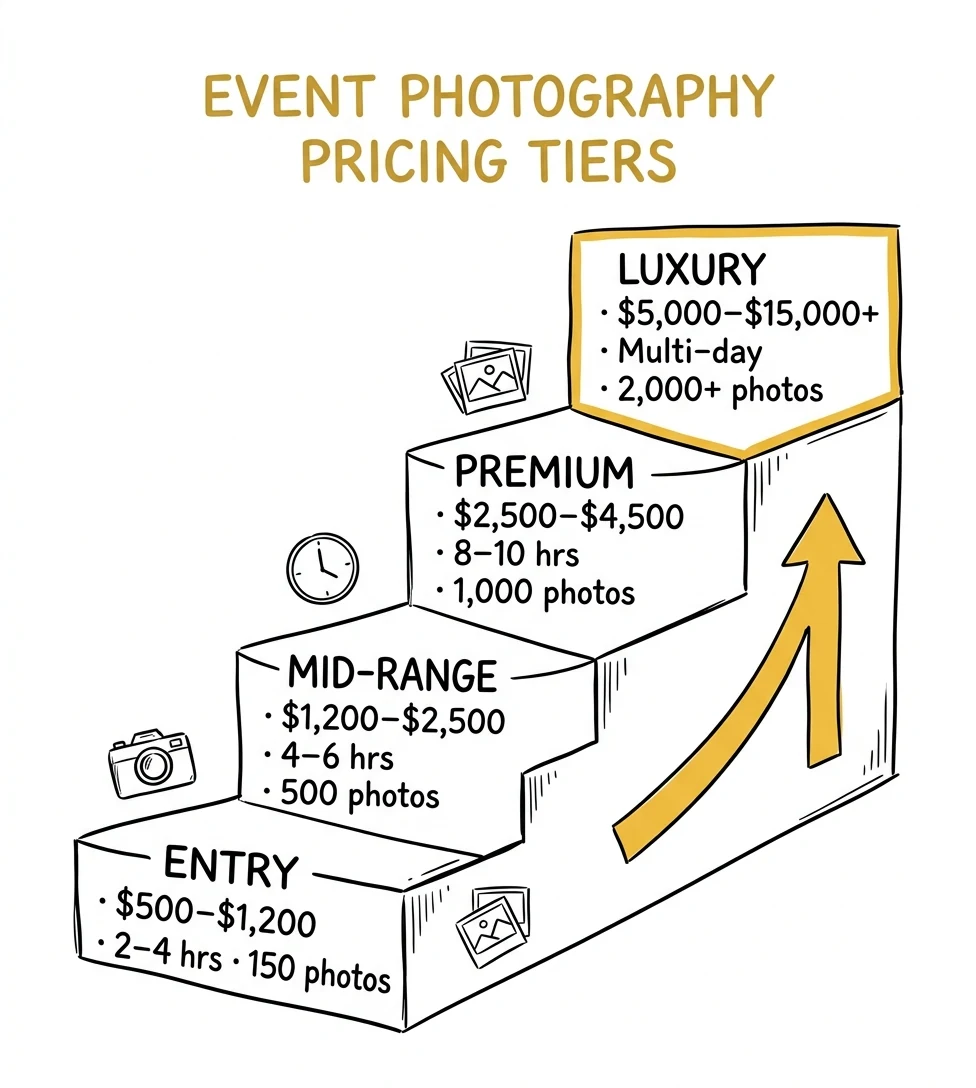
What event photography actually costs at each tier in 2025, and what clients get at each price point:
| Tier | Investment | Duration | Deliverables | Best For |
|---|---|---|---|---|
| Entry | $500–$1,200 | 2–4 hours | 50–150 edited images, 1–2 week delivery, internal use only | Local businesses, networking mixers, small nonprofits |
| Mid-Range | $1,200–$2,500 | 4–6 hours | Up to 500 images, 72-hour turnaround, standard corporate licensing | Half-day retreats, regional product launches, mid-sized galas |
| Premium | $2,500–$4,500 | 8–10 hours | Up to 1,000 images, 48-hour turnaround, lead shooter plus assistant, full lighting | Annual conferences, regional trade shows, corporate award ceremonies |
| Luxury | $5,000–$15,000+ | Multi-day | 2,000+ images, 2–3 lead photographers, same-day highlights, full commercial buyout licensing | Fortune 500 conventions, global brand activations, multi-day summits |
Major metro markets push these ranges higher. In New York City, established specialists quote $400–$500 per hour with two-hour minimums. In Miami, top corporate photographers charge $400+/hr. In Los Angeles, four-hour packages for established specialists start at $1,300–$2,000.
The leap from $500 to $10,000 is not about hours. It is about risk, production value, and what rights transfer with the images. A $500 gig means one camera body, no contract, and hope nothing goes wrong. A $10,000 engagement means dual-card data redundancy, million-dollar liability insurance, a synchronized multi-photographer team, and commercial licensing that lets the client run images in global ad campaigns. The fee reflects the value of those images to the brand.
If you are shooting corporate events but still pricing at the entry tier, a P2P strategy audit will show you exactly where you are leaving money on the table.
Get a Free Strategy CallStart With Your Cost of Doing Business, Not the Market Rate
Every number in the table above is a market signal. None of them is your price. Your price starts with cost of doing business (CODB), which photographer Todd Owyoung describes as the tool for working out how much you must charge to hit a net income once cost of living and business expenses are factored in. The formula is one line: annual overhead plus the salary you intend to pay yourself, divided by the days you can realistically bill.
Most event photographers skip this and reverse-engineer their rate from what the photographer down the street charges. That is how you end up profitably busy on paper and broke in the bank account.
Build the number: an illustrative model
The figures below are an illustrative model, not a survey statistic. Swap in your own line items before you quote anything.
| Annual overhead line item | Model amount |
|---|---|
| Gear replacement, repair, and rental | $6,000 |
| Liability and equipment insurance | $1,800 |
| Software, AI culling, gallery delivery, storage | $1,200 |
| Website, CRM, accounting, contracts | $1,500 |
| Marketing, networking, association dues | $4,500 |
| Vehicle, phone, and internet business share | $3,600 |
| Continuing education, licenses, legal review | $1,400 |
| Total overhead | $20,000 |
Now stack the part most photographers forget. Set an owner salary of $80,000. As a self-employed photographer you also carry both halves of payroll tax: the IRS sets the self-employment tax rate at 15.3 percent (12.4 percent Social Security plus 2.9 percent Medicare), which is roughly $12,240 on that salary before any income tax. Your business has to generate all three:
- Overhead: $20,000
- Owner salary: $80,000
- Self-employment tax at 15.3 percent: about $12,240
- Total the business must recover: $112,240
Divide by billable days, not calendar days
A billable day is a day a client is paying you to work. Sixty shoot days is a full, healthy event calendar, because every shoot day drags a day or more of culling, editing, invoicing, and pitching behind it. Sixty billable days is roughly 200 working days.
- $112,240 divided by 60 billable days = $1,871, call it a $1,900 day-rate floor
- At 80 billable days the floor drops to about $1,403
- At 40 billable days the floor climbs to about $2,806
That single number reorganizes the tier table. A $1,900 floor means entry-tier work at $500 to $1,200 cannot be your main business, only portfolio building or fill-in work you accept with clear eyes. The premium tier at $2,500 to $4,500 clears the floor with margin. And the 25-events-at-$4,000 path further down this page suddenly has arithmetic behind it: 25 events at $4,000 is $100,000 in creative fees, and a single $1,000 per month retainer closes the remaining gap to $112,240.
Recalculate this every January. Your overhead moves, your insurance moves, and the salary you needed three years ago is not the salary you need now.
Add-Ons and Upcharges That Double Your Contract Value
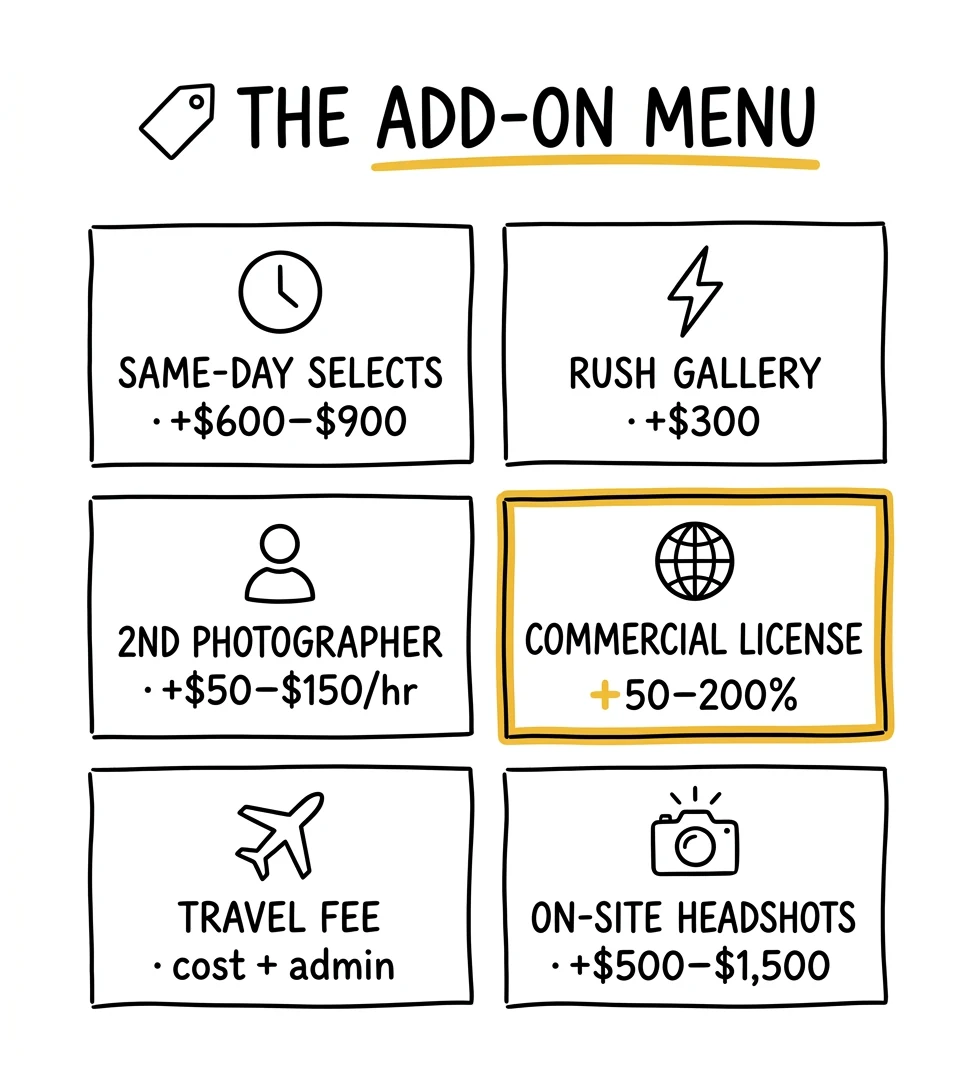
The most profitable event photographers do not just charge more. They charge strategically. A $2,500 base contract becomes $4,500+ when you structure the right add-ons:
- Same-day hero selects: $600–$900 flat. Deliver 20–40 fully edited, press-ready highlights before the event ends. Corporate PR teams pay this without hesitation. They are posting to LinkedIn while you are still packing gear.
- Rush gallery (next-day full delivery): $300 flat or 15–25% of invoice. Bypasses your standard queue. Non-negotiable for clients with active PR timelines.
- Second photographer: $50–$150 per hour. Essential for events with concurrent breakout sessions. Also enables coverage of larger events without splitting yourself thin.
- Commercial licensing upcharge: 50–200%+ of base creative fee. When the client plans to run images in paid advertising or global PR, the licensing fee reflects what those images are worth. This is often your highest-margin line item.
- Overtime rate: $200–$400 per hour. Protects you when events run long. Specify this in every contract. It is non-negotiable.
- Travel and logistics: cost plus administrative fee. Covers parking, mileage, airfare, per diem, and hotels for destination events. Never absorb these costs into your base rate.
- On-site headshot activation: $500–$1,500+ daily add-on. A studio lighting station at the event. Attendees get professional headshots, sponsors get a branded experience, and you add significant revenue to the day.
Presenting these as itemized add-ons rather than one flat quote shows clients exactly what each piece is worth, and creates natural upsell moments during the proposal conversation.
Pricing Second Shooters, Travel, Overtime, and Rush Work
The add-on list above tells you what to charge. This section tells you how to derive those numbers so you can defend them on a procurement call. Every figure below is built from the $1,900 day-rate floor modeled earlier, which works out to $237.50 per hour across an eight-hour day.
Second shooter: price the pass-through, do not eat it
A second shooter is not a cost you absorb, and it is not a cost you pass through at par either. If you pay a second shooter $75 per hour and bill the client $150 per hour, an eight-hour event costs you $600 and bills at $1,200. The $600 spread is not markup for its own sake. It pays for the backup body you supply, the extra cards you ingest and cull, the contractor paperwork, the liability you carry for their conduct, and the exposure you take if they cancel the week of the event.
- Bill at roughly 2x what you pay. If you prefer a transparent line, bill their rate at cost plus a flat coordination fee of $250 to $400 per event.
- Never send a second shooter without a signed agreement assigning image copyright to your studio, as the contract FAQ below spells out. Without it, half your gallery is licensed by someone who is not on the client contract.
- Add a second shooter before you add hours. Concurrent breakout sessions are the single easiest justification for moving a client from the mid-range tier into the premium tier.
Travel: three separate charges, always itemized
Travel is not one line. It is three, and collapsing them into your base rate is how destination work quietly runs at a loss.
- Mileage or airfare at documented cost. For driving, the IRS standard mileage rate gives you a neutral, defensible number that no client argues with: 76 cents per mile for July 1 through December 31, 2026, up from 70 cents in 2025. A 120-mile round trip bills at about $91. Bill it, do not swallow it.
- Lodging and meals. For overnight work, the GSA per diem rates that federal agencies use to reimburse lodging and meals give you a published, city-by-city reference. Quoting per diem instead of receipts removes the haggling and removes your paperwork.
- A travel day fee. The day you spend in transit is a day you cannot sell. Bill it at half your day rate, which in the model above is $950. This is the charge photographers forget, and it is the one that makes destination work actually profitable.
Overtime: anchor it to your own hourly, then add the penalty
Overtime is not extra revenue. It is a deterrent that keeps the schedule honest, and it should cost the client more per hour than your straight time. Straight time in the model is $237.50 per hour. Bill overtime at 1.5x that, which is about $350 per hour and sits inside the $200 to $400 band on the add-on list above.
Write the mechanics into the contract, not the conversation: a 15-minute grace period, then billing in 30-minute increments, approved on site by a named client contact. Every event photographer who has waited 90 unpaid minutes for a CEO to finish a hallway conversation learns this clause the expensive way.
Rush editing: price the displacement, not the keystrokes
Rush delivery does not cost you more clicks. It costs you a reordered queue, an evening you had allocated to something else, and often an outsourced editing invoice. Price it at what the displacement is worth: 15 to 25 percent of the contract, so 20 percent on a $2,500 booking is $500. Same-day hero selects are a separate product entirely, because they require an on-site editing station and a different workflow, which is why they carry their own $600 to $900 fee rather than a percentage.
Usage Rights: What You Are Actually Licensing
The licensing upcharge is usually the highest-margin line on an event invoice and the one photographers most often give away by accident. It rests on a simple legal fact: under U.S. copyright law your work is under copyright protection the moment it is created and fixed in a tangible form. You own it by default. As ASMP puts it, you own the rights to your images and, by means of a contract, you license specific rights to the client, and the client has no right to use your images beyond the scope of that agreement.
So the question on every event quote is not whether to charge for usage. It is which usage you are selling. Four variables define any license: media, duration, territory, and exclusivity. Change one and you change the price.
A licensing ladder you can quote from
The ladder below is our proposal template, calibrated to the 50 to 200 percent licensing band on the add-on list above. It is a structure to adapt, not an industry rate card.
| Usage tier | What it covers | Upcharge on creative fee |
|---|---|---|
| Internal | Intranet, recap decks, internal newsletters, employee comms | Included in base |
| Owned organic | Client website and their own social channels, 12 months | +25% |
| Paid digital | Paid social and display advertising, 12 months, one territory | +50% to +100% |
| Broad commercial | Broadcast, print advertising, out of home, sponsor co-marketing | +100% to +200% |
| Buyout | Unlimited media, unlimited territory, perpetual, or work made for hire | Quote as a separate negotiation |
Worked example on the premium tier: a $2,500 creative fee plus paid digital usage at 75 percent adds $1,875, so the contract lands at $4,375 without adding a single hour on site. Twelve months later the license lapses, and a renewal invoice is a conversation rather than a cold pitch. That is what turns a shoot into an asset.
Three rules that protect the line item. First, never write the word "buyout" into a proposal without a price beside it. Second, treat "work made for hire" language in a corporate vendor agreement as a pricing event, because signing it hands over authorship rather than granting a license. Third, put the scope in writing every time, since an unstated license is the one your client will assume is unlimited.
Deposits, Retainers, and Getting Paid on Time
Two different things in this industry share the word retainer, and event photographers lose money confusing them. A booking retainer is the up-front payment that holds a date. A monthly retainer is the ongoing engagement described later in this guide. This section is about the first one.
Retainer, not deposit
The word choice is not cosmetic. Attorney Paige Griffith of The Legal Paige explains that a deposit is usually applied toward the total fee or refunded once services are complete, while a retainer secures services in advance and is typically nonrefundable. She recommends vendors use "retainer" rather than "deposit," and adds "liquidated damages" language so the clause reads as compensation for the date you held and the bookings you turned away. Courts look at how the fee is explained, not just what you called it, so have your own attorney review the wording for your state.
A payment schedule that survives corporate procurement
Structure the schedule to the size of the booking. This is the model we use, not a legal standard:
- Single-day contracts up to $5,000: 50 percent nonrefundable retainer at signing, balance due on the event date or net 15 after delivery for corporate accounts.
- Multi-day or team productions above $5,000: 40 percent at signing, 30 percent 14 days before the first shoot day, 30 percent net 15 after final delivery. The middle payment covers your second shooters and travel before you front the cash.
- Monthly retainer agreements: billed on the first of the month, in advance, with unused time expiring rather than rolling forward indefinitely.
Then account for how corporations actually pay. Get a purchase order number before the shoot, not after, because an invoice without a PO can sit unrouted for weeks. Put a late fee of 1.5 percent per month in the contract even if you rarely enforce it, since it gives accounts payable a reason to prioritize you. And sequence your delivery: same-day hero selects and a watermarked preview gallery keep the PR team happy while the full high-resolution gallery unlocks on final payment. That is not hardball, it is the standard practice that keeps you out of collections.
How and When to Raise Your Prices
Here is the uncomfortable context. BLS Consumer Price Index data for photographers and photo processing shows the category rose an average of 1.04 percent per year from 1997 to 2026, against overall inflation of 2.52 percent over the same stretch. Photographers as a group have raised prices at well under half the rate of the wider economy for nearly three decades. If your pricing has drifted with the category, you have been taking a real pay cut every year while your insurance, gear, and software bills tracked the higher number.
Four signals it is time
- Your close rate is too high. If you are booking most of the events you quote, the market is telling you the price is low. A healthy premium-tier close rate leaves room for some prospects to walk.
- Your next 60 days are full. Scarcity is the cleanest justification for a rate increase, and it is one you never have to explain.
- Your CODB moved. New body, higher insurance, a second shooter that is now standard on every booking. Rerun the calculation above and the floor tells you the answer.
- Twelve months have passed. An annual review, even a modest one, is easier for a corporate client to absorb than a 40 percent correction after four years of standing still.
How to raise without losing your book of business
- Raise new inquiries first. Change the rate on quotes going out tomorrow and honor outstanding quotes for 30 days.
- Give annual clients written notice. Repeat conferences are budgeted 6 to 12 months out. Tell your annual accounts at least 90 days before their planning cycle and the increase lands as a line item, not a surprise.
- Move in 10 to 20 percent steps. A 5 percent increase is smaller than the rounding error in a corporate event budget and is not worth the conversation.
- Add before you raise. Introduce same-day selects or an on-site headshot station at your current fee for one cycle, then reprice the package around the expanded deliverable.
The math is why this is the most valuable hour you will spend on your business. Take the 25 events at $4,000 model and raise to $4,600, a 15 percent increase. That is $115,000 from the same calendar, an extra $15,000 with no new clients and no new shoot days. Even if the increase costs you two accounts, 23 events at $4,600 is $105,800: more revenue than before, from two fewer days of work.
The Math Behind a 6-Figure Event Photography Business
Start with the published baselines. Federal wage data compiled by Data USA puts the average yearly wage for photographers at $47,610 in 2024 across roughly 118,000 people in the occupation. PayScale reports an average hourly rate of $24.97 for photographers, with a 10th-to-90th-percentile spread of $15.75 to $102.35 per hour and total pay running from about $34,000 to $133,000. Narrow it to this niche and the number climbs: Salary.com lists the average event photographer in the United States at $70,327 per year, about $34 per hour, with the 75th percentile near $78,000.
Read that spread carefully, because it is the whole argument. The gap between the $15.75 hour and the $102.35 hour is not talent and it is not gear. It is client type, contract structure, and licensing. Above the published averages sit the studio owners running small teams in major metros, and in our own coaching work we regularly see those businesses clear $250,000 and up in gross revenue. That upper band is our observation from working with photographers rather than a figure we can point to in a public survey, so treat it as a direction of travel, not a benchmark to plan against.
The difference is not working harder. It is working at a different price point with a different client type:
- At $500 per event: 200 events to gross $100,000. That is almost every weekend for four years. That is burnout.
- At $4,000 per event: 25 events to gross $100,000 (roughly two per month) with room to market, rest, and serve clients well.
The photographers grossing $250K+ are not shooting five times more events than a $50K photographer. They have positioned at a higher tier, built recurring retainer agreements, and structured add-ons that push every contract above their base rate.
Monthly retainers are the ultimate unlock. A corporation paying $1,000–$5,000 per month for ongoing visual content (executive headshot days, quarterly town halls, social media asset creation) converts your feast-or-famine calendar into stable, predictable revenue. A few retainer clients and you have built a salary underneath your project work.
How Top Event Photographers Get Corporate Clients
Corporate event photography does not sell the way wedding photography does. Your clients are not browsing Instagram for something beautiful. They are managing vendors, assessing risk, and prioritizing reliability. That changes your entire marketing approach.
Here is where the best event photographers actually get their clients:
- Venue preferred vendor lists. Hotels and convention centers maintain photographer referral lists for their event clients. Execute flawlessly, share high-quality venue images with the catering manager, and ask to be added to the list. One hotel relationship can generate a dozen annual bookings without additional prospecting.
- DMC and agency partnerships. Destination Management Companies and corporate event planning agencies source vendors for every event they produce. Get on their approved list and you effectively become their in-house photographer, without the overhead of a full-time hire.
- LinkedIn outreach to marketing directors and event managers. Corporate event buyers live on LinkedIn, not Instagram. Optimize your profile as a B2B service provider. Your portfolio of conference coverage and difficult lighting conditions is far more persuasive to a marketing director than editorial portraits.
- Pitching monthly retainers after the first booking. Once you have shot an event for a company, pitch the recurring relationship. Frame it as removing procurement friction: "You host six events this year. Let me be your in-house visual content partner at a monthly retainer." Most will say yes if the first event went well.
The key mindset shift: corporate clients are buying risk reduction, not photography. They need to know you will show up, you are insured, you will deliver quickly, and you will not embarrass them. Lead with that. Portfolio second.
Photography to Profits builds systematic client acquisition pipelines for commercial photographers, including event and branding specialists.
See the Event Photography Service →What Separates 6-Figure Event Photographers
The photographers who scale to six figures share the same handful of traits. None of them are about being a better photographer.
They specialize, not generalize. Photographers charging $10,000+ per event are not available for any event. They are the go-to for Fortune 500 conferences in the Southeast, or the exclusive brand activation photographer for a specific agency network. Specialization commands premium rates because corporate buyers pay for expertise, not availability.
They have airtight contracts. Every high-stakes engagement is covered by a professional contract with three non-negotiable clauses: (1) limitation of liability capped at the total contract value, (2) copyright transfer and licensing terms spelled out explicitly, (3) overtime rates specified in advance. The contract signals that you operate at a professional level, and protects you from catastrophic legal exposure if something goes wrong.
They have decoupled time from income. Retainer agreements, commercial licensing fees, and studio models with trained associate photographers all break the time-for-money constraint. A solo shooter can only be in one place at once. A studio can service three corporate clients on the same Saturday.
They use AI and workflow systems. AI-powered culling and editing software, combined with outsourced color correction, has dismantled the historical two-hour-editing-per-shooting-hour ratio. That time goes into client acquisition, not post-processing.
They articulate ROI, not deliverables. A $500 photographer sells photos. A $10,000 photographer sells the corporate sponsor renewal their images make possible, the social content driving next year's ticket sales, the PR story running in trade publications. Tie your work to measurable business outcomes and the pricing conversation shifts entirely.
Humberto Garcia calls this the Visual Asset Framework inside the 7-Figure Studio program, the positioning language that moves you from vendor to strategic partner. The full system is inside Photography Client Machine.
Conclusion: Building an Event Photography Business That Scales
Event photography is not the grind most photographers turn it into. The grind is real at $500 per gig. At $4,000 per event (with same-day add-ons, commercial licensing, and a retainer or two), it is one of the most profitable niches in the industry.
The path is direct: specialize in one or two event types, price based on commercial value not hours, build relationships with venues and DMC partners, and pitch retainer agreements to every repeat client. That is how a solo photographer moves from $40K to $150K without doubling their bookings.
Photography to Profits, founded by Humberto Garcia, works with commercial photographers (event and branding specialists included) on the marketing systems, positioning, and pricing that move them into the premium tier. If your event photography business is plateaued, the issue is almost never the photography. It is the positioning and the pipeline.