How to Make Your First $1,000 as a Photographer in 2026
If you’re struggling to turn your photography into a real business, you’re not alone. Most photographers get stuck in the same place: they know they’re good enough to charge, but they don’t know how to actually get paid, and when they do charge, they’re selling digital files for $150 and wondering why they can’t pay their bills.
Here’s the truth most photography advice won’t tell you: you’re better off shooting for free than charging cheap session fees for digitals.
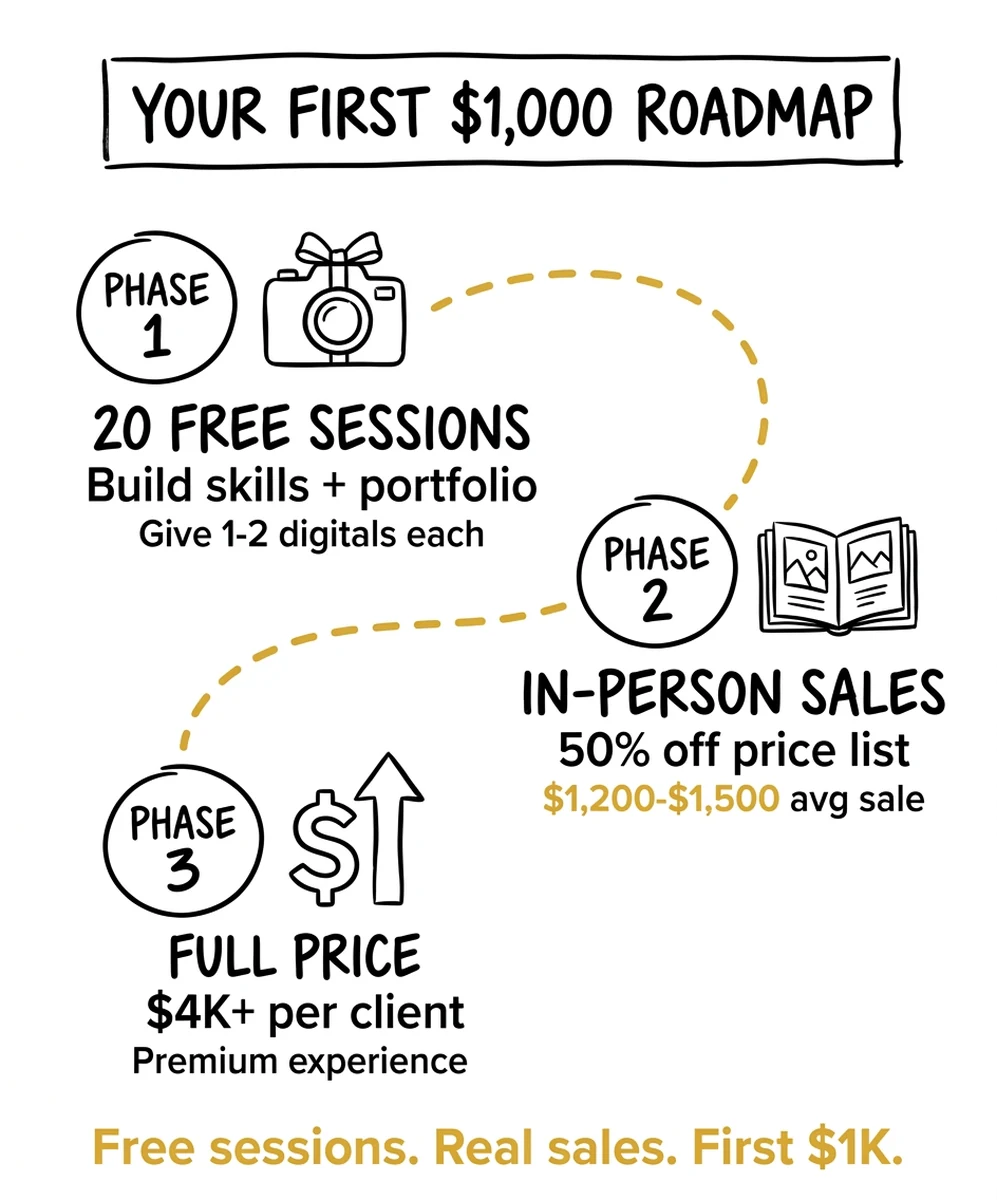
That sounds backwards, but it’s the model that consistently gets photographers to their first $1,000 (and then to $4,000+ per client) faster than any other approach. Instead of charging a small session fee and handing over a USB drive, you shoot for free, give your clients one or two digital images as a thank-you, and then invite them to a sales appointment where they can purchase albums, prints, and wall art from a real price list.
This works whether you shoot families, boudoir, pets, headshots, seniors, or anything else. The genre doesn’t matter. The model does.
Why Free Sessions Beat Cheap Session Fees
Most beginning photographers think the path to $1,000 is: charge $200 per session, book 5 clients, done. But that math hides a trap.
When you charge $200 for a session and hand over 20 digital files, you’ve trained your client to value your work at $10 per image. You’ve also eliminated any reason for them to come back, buy prints, or refer you to anyone. They got everything they needed for $200. There’s no relationship, no experience, and no real profit after you subtract your time, editing, travel, and gear costs.
Now compare that to the free session model:
- You shoot for free, zero barrier to entry for the client.
- You give them 1–2 digital images as a genuine thank-you. They feel taken care of.
- You invite them to an in-person sales appointment to see their full gallery displayed on products: albums, canvas wraps, framed prints, wall collections.
- You present a real price list, discounted 50% because they’re one of your first clients.
- Even at 50% off, the average sale lands at $1,200–$1,500.
One client at $1,200 beats six clients at $200. And you only need one to hit your first $1,000.
Step 1: Build Your Skills With 20 Free Sessions
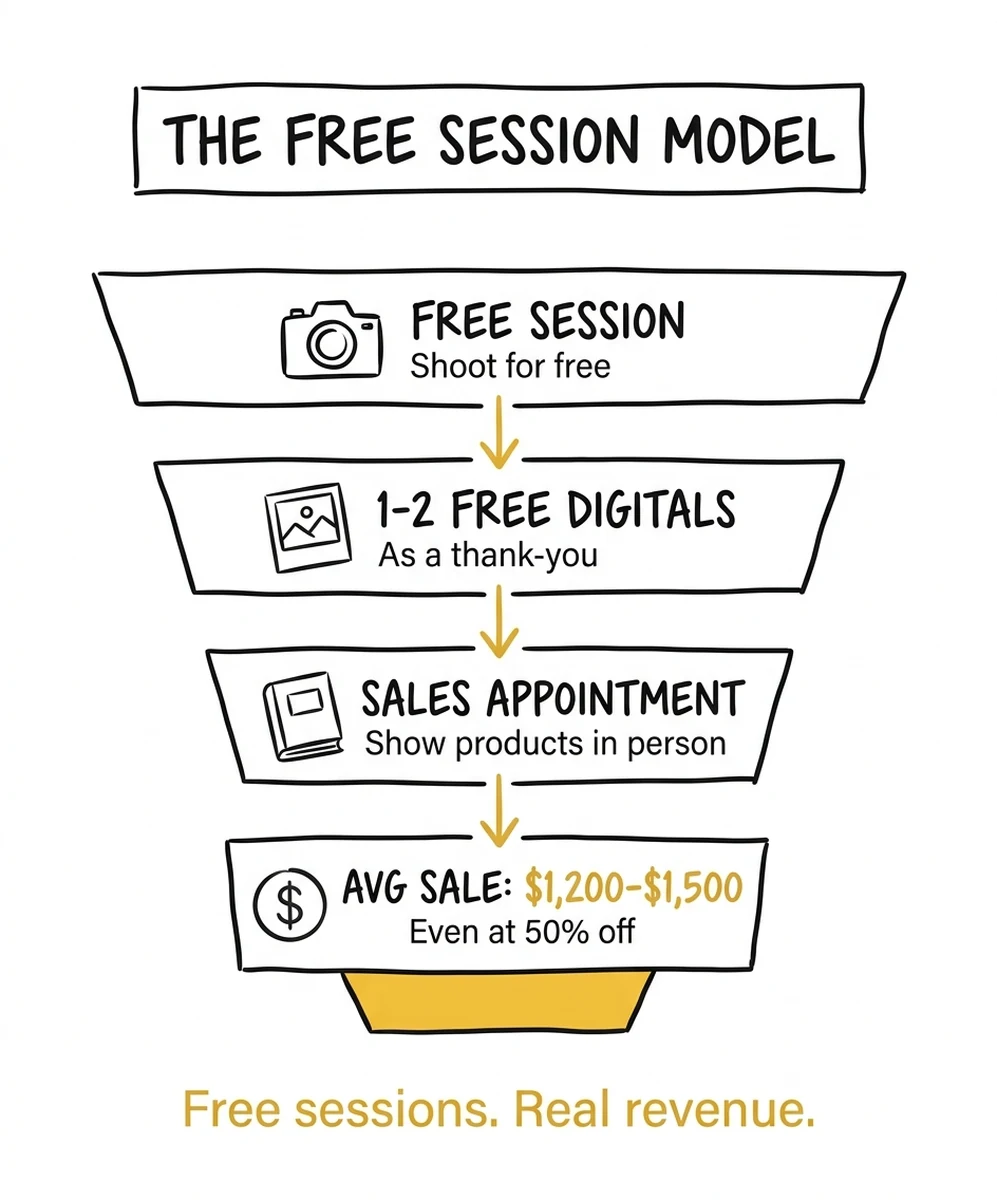
Before you worry about money, worry about reps. Your goal is to shoot 20 free sessions as fast as possible: different people, different settings, different challenges. This does three things at once:
- You get dramatically better, fast. Twenty sessions is more real-world shooting experience than most beginners get in a year of “studying” and watching YouTube tutorials.
- You build a portfolio that actually represents your work. Not test shots of your dog or your kids, real sessions with real clients in real conditions.
- You practice the entire client experience. Communicating before the session, directing during, delivering after. This is the skill that separates professionals from hobbyists, and you can’t learn it from a course.
For each free session, give the client 1–2 of your best edited digital images. This isn’t charity. It’s compensation for their time and a preview of what you can do. More importantly, it gives them something to share on social media, which becomes free marketing for you.
These 20 sessions aren’t about a specific genre. If you want to shoot boudoir, shoot boudoir. If you want to shoot families with their dogs, shoot that. Headshots, seniors, maternity, whatever pulls you. The model works the same regardless of what you point your camera at.
Step 2: Set Up a Real Price List
This is where most photographers go wrong. They never create a real price list because they don’t think they’re “ready.” Or they create one with prices so low it doesn’t matter.
You need a price list with real products at real prices, before you do your first sales appointment. This means:
- Albums: a signature album starting at $800–$1,500
- Wall art: canvas wraps, framed prints, metal prints from $200–$2,000+ depending on size
- Print collections: bundled packages of matted prints
- Digital files: available, but priced as add-ons, not the main product. Individual digitals at $75–$150 each, full gallery at $1,000+
For your first 20 sales clients, discount the entire price list by 50%. This does two things: it removes the guilt you’d feel charging full price as a newer photographer, and it still gets you to a $1,200–$1,500 average sale, because a 50% discount on a well-built price list is still a premium experience.
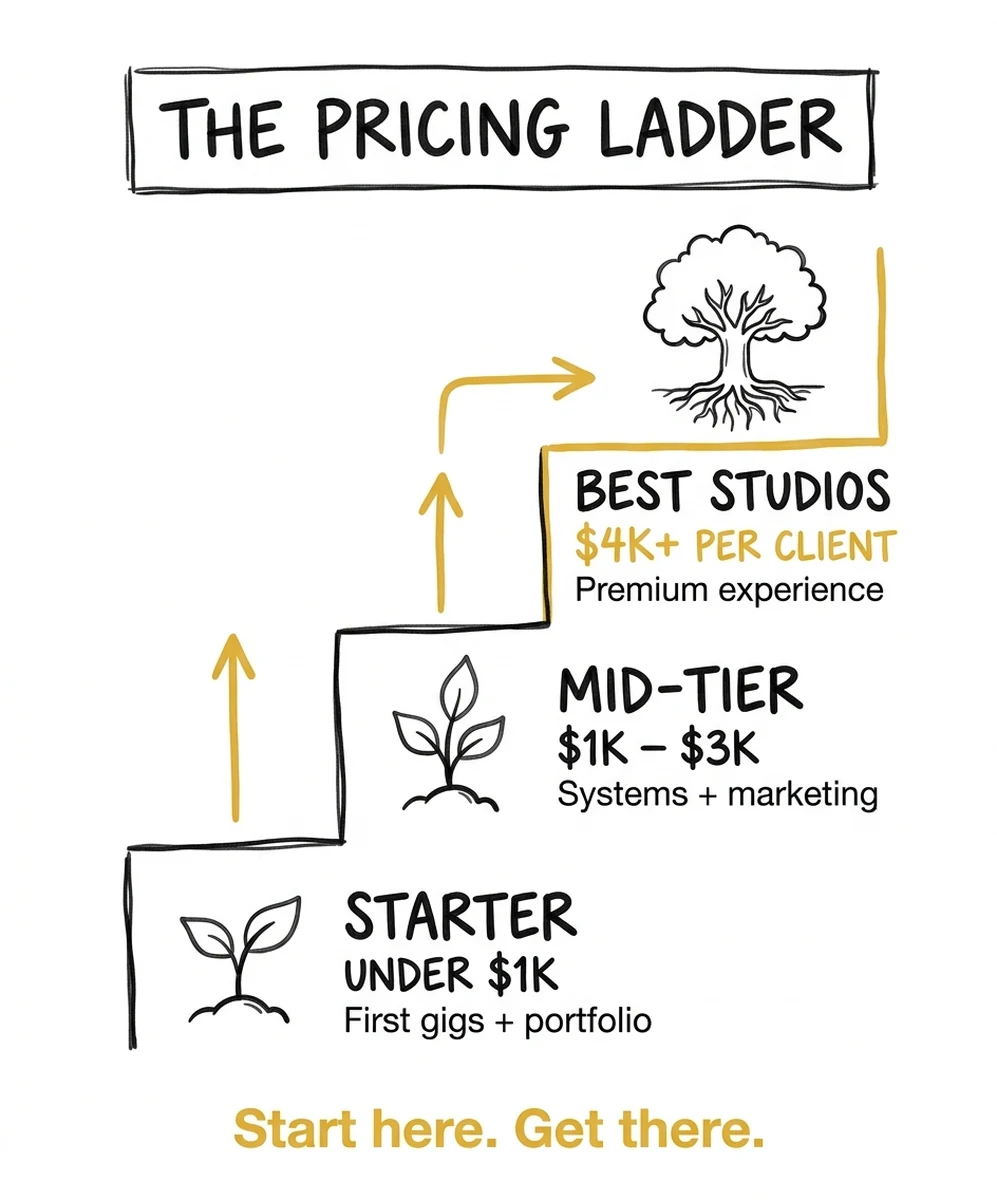
The pricing ladder is clear: you’re starting at the bottom rung (under $1K per client at your 50% introductory rate), but you’re building the habits and systems of a $4K+ studio from day one. The photographers who start by charging $150 for digitals have to completely reinvent their business model later. You won’t, because you’re doing it right from the start.
Step 3: Run Your First Sales Appointments
After each free session, your job is to book an in-person sales appointment. This is where your $1,000 comes from, not from the session itself.
Here’s how it works:
- Shoot the session. Do your best work. Give the client an incredible experience.
- Send the 1–2 complimentary digitals within 24–48 hours. They’re thrilled.
- Book the reveal appointment. “I’d love to show you the full gallery. I have some beautiful products I think you’ll love. Can we meet [Tuesday/Thursday] at [your studio/their home/a coffee shop]?”
- Present the gallery in person. Show the images on a big screen or projector. Let them react. Then walk them through your product options: albums, wall art, print collections.
- Present the price list at 50% off. “Because you’re one of my first clients, I’m offering my full product line at 50% off as a thank-you for trusting me with your session.”
Most clients will spend $1,200–$1,500 at 50% off without pressure, because they’re seeing their images beautifully displayed and they want to own them. You’re not selling. You’re giving them the opportunity to buy products they genuinely want.
One sale at $1,200 and you’ve crossed $1,000. Two sales and you’re at $2,400+. You don’t need dozens of clients. You need a handful who actually buy.
Step 4: Get Clients in the Door
The beauty of offering free sessions is that the hardest part of marketing (getting someone to say yes) becomes dramatically easier. You’re not asking anyone to spend money. You’re offering them free professional photography. Most people say yes.
Start With Your Network
Message 20–30 people you know. Be specific: “I’m building my portfolio and I’m offering free photography sessions, no session fee. You’ll get 1–2 edited images as a thank-you, and I’ll show you the full gallery afterward if you’d like to see it. Want to set something up this weekend?”
That message will fill your calendar. Friends, family, coworkers, neighbors, people from your gym, parents from your kids’ school. Everyone knows someone who’d love free professional photos.
Social Media
Post your best work from every session. Instagram Reels drive 50% of all time on the platform in 2026 and reach 65% of non-followers. Short behind-the-scenes clips from your sessions are the strongest discovery tool you have. Show the work. Show the experience. Show the products.
Facebook community groups are equally powerful for local reach. Join parent groups, neighborhood groups, and local business boards. Be genuinely helpful, share your work, and offer free sessions when appropriate.
Google Business Profile
Set this up immediately. It’s free and takes 30 minutes. When someone searches “photographer near me,” Google’s local pack shows 3 businesses. Ask every satisfied client to leave a Google review. Reviews directly influence your ranking and give future clients the social proof they need to book.
Referrals
After every session and sales appointment, ask directly: “I’d love to photograph more people like you. Would you share my information with anyone you know who might enjoy a session?” The clients who just bought $1,200 in products are your best referral sources. They’re genuinely excited about what you created for them.
Step 5: Define Your Focus (But Don’t Overthink It)
You don’t need to pick a niche before you pick up your camera. Shoot whatever excites you for your first 20 sessions: families, couples, pets, headshots, boudoir, seniors, maternity. The model is identical regardless of genre:
- Free session
- 1–2 complimentary digitals
- Sales appointment with products
- 50% off price list
What you’ll find is that after 20 sessions, your focus defines itself. You’ll notice which types of sessions you love, which clients you connect with, and which images in your portfolio are the strongest. That’s your niche, not something you chose from a list, but something that emerged from doing the work.
Once you know your focus, double down. If every family session averages $1,200 but headshot clients only buy $400, the answer is obvious. Let the market and your results tell you where to go.
Step 6: Business Basics (Handle These Early)
You don’t need a law degree, but don’t skip the basics. They protect you and make you look professional:
- LLC: $100–$400 depending on your state. Separates personal assets from business liability. Get a free EIN from the IRS online.
- Contracts: Every session (even free ones) needs a signed agreement. Use templates from PandaDoc. Cover: what’s included (session + 1–2 digitals), what’s available for purchase, model release permission.
- Model releases: Get a signed release from every client. You’ll want to use their images in your portfolio and marketing.
- Insurance: Professional liability runs $17–$28/month. One equipment theft or liability claim without insurance can end your business.
- Separate bank account: Open a business checking account. Don’t mix personal and business money.
- Tax planning: Set aside 25–30% of revenue for taxes. Deduct equipment, software, mileage, product costs, and home office space.
Gear: Don’t Let This Stop You
You don’t need expensive equipment to start. A photographer with a $500 setup and strong client skills will out-earn a photographer with a $5,000 kit and no clients, every single time.
Starter ($500): Used Sony a6000 (~$350) + Sigma 56mm f/1.4 (~$125). Handles everything you need for your first 20 sessions.
Mid-tier ($1,000): Used Sony a6400 + two versatile lenses. More range, better autofocus.
Full-frame ($2,000–$2,500): Used Sony a7c + Sigma 24-70mm + Sigma 85mm. Professional-grade. Invest here after you’re selling consistently.
Add Adobe Lightroom ($10–$20/month) for editing. Invest in backup drives before your first session. And in 2026, AI tools like Topaz Photo AI are genuine time-savers for batch editing as your volume grows.
Your Action Plan
Phase 1, shoot (Weeks 1–4): Get your gear. Set up Google Business Profile + Instagram. Reach out to 25 people offering free sessions. Shoot 10–20 sessions. Give 1–2 edited digitals per client. Collect Google reviews from everyone.
Phase 2, sell (Weeks 3–6): Finalize your price list if you haven’t already. Start booking in-person sales appointments with your free-session clients. Present at 50% off. Aim for $1,200–$1,500 per sale. You’ll hit $1,000 after your first sale.
Phase 3, scale (Month 2+): Raise your discount from 50% to 40%, then 30%, then full price. Ask every client for referrals. Start a simple email list. Keep shooting, keep selling, keep raising your prices. The photographers who follow this model consistently reach $4,000+ per client within 6–12 months.
Your first $1,000 doesn’t come from charging session fees. It comes from giving people an incredible experience, showing them beautiful products, and letting them buy. One sale. That’s all it takes.